If you want one biography, read Jean Edward Smith's FDR, which is the standard modern single volume. If you want the Depression and the war as one story about the whole country, read David M. Kennedy's Freedom from Fear. If you want the war years inside the White House, read Doris Kearns Goodwin's No Ordinary Time. If you want something short, Roy Jenkins wrote a 186-page life. And if you have under an hour rather than a month, ours covers the whole life in one sitting.
Every book listed here is real, in print or easily found through a library, and worth the time. Reading times are honest estimates from page count, not measured. One thing worth knowing before you buy: there is no single-volume life of Roosevelt that covers everything well, and the authors mostly do not pretend otherwise. His twelve years in office contain two enormous subjects, the New Deal and the Second World War, and books that are strong on one are usually thin on the other. We have said in each entry which years and which subject the book actually covers, so you can pick by period rather than by reputation. Smith and Jenkins are the ones that attempt the whole life. Katznelson is the New Deal. Goodwin and Hamilton are the war. Ward is the years before the presidency, which almost everything else compresses into a chapter.
The short version
Sorted by what you want, not by what is most famous.
| Book | Length | Best for |
|---|---|---|
| FDR Jean Edward Smith, 2007 | ~858 pages About 25 hours | The standard modern one-volume life. Birth to death, with the politics kept clear |
| Freedom from Fear: The American People in Depression and War, 1929-1945 David M. Kennedy, 1999 | ~936 pages About 27 hours | The whole era rather than the man. Both halves of the story in one book |
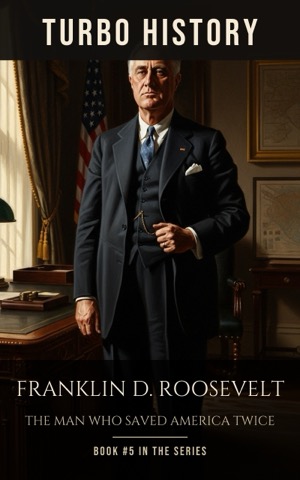
| Franklin D. Roosevelt Turbo History · ours | ~7,000 words Under an hour | The whole life in one sitting. Hyde Park to Warm Springs, the New Deal and the war |
| No Ordinary Time: Franklin and Eleanor Roosevelt: The Home Front in World War II Doris Kearns Goodwin, 1994 | ~759 pages About 22 hours | The war years from inside the house. Franklin, Eleanor, and the people around them |
| Fear Itself: The New Deal and the Origins of Our Time Ira Katznelson, 2013 | ~706 pages About 20 hours | The New Deal argued rather than narrated. Why Southern votes shaped what it became |
| The Mantle of Command: FDR at War, 1941-1942 Nigel Hamilton, 2014 | ~544 pages About 15 hours | Roosevelt as commander in chief. The strategic decisions of the first year of the war |
| A First-Class Temperament: The Emergence of Franklin Roosevelt Geoffrey C. Ward, 1989 | ~944 pages About 27 hours | The years before the presidency. 1905 to 1928, including polio and the marriage |
| Roosevelt: The Lion and the Fox James MacGregor Burns, 1956 | ~553 pages About 16 hours | The classic political reading. Roosevelt as a study in how power is used |
| Franklin Delano Roosevelt Roy Jenkins, completed by Richard E. Neustadt, 2003 | ~186 pages About 5 hours | The shortest serious whole-life account. One evening, written by a working politician |
The picks, in detail
01
FDR
Smith wrote the biography most people should read first: it covers the whole life, it is well organised, and it is unusually clear on how Roosevelt actually operated as a politician rather than as a symbol. It won the Francis Parkman Prize and is admiring without being uncritical. The cost is length and coverage. At 858 pages it is a commitment, and like every single volume it has to compress: the war years in particular move faster than a reader coming for the war would want.
02
Freedom from Fear: The American People in Depression and War, 1929-1945
This is the Oxford History of the United States volume for the period and it won the Pulitzer. It is the best single account of the Depression and the war together, and Roosevelt is at the centre of it without the book being a biography, which means you get the economics, the politics and the military decisions all in one frame. It is very long, it assumes you want analysis rather than anecdote, and if you specifically want Roosevelt the person you will be reading past a lot of context to find him.
03
Franklin D. Roosevelt ours
Every book on this list goes deeper than ours, and most of them are hard work. That is not a criticism, it is the entire point of them. Smith gives you 858 pages on the life. Kennedy gives you 936 pages on the era. They are good books, and they want weeks of your life.
If you are studying this properly, or sitting an exam on it, buy one of those and give it the time it deserves. We are not pretending to compete with them.
If you are not, ours might suit you better. It starts at Springwood in 1882 with tutors, a controlling mother and a sheltered childhood, then Groton, Harvard, the marriage to Eleanor and the crack in it, the state senate seat in 1910, the Navy Department at thirty-one, the failed vice-presidential run in 1920 and the polio at Campobello in 1921. Then the governorship, the 1932 landslide, the bank holiday and the Hundred Days, the CCC and the WPA, Glass-Steagall and the SEC, the Tennessee Valley Authority, Social Security, and the court-packing fight that ended his run of domestic wins. Then Pearl Harbor, the Arsenal of Democracy, Tehran and Yalta, Overlord, and the stroke at Warm Springs in April 1945. The last chapter covers what survived him, from the FDIC sticker on your bank to the United Nations, and what he got wrong, including Japanese internment, the unfilled immigration quotas during the Holocaust, and his refusal to back federal anti-lynching legislation.
That is what the whole series is for. Love history, but hate how it was taught at school? Same. School turned it into a memory test: names, dates, family trees, exam. The actual story never stood a chance. Turbo History is one figure or one event per book, told in under an hour. The rise, the fall, and why it still matters. Dates included, memorising optional. Sources at the back if you want to go further, and every book on this page is a good place to go next.
04
No Ordinary Time: Franklin and Eleanor Roosevelt: The Home Front in World War II
Goodwin won the Pulitzer for this and it is the most humanly readable book on this page: the White House as a working household from May 1940 to April 1945, the marriage, Harry Hopkins living upstairs, Eleanor pushing on civil rights while Franklin managed the war. It is built partly on interviews with people who were there. It covers only the last five years, it is domestic rather than strategic, and if you want the war fought on maps you should read Hamilton instead.
05
Fear Itself: The New Deal and the Origins of Our Time
Katznelson's case is that the New Deal only passed because Southern Democrats supplied the votes, and that the price was legislation written to leave segregation untouched and to exclude most Black workers from its protections. It is the most useful book here for understanding why the New Deal is both a landmark and a compromise. It is a work of argument by a political scientist, so it is dense, thematic rather than chronological, and it assumes you already know the chronology it is reinterpreting.
06
The Mantle of Command: FDR at War, 1941-1942
Hamilton takes the year from Pearl Harbor onward and argues that Roosevelt, not his generals and not Churchill, drove the decisive strategic choices, including the North Africa landings ahead of a cross-Channel invasion. It is the best book on Roosevelt actually running a war. It is also openly revisionist and hard on Churchill, so read it knowing it is making a case, and it covers only about twelve months, with two further volumes needed to reach 1945.
07
A First-Class Temperament: The Emergence of Franklin Roosevelt
Ward covers the period most biographies compress into a chapter: the Navy Department job, the affair with Lucy Mercer that broke the marriage, the polio in 1921 and the long years of rehabilitation at Warm Springs. It won the National Book Critics Circle Award and the Francis Parkman Prize, and it is the fullest account of how the man who took office in 1933 was made. It stops in 1928, so it contains no presidency at all, and it is enormous for a book that ends before the story most readers came for.
08
Roosevelt: The Lion and the Fox
Burns wrote the interpretation that stuck: the fox who manoeuvres and the lion who leads, applied to Roosevelt from birth to 1940. Political scientists still teach it, and it is sharper on his evasiveness and his failures, including the court-packing fight, than most admiring biographies. It was written in 1956 without access to later archives, and it ends in 1940, with the war covered in a second volume, Roosevelt: The Soldier of Freedom, published in 1970.
09
Franklin Delano Roosevelt
Jenkins was a British cabinet minister as well as a biographer, and he brings a practitioner's eye to how Roosevelt handled Congress, his cabinet and Churchill. At under 200 pages it is the fastest way to get the complete arc from a serious writer. He died before finishing it and Neustadt completed the final section, and at that length whole years pass in a paragraph, so treat it as an outline rather than an account.
Questions people actually ask
What is the best book about FDR?
Jean Edward Smith's FDR (2007) is the standard modern single-volume biography and the best starting point if you want one book covering the whole life. If you would rather have the period than the person, David M. Kennedy's Freedom from Fear covers the Depression and the war together and won the Pulitzer. Neither is short: Smith runs to about 858 pages and Kennedy to about 936.
Is there one book that covers all of FDR's life well?
Not really, and that is worth knowing before you buy. Smith and Jenkins both attempt the full life and both have to compress heavily, because Roosevelt's presidency contains two enormous subjects. Most readers do better pairing a general life with one specialist book: Katznelson for the New Deal, Goodwin or Hamilton for the war, Ward for everything before 1929.
What is the best book on the New Deal?
Ira Katznelson's Fear Itself (2013) is the most useful modern treatment, because it explains the compromise at the heart of it: the New Deal passed on Southern Democratic votes, and the price was legislation that protected segregation and left most Black workers outside its coverage. It is an argument rather than a narrative, so read Smith or Kennedy first if you do not already know the sequence of events.
What is the best book on FDR during the Second World War?
It depends which war you mean. For the White House and the home front, Doris Kearns Goodwin's No Ordinary Time covers May 1940 to April 1945 and won the Pulitzer. For Roosevelt as commander in chief making strategic decisions, Nigel Hamilton's The Mantle of Command covers 1941 to 1942 and argues that he, not his generals, drove the key choices. Hamilton is deliberately revisionist, so read it as a case being made.
What is the best short book about FDR?
Roy Jenkins's Franklin Delano Roosevelt, at about 186 pages, is the shortest serious whole-life account, written by someone who had been a cabinet minister himself and completed after his death by Richard Neustadt. At that length it is an outline rather than a full account. Our own hour-long version covers the whole life if you want the shape of it tonight.
This book is free sometimes. Want to know when?
Franklin D. Roosevelt goes free on Amazon from time to time, along with the rest of the series. Leave your email and we will tell you the moment it does.
More from the series
One figure or one event per book. Under an hour each.