If you want one full biography, read Ron Chernow's Washington: A Life, which is the standard modern choice and won the Pulitzer. If 900 pages is too much, James Thomas Flexner's Washington: The Indispensable Man is his own abridgement of a four-volume life and half the length. If you want the argument rather than the chronology, Joseph Ellis's His Excellency asks why Washington was the way he was, and Erica Armstrong Dunbar's Never Caught shows you the household from the inside. And if you have under an hour rather than a fortnight, ours covers the whole life in one sitting. Everything below is sorted by what you are actually trying to get out of it.
Every book listed here is real, checked against publisher pages, prize records or library catalogues, and worth the time. Reading times are honest estimates from page count at roughly 250 words per minute. Washington books vary enormously in how they handle slavery, from near silence in the older classics to Dunbar putting it at the centre, and we say which is which rather than leaving you to find out 400 pages in.
The short version
Sorted by what you want, not by what is most famous.
| Book | Length | Best for |
|---|---|---|
| Washington: A Life Ron Chernow, 2010 | ~904 pages About 23 hours | The complete life in one volume. Cradle to grave, nothing skipped, nothing softened |
| George Washington: A Biography Douglas Southall Freeman (final volume completed by John Alexander Carroll and Mary Wells Ashworth), 1948 | ~3,580 pages across 7 volumes, published 1948 to 1957 About 90 hours | The definitive research doorstop. Seven volumes, still the place to check a specific date or decision |
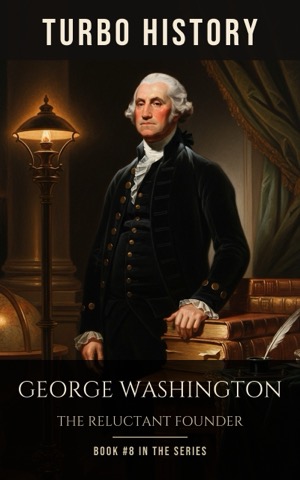
| George Washington Turbo History · ours | ~6,700 words Under an hour | The whole life in one sitting. How a fatherless surveyor became a general, a president, and then walked away |
| Washington: The Indispensable Man James Thomas Flexner, 1974 | ~400 pages About 10 hours | The one-volume classic. A four-volume life boiled down to something you can finish in a week |
| His Excellency: George Washington Joseph J. Ellis, 2004 | ~320 pages About 8 hours | The character study. Less what he did, more why he was like that |
| Founding Father: Rediscovering George Washington Richard Brookhiser, 1996 | ~250 pages About 6 hours | The short way in. A brisk moral portrait rather than a full biography |
| General George Washington: A Military Life Edward G. Lengel, 2005 | ~450 pages About 11 hours | Washington the soldier, judged honestly. Every campaign, including the ones he lost |
| Washington's Crossing David Hackett Fischer, 2004 | ~564 pages About 14 hours | One campaign at full depth. Trenton and Princeton, the winter that saved the Revolution |
| Never Caught: The Washingtons' Relentless Pursuit of Their Runaway Slave, Ona Judge Erica Armstrong Dunbar, 2017 | ~253 pages About 6 hours | The Washington household seen from below. Short, specific, and the necessary corrective |
The picks, in detail
01
Washington: A Life
This is the book most people mean when they ask for the Washington biography, and it won the Pulitzer for good reason. Chernow is unusually good at making a famously guarded man feel like a person, and he does not dodge the slavery. The cost is bulk: 900 pages of steady, unhurried narrative, and it takes a while to get moving.
02
George Washington: A Biography
Nobody has since matched Freeman for sheer coverage: if you want to know where Washington was and what he decided on a given week, it is in here. Some of the interpretation has aged, particularly the reverence, and it is a reference work more than a reading experience. Treat it as a library to consult rather than a book to finish.
03
George Washington ours
Every book on this list goes deeper than ours, and most of them are hard work. That is not a criticism, it is the entire point of them. Chernow gives you 904 pages and around twenty-three hours. Fischer spends 564 pages on a few weeks in the winter of 1776. They are good books, and they want weeks of your life.
If you are studying Washington properly, or sitting an exam on the Revolution, buy one of those and give it the time it deserves. We are not pretending to compete with them.
If you are not, ours might suit you better. It starts with the death of his father when he was eleven, his half-brother Lawrence standing in as a substitute, the trip to Barbados that left him scarred by smallpox and then left him without Lawrence at all, and what those losses built into him. Then the rise: the Ohio Valley expedition, Mount Vernon, the war, the presidency, the final years and the death. There is a chapter on what else the world was doing at the time, from Europe and the Islamic world to China, India, Africa and the rest of the Americas. And it ends on the precedents he set, the government he actually built, why Bolivar and others copied him, and the unfinished business: he died owning 123 enslaved people, freed them in his will, chased runaways, sold people to raise cash, called slavery a moral evil in private and stayed silent about it in public.
That is what the whole series is for. Love history, but hate how it was taught at school? Same. School turned it into a memory test: names, dates, family trees, exam. The actual story never stood a chance. Turbo History is one figure or one event per book, told in under an hour. The rise, the fall, and why it still matters. Dates included, memorising optional. Sources at the back if you want to go further, and every book on this page is a good place to go next.
04
Washington: The Indispensable Man
Flexner spent years on the full four-volume biography, then cut it himself, so this reads like an expert choosing what actually matters. It is warm, clear and fast, and for decades it was the standard recommendation. It is now half a century old, so on slavery and on Washington's contemporaries it is thinner than Chernow.
05
His Excellency: George Washington
Ellis is interested in Washington's ambition, his self-control and the distance he kept from everyone, and he argues a case rather than just narrating. That makes it the most interesting short book here and the most arguable. It assumes you already know the basic outline of the Revolution, so it is a poor first book but an excellent second one.
06
Founding Father: Rediscovering George Washington
Brookhiser wrote this as a set of linked essays on Washington's career and character, not a life story, and it is the quickest serious read on this list. It is very good on why contemporaries deferred to him. It is also openly admiring and light on the darker material, so do not make it your only book.
07
General George Washington: A Military Life
Lengel edited Washington's papers for years and uses them to assess him as a commander rather than as a monument, including the tactical mistakes. If you want to understand how an often-beaten general won a war, this is the book. It is more military detail than a general reader may want, and it largely ignores the presidency.
08
Washington's Crossing
Fischer takes a few weeks of late 1776 and makes them gripping, with real attention to the Hessians and the ordinary soldiers as well as to Washington. It won the Pulitzer and it is the best-written book on this list. The trade-off is scope: you get one campaign, not a life, and the appendices are long.
09
Never Caught: The Washingtons' Relentless Pursuit of Their Runaway Slave, Ona Judge
Ona Judge escaped from the presidential household in 1796 and the Washingtons kept chasing her for years, which tells you more about the man than most set-piece biographies do. Dunbar reconstructs a life from very thin records and says clearly where she is inferring. It is short and readable, but it is a single thread, not a general history.
Questions people actually ask
What is the best book about George Washington?
Ron Chernow's Washington: A Life (2010) is the clear first choice. It covers the whole life in one volume, it is honest about slavery and about Washington's temper and ambition, and it won the Pulitzer Prize for Biography. The catch is 900 pages, so budget around 23 hours.
Where should I start with George Washington?
If you want the full story but not 900 pages, start with James Thomas Flexner's Washington: The Indispensable Man, his own abridgement of a four-volume life. If you already know the basic outline of the Revolution, Joseph Ellis's His Excellency is the more interesting read because it argues about Washington's character rather than just narrating it. Save Chernow for when you know you want the long version.
What is the best short book about George Washington?
Richard Brookhiser's Founding Father: Rediscovering George Washington runs about 250 pages and is a portrait rather than a biography, which is why it moves so fast. It is admiring, so pair it with Erica Armstrong Dunbar's Never Caught, which is a similar length and much less comfortable. Between them you get roughly twelve hours and two very different Washingtons.
Which book is best on Washington as a general?
Edward Lengel's General George Washington: A Military Life is the honest assessment, written by an editor of the Washington papers, and it does not hide the defeats. For one campaign in depth, David Hackett Fischer's Washington's Crossing on Trenton and Princeton is better written and won the Pulitzer. Read Lengel for the verdict, Fischer for the experience.
Do any good books deal with Washington and slavery?
Yes. Erica Armstrong Dunbar's Never Caught follows Ona Judge, who fled the presidential household in 1796 while the Washingtons tried to get her back, and it is short and direct. Chernow's biography also treats Mount Vernon's enslaved community at length rather than as a footnote, which older lives such as Flexner's and Freeman's do not. If this is your main interest, read Dunbar first.
This book is free sometimes. Want to know when?
George Washington goes free on Amazon from time to time, along with the rest of the series. Leave your email and we will tell you the moment it does.
More from the series
One figure or one event per book. Under an hour each.