If you want one full biography that you will actually finish, read Jon Meacham's Thomas Jefferson: The Art of Power. If you want the scholarly standard in a single volume, Merrill Peterson's Thomas Jefferson and the New Nation is still it. If you want the part of the story Jefferson's admirers spent two centuries avoiding, read Annette Gordon-Reed, whose The Hemingses of Monticello is the best book on this page. R. B. Bernstein's short life is the fastest honest way in. And if you have under an hour rather than a fortnight, ours covers the whole life in one sitting.
Every book listed here is real, in print or easily found, and worth the time. Reading times are honest estimates from page count at roughly 250 words per minute. The Sally Hemings scholarship is not a footnote on this page. Annette Gordon-Reed's work is the most important Jefferson writing of the last thirty years, and it changed what a serious Jefferson biography is allowed to leave out. The older books here, Malone above all, were written before the 1998 DNA evidence and actively dismissed the Hemings testimony, and we say so in the entries rather than listing them as though nothing had happened since.
The short version
Sorted by what you want, not by what is most famous.
| Book | Length | Best for |
|---|---|---|
| Thomas Jefferson and the New Nation: A Biography Merrill D. Peterson, 1970 | ~1,072 pages About 30 hours | The most complete single volume. Jefferson as a political thinker, followed all the way through |
| Thomas Jefferson: The Art of Power Jon Meacham, 2012 | ~800 pages About 22 hours | The readable full-length life. Jefferson as a working politician rather than a marble philosopher |
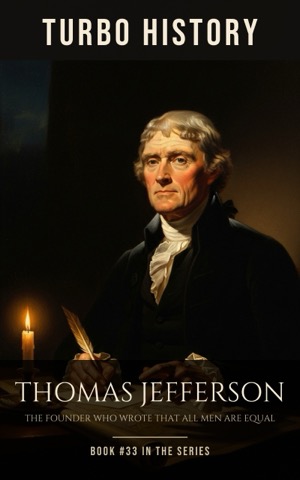
| Thomas Jefferson: The Founder Who Wrote That All Men Are Equal Turbo History · ours | ~5,400 words Under an hour | The whole life in one sitting. The Declaration, the presidency, and the contradiction he never resolved |
| The Hemingses of Monticello: An American Family Annette Gordon-Reed, 2008 | ~800 pages About 22 hours | The best book on this page. Four generations of an enslaved family, reconstructed from almost nothing |
| American Sphinx: The Character of Thomas Jefferson Joseph J. Ellis, 1997 | ~365 pages About 10 hours | The character study, not the chronology. How one man held both halves of the contradiction |
| Thomas Jefferson and Sally Hemings: An American Controversy Annette Gordon-Reed, 1997 | ~288 pages About 8 hours | The book that broke the consensus. A lawyer cross-examining two centuries of historians |
| Thomas Jefferson R. B. Bernstein, 2003 | ~253 pages About 7 hours | The short scholarly life. Everything essential, no padding, Hemings included rather than dodged |
| Jefferson and His Time Dumas Malone, 1948 | Six volumes Months, not hours | The classic, and the reference of last resort. The fullest documentary account of the life anywhere |
The picks, in detail
01
Thomas Jefferson and the New Nation: A Biography
For decades this was the one-volume answer to Malone's six, and it is still the most thorough serious life you can hold in one hand. Peterson is particularly good on the ideas: where Jefferson's politics came from and how they shifted under the pressure of actually governing. The cost is size and vintage, since it is a thousand pages of dense mid-century academic prose, and its handling of slavery and of Sally Hemings is badly out of date.
02
Thomas Jefferson: The Art of Power
Meacham writes proper narrative and his argument is genuinely clarifying: the man who claimed to hate power was extremely good at getting and keeping it. This is the version most general readers finish, and the notes at the back are heavy, so the actual text is shorter than the page count suggests. The weakness is sympathy, because Meacham tends to explain Jefferson's evasions where Gordon-Reed presses them.
03
Thomas Jefferson: The Founder Who Wrote That All Men Are Equal ours
Every book on this list goes deeper than ours, and most of them are hard work. That is not a criticism, it is the entire point of them. Peterson runs to about 1,072 pages. Gordon-Reed's The Hemingses of Monticello is around 800 and earns every one of them. They are good books, and they want weeks of your life.
If you are researching Jefferson properly, or studying him, or sitting an exam on him, buy one of those and give it the time it deserves. We are not pretending to compete with them.
If you are not, ours might suit you better. It opens in February 1770 with Jefferson watching Shadwell burn and losing the 200 pounds sterling worth of books he had been collecting since adolescence, then goes back to the third of ten children born to a self-taught surveyor and a Randolph. It runs through the House of Burgesses at twenty-six, the freedom suits he took for enslaved clients, the eighteen days in Philadelphia that produced the Declaration, the governorship of Virginia, the presidency, and the Louisiana Purchase that flattened his own constitutional principles. There is a chapter on what else was happening in the world at the time, from Europe to China to the Americas, and a chapter on why it still matters: the sentence every liberation movement has borrowed, the wall of separation that had doors in it, the empire of liberty and what it meant for Native Americans, and the slavery paradox, including the 1792 calculation of profit on the birth of enslaved children, the five people he freed in his will and the roughly 130 sold at auction to pay his debts.
That is what the whole series is for. Love history, but hate how it was taught at school? Same. School turned it into a memory test: names, dates, family trees, exam. The actual story never stood a chance. Turbo History is one figure or one event per book, told in under an hour. The rise, the fall, and why it still matters. Dates included, memorising optional. Sources at the back if you want to go further, and every book on this page is a good place to go next.
04
The Hemingses of Monticello: An American Family
Gordon-Reed rebuilds the Hemings family out of fragments and turns Monticello from a monument back into a place where people lived, worked and were sold. It won the Pulitzer and the National Book Award and it permanently changed how Jefferson is written about. It is long and deliberately slow, because the sources are so thin that she has to reason carefully in front of you about what can and cannot be inferred, and readers who want momentum will find that heavy going.
05
American Sphinx: The Character of Thomas Jefferson
Ellis builds the book around a handful of moments rather than marching through the life, and it is the sharpest short account of how a man could write that all men are created equal and still own people. It won the National Book Award and it is the one that gets quoted in arguments. Two costs: it assumes you already know the basic sequence of events, and the first edition hedged on the Hemings relationship, so get a later printing with the corrective preface.
06
Thomas Jefferson and Sally Hemings: An American Controversy
Gordon-Reed does not set out to prove the relationship happened. She examines how professional historians handled the evidence, and shows them repeatedly discounting Black testimony while accepting white denials at face value. It appeared a year before the DNA results, which is part of why it matters. It reads like a legal brief, methodical and repetitive by design, and it is about the historiography rather than about Jefferson or Hemings as people.
07
Thomas Jefferson
This was the first concise scholarly life of Jefferson in about sixty years, and Gordon S. Wood called it the best short biography of him ever written. Unlike most short lives of its era it deals with Sally Hemings directly instead of tiptoeing around the subject. The cost is compression, since episodes that deserve a chapter get a paragraph and there is very little scene or texture, so it works better as a first or last read than as your only one.
08
Jefferson and His Time
Malone spent thirty-eight years on this and won a Pulitzer for it, and no other work follows Jefferson day by day in comparable detail. Treat it as a reference shelf rather than a reading project, because six volumes is a months-long commitment and the prose is stately rather than lively. It is also openly protective of its subject: Malone dismissed the Hemings evidence, which is now the weakest thing about the series and the reason it cannot be your only source.
Questions people actually ask
What is the best book about Thomas Jefferson?
It depends what you want. For the fullest single-volume scholarly life, Merrill Peterson's Thomas Jefferson and the New Nation (1970) is still the benchmark at about 1,072 pages. For the best-written full biography, Jon Meacham's Thomas Jefferson: The Art of Power (2012). For the most important Jefferson book of the last thirty years, Annette Gordon-Reed's The Hemingses of Monticello.
Where should I start with Thomas Jefferson?
Start with R. B. Bernstein's Thomas Jefferson (2003), about 253 pages, which gives you the whole life accurately and quickly and does not dodge Sally Hemings. Move to Meacham if you want narrative and scale, or to Joseph Ellis if what interests you is the contradiction at the centre of the man rather than the sequence of events.
What is the best book on Thomas Jefferson and Sally Hemings?
Annette Gordon-Reed's The Hemingses of Monticello (2008) is the major work, roughly 800 pages, and it reconstructs four generations of the enslaved Hemings family rather than treating Sally Hemings as a single episode in Jefferson's life. Read her earlier Thomas Jefferson and Sally Hemings: An American Controversy (1997) first if you want to see how historians handled the evidence before the DNA results, because it is shorter and it is the book that forced the reassessment.
What is the best short book about Thomas Jefferson?
R. B. Bernstein's Thomas Jefferson, at about 253 pages, is the best short scholarly life and covers slavery and Hemings squarely. Joseph Ellis's American Sphinx is around 365 pages and is short by Jefferson standards, though it is a character study rather than a full biography. Our own hour-long version covers the whole life if you want the shape of it tonight.
Are the older Jefferson biographies still worth reading?
Yes, with a warning. Dumas Malone's six-volume Jefferson and His Time remains the most detailed documentary account of the life, and Peterson is still a serious one-volume study. But both were written before the 1998 DNA evidence, and Malone in particular dismissed the Hemings testimony. Use them for detail and pair them with Gordon-Reed, rather than relying on them alone.
This book is free sometimes. Want to know when?
Thomas Jefferson goes free on Amazon from time to time, along with the rest of the series. Leave your email and we will tell you the moment it does.
More from the series
One figure or one event per book. Under an hour each.