If you want to see the actual evidence, read Brent Shaw's Spartacus and the Slave Wars, which prints the ancient sources in translation and lets you judge them yourself. If you want a readable narrative history, read Barry Strauss's The Spartacus War. If you want the sharpest argument about what Spartacus may have been trying to do, read Aldo Schiavone's Spartacus, and read it knowing that other historians think he goes too far. And if you have under an hour rather than a fortnight, ours covers the whole revolt in one sitting. Everything below is sorted by what you are actually trying to get out of it.
Every book listed here is real, in print or easily found second hand, and worth the time. Reading times are honest estimates from page count, not measurements. One warning specific to this subject, and it applies to every book on the list. Everything we know about Spartacus comes from a handful of fragmentary Roman writers, mostly Plutarch and Appian, writing between roughly 150 and 250 years after the events, and every one of them belonged to the class the rebels were fighting. Nothing survives from the rebel side. We do not know where Spartacus was born in any detail, we do not know what he wanted, and we do not know why he turned back from the Alps. The 1960 Kubrick film, which popularised the idea that he was fighting to abolish slavery, has shaped the popular image far more than the evidence has. Any book that tells you confidently what was in his head is filling gaps, and the good ones say so.
The short version
Sorted by what you want, not by what is most famous.
| Book | Length | Best for |
|---|---|---|
| Spartacus and the Slave Wars: A Brief History with Documents Brent D. Shaw, editor, 2001 | ~208 pages About 6 hours | The primary sources in translation. Everything the ancients actually wrote, in one place |
| The Spartacus War Barry Strauss, 2009 | ~264 pages About 8 hours | The readable narrative. A working classicist writing military history for a general audience |
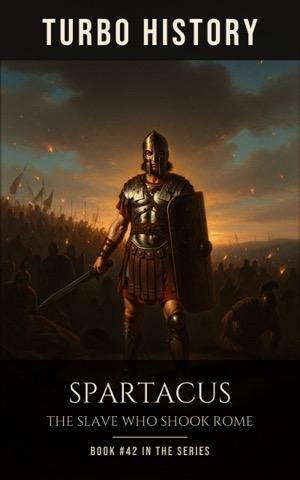
| Spartacus: The Slave Who Shook Rome Turbo History · ours | ~5,400 words Under an hour | The whole revolt in one sitting. What happened, what the Romans wrote down, and why the symbol outgrew the man |
| Spartacus Aldo Schiavone, translated by Jeremy Carden, 2013 | ~177 pages About 5 hours | The strongest argument about what he wanted. Short, serious and deliberately provocative |
| Slavery and Rebellion in the Roman World, 140 B.C. to 70 B.C. Keith R. Bradley, 1989 | ~186 pages About 5 hours | The scholarly context. Why three big slave wars happened in seventy years, not just this one |
| Spartacus Theresa Urbainczyk, 2004 | ~144 pages About 4 hours | The short scholarly one. A classicist covering the war and the afterlife in under 150 pages |
| Spartacus: Film and History Martin M. Winkler, editor, 2007 | ~267 pages About 8 hours | The specialist angle. How Kubrick's 1960 film became what most people mean by Spartacus |
| Fall of the Roman Republic: Six Lives Plutarch, translated by Rex Warner, 2005 | ~414 pages About 12 hours | A primary source in full. Plutarch's Life of Crassus is one of the two main accounts we have |
The picks, in detail
01
Spartacus and the Slave Wars: A Brief History with Documents
Shaw translates around eighty Greek and Latin passages covering the slave revolts in Sicily and Italy, arranges them by theme, and wraps them in an introduction that explains what Roman slavery was actually like. This is the book that shows you how little evidence exists, which is the single most useful thing you can learn about Spartacus. It is a teaching edition rather than a narrative, so you get fragments and commentary rather than a story with a beginning and an end.
02
The Spartacus War
Strauss is a Cornell classicist and this is the most enjoyable full account of the revolt in English: the breakout from the school at Capua, the raid down Vesuvius, the destruction of consular armies, the trap in Bruttium and the last battle. He walked the ground in Italy and it shows in the terrain writing. The cost is that he fills the gaps in the sources with plausible reconstruction, particularly around motives and around Spartacus's wife, and you need to keep track of where the evidence stops.
03
Spartacus: The Slave Who Shook Rome ours
Every book on this list goes deeper than ours, and most of them are hard work. That is not a criticism, it is the entire point of them. Shaw gives you 208 pages of translated ancient sources with the commentary to make sense of them. Strauss gives you 264 pages of narrative built on walking the Italian ground. They are good books, and they want weeks of your life.
If you are studying Roman history properly, or sitting an exam on the late Republic, buy one of those and give it the time it deserves. We are not pretending to compete with them.
If you are not, ours might suit you better. It starts with what little can be said about a Thracian who may have soldiered for Rome - the sources disagree - and was enslaved, and ended up in a gladiator school at Capua. Then the breakout, the growth from a few dozen escapees into an army, the destruction of Roman forces sent to deal with it, the turn back from the Alps, the failed crossing to Sicily and the last battle, followed by the six thousand crucifixions along the Appian Way. There is a chapter on what else was happening in Europe, the Islamic world, China, India, Africa and the Americas in the years 73 to 71 BC. And it ends honestly: on the permanent fear the revolt left in the Roman elite, on how the name travelled from Voltaire to Marx to the Spartacus League to Soviet sports leagues, and on the darker part the heroic versions leave out, which is that a desperate army burned villas and killed people who had done nothing.
That is what the whole series is for. Love history, but hate how it was taught at school? Same. School turned it into a memory test: names, dates, family trees, exam. The actual story never stood a chance. Turbo History is one figure or one event per book, told in under an hour. The rise, the fall, and why it still matters. Dates included, memorising optional. Sources at the back if you want to go further, and every book on this page is a good place to go next.
04
Spartacus
Schiavone is a major historian of Roman law and he argues that Spartacus had a political aim, an attempt to build alliances with Italian communities and the Roman poor, rather than simply trying to get home. It is short, it is well translated, and it forces you to think about the problem rather than the pageantry. Reviewers, including Theresa Urbainczyk in Bryn Mawr Classical Review, have pointed out that he invents sensory detail and speculates well past the sources, so read it as an argument rather than a settled account.
05
Slavery and Rebellion in the Roman World, 140 B.C. to 70 B.C.
Bradley is the leading historian of Roman slavery and he puts Spartacus alongside the two Sicilian revolts that came before, which is the only way the war makes structural sense. The argument is that these were not random outbursts but the predictable result of how Rome acquired and worked its slaves. It is an academic monograph, so the prose is plain and the footnotes are heavy, and it spends less time on Spartacus himself than you might expect.
06
Spartacus
Part of the Ancients in Action series, this covers the revolt itself and then the long afterlife, from Roman writers through Marx and the Spartacus League to Hollywood. Urbainczyk is careful about the difference between what the sources say and what has been read into them, which is the discipline this subject most needs. It is brief by design, so if you want the campaign followed battle by battle you will find it thin.
07
Spartacus: Film and History
A collection of essays by classicists and film scholars on the 1960 film, the Howard Fast novel behind it, the blacklist politics of Dalton Trumbo's screenplay, and where all of it departs from the ancient evidence. If you want to understand why the popular Spartacus is an abolitionist and the historical one probably was not, this is the book that explains the mechanism. It is a scholarly collection, so it is uneven, and it is about the film first and the war second.
08
Fall of the Roman Republic: Six Lives
This Penguin Classics volume collects Plutarch's lives of Marius, Sulla, Crassus, Pompey, Caesar and Cicero, and the Crassus is where most of the familiar Spartacus story comes from, including the decimation of Crassus's own troops. Reading it whole shows you how brief the coverage really is and how much it is about Roman politicians rather than the rebels. Plutarch was writing around 200 years after the war, he is a moralist rather than a reporter, and the other five lives are a long detour if Spartacus is all you want.
Questions people actually ask
What is the best book about Spartacus?
For most readers, Barry Strauss's The Spartacus War is the best single book: about 264 pages, written by a classicist, and the most complete narrative of the war in English. If you care more about evidence than story, Brent Shaw's Spartacus and the Slave Wars is the better choice, because it prints the ancient sources in translation and lets you see how thin they are. Serious readers usually end up wanting both.
Where should I start with Spartacus?
Start with Strauss for the shape of the war, then read Shaw to see the actual evidence behind it. That order works because Strauss gives you a story to hang the fragments on, and Shaw then shows you how much of that story is reconstruction. If you want one short book instead, Theresa Urbainczyk's Spartacus covers the war and its afterlife in about 144 pages.
Do we know what Spartacus actually wanted?
No. Every surviving account is Roman, written well after the events, and none of them had any interest in reporting his aims accurately. Plutarch suggests escape over the Alps, Appian suggests something closer to a march on Rome, and the two do not fit together. Aldo Schiavone argues for a political programme aimed at Italian communities and the Roman poor, which is the most interesting case anyone has made, but it is an argument rather than a finding, and reviewers have said he goes further than the sources allow.
How accurate is the Spartacus film?
Not very, and it matters because the 1960 Kubrick film has shaped the popular image more than the ancient sources have. Its central idea, that Spartacus was fighting to abolish slavery, appears in no ancient account. Martin Winkler's Spartacus: Film and History is a collection of essays that works through the film, Howard Fast's novel and Dalton Trumbo's screenplay, and shows where each departs from the evidence.
What are the original ancient sources on Spartacus?
Mainly Plutarch's Life of Crassus and Appian's Civil Wars, with shorter mentions in Sallust, Florus, Livy's summaries and others. Plutarch is available in the Penguin Classics volume Fall of the Roman Republic, translated by Rex Warner. If you would rather have all the fragments gathered in one place with commentary, Brent Shaw's Spartacus and the Slave Wars collects around eighty passages in translation and is the more practical option.
This book is free sometimes. Want to know when?
Spartacus goes free on Amazon from time to time, along with the rest of the series. Leave your email and we will tell you the moment it does.
More from the series
One figure or one event per book. Under an hour each.