If you want one modern biography that treats the evidence sceptically, read Peter Green's Alexander of Macedon. If you want the version that made a generation fall in love with him, read Robin Lane Fox's Alexander the Great, and notice how differently the same events sound. Paul Cartledge's Alexander the Great: The Hunt for a New Past is the best book on why historians cannot agree. Read at least some of Arrian's The Campaigns of Alexander, because everything else on this page is built on it. And if you have under an hour rather than a fortnight, ours covers the whole life in one sitting.
Every book listed here is real, in print, and worth the time. Reading times are honest estimates from page count. The thing to understand before you buy anything: not one contemporary account of Alexander survives. Everything we have was written by men living three to five centuries after he died, working from lost sources with their own agendas, and Arrian, Plutarch, Curtius and Diodorus often flatly contradict each other. That is why modern historians split so hard. Robin Lane Fox reads him as a visionary who broke the world open. Peter Green reads him as a gifted, paranoid mass killer who burned cities and murdered his own officers. Both are serious scholars working from the same thin evidence, and neither can be proved right. We have not picked a side on this page.
The short version
Sorted by what you want, not by what is most famous.
| Book | Length | Best for |
|---|---|---|
| Alexander of Macedon, 356-323 B.C.: A Historical Biography Peter Green, 1991 | ~617 pages About 18 hours | The sceptical scholarly life. Alexander as a brilliant, ruthless politician rather than a dreamer |
| Alexander the Great Robin Lane Fox, 1973 | ~568 pages About 16 hours | The classic sympathetic life. Written at twenty seven and still the most vivid narrative of the campaigns |
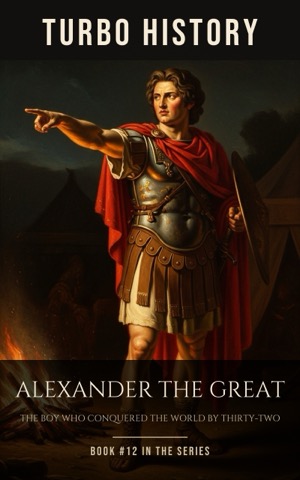
| Alexander the Great: The Boy Who Conquered the World by Thirty-Two Turbo History · ours | ~6,100 words Under an hour | The whole life in one sitting. Thirteen years of conquest, what it cost, and why nobody can agree about him |
| The Campaigns of Alexander Arrian, c. 150 AD | ~432 pages About 12 hours | The main ancient source. The narrative every modern book is arguing with |
| Alexander the Great Philip Freeman, 2011 | ~416 pages About 12 hours | The best readable one-volume life. Straight narrative for someone starting from nothing |
| Alexander the Great: The Hunt for a New Past Paul Cartledge, 2004 | ~329 pages About 9 hours | The evidence problem, explained. Thematic chapters rather than a cradle-to-Babylon narrative |
| Ghost on the Throne: The Death of Alexander the Great and the War for Crown and Empire James Romm, 2011 | ~341 pages About 10 hours | What happened next. The forty-year knife fight between his generals over the corpse of the empire |
| Alexander the Great: A Very Short Introduction Hugh Bowden, 2014 | ~144 pages About 4 hours | The fastest serious orientation. What we can actually know, from a scholar who refuses to guess |
The picks, in detail
01
Alexander of Macedon, 356-323 B.C.: A Historical Biography
Green is a classicist who refuses to be charmed, and he reads the ancient sources as propaganda first and evidence second, which produces a colder and in places far more convincing Alexander. The political analysis of the Macedonian court is the best anywhere. It is long, the tone is openly hostile in places, and readers who come in admiring Alexander often find it a difficult book to sit with.
02
Alexander the Great
Lane Fox walked much of the route and the book has an immediacy no other Alexander biography matches, which is why it stayed in print for fifty years and why Oliver Stone hired him. He is frankly an admirer, and he fills gaps in the evidence with informed imagination. Read it for the feel of the campaign, then read Green for the argument against, or you will come away with one man's Alexander and think it is the record.
03
Alexander the Great: The Boy Who Conquered the World by Thirty-Two ours
Every book on this list goes deeper than ours, and most of them are hard work. That is not a criticism, it is the entire point of them. Green gives you 617 pages of sceptical scholarship. Lane Fox gives you 568 pages of narrative. They are good books, and they want weeks of your life.
If you are studying classics or ancient history, or sitting an exam on any of this, buy one of those and give it the time it deserves. We are not pretending to compete with them.
If you are not, ours might suit you better. It opens with the horse nobody could ride, then Philip's court and what it was actually like to grow up as the heir of a man who kept marrying, then the exile, the murder and the very fast succession. The middle is the campaign: the rise, the expansion east, the years of total domination, and the last stretch to Babylon. There is a chapter on what the rest of the world was doing at the same time, from India and China to Africa and the Americas, which puts the size of his empire in some perspective. The last chapter takes both sides seriously: the Greek language that outlasted him by the better part of two thousand years and the cities that are still standing, and then Thebes razed, Tyre and Massaga massacred, Persepolis burned, the Gedrosian desert march that killed thousands of his own men, and the Zoroastrian texts that call him the accursed.
That is what the whole series is for. Love history, but hate how it was taught at school? Same. School turned it into a memory test: names, dates, family trees, exam. The actual story never stood a chance. Turbo History is one figure or one event per book, told in under an hour. The rise, the fall, and why it still matters. Dates included, memorising optional. Sources at the back if you want to go further, and every book on this page is a good place to go next.
04
The Campaigns of Alexander
Arrian wrote roughly four and a half centuries after Alexander died, but he used the lost memoirs of Ptolemy and Aristobulus, both of whom were there, which makes this the closest thing to a reliable account that survives. The Penguin translation is readable and the introduction explains the source problem properly. Treat it as a document rather than a verdict: Arrian admired his subject, is thin on the politics, and skips or softens episodes that reflect badly on him.
05
Alexander the Great
Freeman writes clean popular history and this is the easiest full biography here to actually finish, moving briskly from Philip's court to Babylon without assuming you know any Greek history. He notes where the sources disagree instead of quietly picking one. It is deliberately light on scholarly argument, so if you want to understand the debates rather than the story, Cartledge or Green will serve you better.
06
Alexander the Great: The Hunt for a New Past
Cartledge is one of the leading Greek historians of his generation and he organises the book around questions rather than chronology: the sources, the army, the kingship, the myth and how each age has remade Alexander in its own image. It is the sharpest thinking on this page. It is not a biography, so read it after you already know the sequence of events or you will be lost.
07
Ghost on the Throne: The Death of Alexander the Great and the War for Crown and Empire
Romm picks up at the moment Alexander dies without an heir anyone can accept and follows the succession wars that killed his son, his half brother, his mother and most of his friends. It is genuinely gripping and it makes the point that no biography can: the empire lasted about as long as the man did. It is a sequel by nature, so it is close to unreadable if you do not already know who Perdiccas, Antipater and Eumenes are.
08
Alexander the Great: A Very Short Introduction
Bowden builds his short account around contemporary documentary evidence such as Babylonian astronomical diaries and Egyptian temple records rather than the later literary sources, which makes it an unusually honest little book. In 144 pages it will tell you more about the limits of the evidence than most 600-page biographies. It is austere, and it deliberately declines to give you the rousing narrative you may have come for.
Questions people actually ask
What is the best book about Alexander the Great?
There is no single answer, because the two best biographies argue opposite cases. Peter Green's Alexander of Macedon is the sceptical scholarly life and the stronger book on politics and evidence. Robin Lane Fox's Alexander the Great is the vivid sympathetic one that most readers enjoy more. If you only want one and you are starting cold, Philip Freeman's Alexander the Great is the most straightforward full narrative.
Are there any contemporary accounts of Alexander the Great?
No. Not one narrative written during his lifetime survives. Everything we have comes from writers living centuries later: Diodorus in the first century BC, Curtius and Plutarch in the first century AD, Arrian in the second. They used earlier accounts by people who were there, including Ptolemy and Callisthenes, but those originals are lost and the surviving versions contradict each other. Hugh Bowden's Very Short Introduction is the best short explanation of what that means in practice.
Which ancient source on Alexander should I read first?
Arrian's The Campaigns of Alexander, in the Penguin Classics translation. He worked from the memoirs of Ptolemy and Aristobulus, both eyewitnesses, and he is the least sensational of the ancient writers. Read Plutarch's Life of Alexander afterwards for the anecdotes and the character sketch. Just remember Arrian is an admirer writing about four hundred and fifty years after the fact.
Was Alexander the Great actually great?
Historians genuinely disagree, and anyone who tells you it is settled is selling something. The case for: he broke the Persian Empire, spread Greek as the common language from Egypt to Afghanistan, and founded cities that are still inhabited. The case against: he razed Thebes and sold the survivors, massacred the populations of Tyre, Gaza and Massaga, killed his own officers including Cleitus and Parmenion, marched thousands of his men to death in the Gedrosian desert, and left no succession plan at all. Green makes the second case hardest, Lane Fox the first.
What is the best short book about Alexander the Great?
Hugh Bowden's Alexander the Great: A Very Short Introduction, at roughly 144 pages, is the best brief serious account and unusually honest about what the evidence can and cannot support. Paul Cartledge's book is about 329 pages and is short by the standards of this shelf while being far more interesting than a summary. Our own hour-long version covers the whole life if you want the shape of it tonight.
This book is free sometimes. Want to know when?
Alexander the Great goes free on Amazon from time to time, along with the rest of the series. Leave your email and we will tell you the moment it does.
More from the series
One figure or one event per book. Under an hour each.