If you want the standard modern life, read David Bates's William the Conqueror in the Yale English Monarchs series. If you want the conquest told as a story you can follow, read Marc Morris's The Norman Conquest. If you want the shortest serious overview, George Garnett's Very Short Introduction does it in under 150 pages, and the Anglo-Saxon Chronicle gives you the English side in the words of people who lived through it. And if you have under an hour rather than a fortnight, ours covers the whole life in one sitting. Everything below is sorted by what you are actually trying to get out of it.
Every book listed here is real, in print or easily found in libraries, and worth the time. Reading times are honest estimates from page count at roughly 250 words per minute, so treat them as a guide rather than a promise. One thing to keep in mind while you read: almost every written account of 1066 comes from the winners. William of Poitiers and William of Jumieges were Norman churchmen writing to justify the conquest, and the Bayeux Tapestry is a Norman commission. The Anglo-Saxon Chronicle and the Domesday Book are the main counterweights, and both have their own gaps. The scale of the Harrying of the North is genuinely disputed: the chroniclers give figures in the tens of thousands, Domesday records large areas as waste seventeen years later, and historians still argue about how much of that was deliberate devastation and how much was record-keeping and tax status. We say where the disagreement sits rather than picking a number and pretending it is settled.
The short version
Sorted by what you want, not by what is most famous.
| Book | Length | Best for |
|---|---|---|
| William the Conqueror David Bates, 2016 | ~596 pages About 17 hours | The standard modern life. Decades of charter work turned into one authoritative biography |
| The Norman Conquest: The Battle of Hastings and the Fall of Anglo-Saxon England Marc Morris, 2012 | ~464 pages About 13 hours | The best readable one-volume account. The conquest as a story you can follow from start to finish |
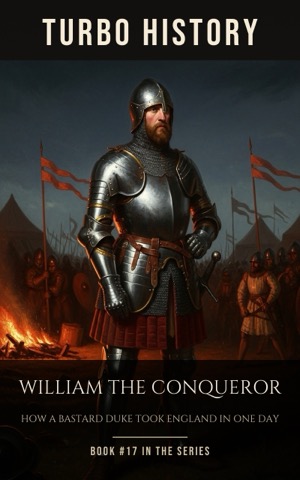
| William the Conqueror: How a Bastard Duke Took England in One Day Turbo History · ours | ~8,200 words Under an hour | The whole life in one sitting. How a boy nobody expected to survive ended up owning England |
| William the Conqueror: The Norman Impact upon England David C. Douglas, 1964 | ~476 pages About 14 hours | The classic that shaped the field. Still the clearest statement of the case for William as a great ruler |
| The Anglo-Saxon Chronicle Translated by Michael Swanton, 2000 | ~388 pages About 11 hours | The primary source, and the English side of it. Year-by-year entries written by people living through the conquest |
| The Bayeux Tapestry: The Life Story of a Masterpiece Carola Hicks, 2006 | ~368 pages About 10 hours | The specialist angle. What the most famous piece of conquest evidence actually is and who made it |
| 1066: The Year of the Conquest David Howarth, 1977 | ~208 pages About 6 hours | The short readable classic. One year, told from the ground up rather than from the throne down |
| The Norman Conquest: A Very Short Introduction George Garnett, 2009 | ~147 pages About 4 hours | The fastest serious overview. What the conquest changed, argued rather than narrated |
The picks, in detail
01
William the Conqueror
Bates spent a career in the Norman and French archives, and this is the book other historians now cite as the default. It is unusually careful about what the sources can and cannot support, and it treats William as a ruler of Normandy first rather than as an English story that starts in 1066. The cost is that it reads like scholarship rather than narrative, and 596 pages of qualified argument is hard work if you are new to the period.
02
The Norman Conquest: The Battle of Hastings and the Fall of Anglo-Saxon England
Morris writes for general readers without cutting corners on the evidence, and he is good at telling you when a chronicler is lying and why. He gives proper weight to what happened after Hastings, which most popular accounts rush past. It is a book about the conquest rather than about William, so the man himself gets less attention than the events, and the first hundred pages are heavy on Anglo-Saxon background before the invasion arrives.
03
William the Conqueror: How a Bastard Duke Took England in One Day ours
Every book on this list goes deeper than ours, and most of them are hard work. That is not a criticism, it is the entire point of them. Bates gives you 596 pages built on a career in the archives. Morris gives you 464 pages and expects you to keep three claimants and two invasions straight. They are good books, and they want weeks of your life.
If you are studying this period, or sitting an exam on it, buy one of those instead. Bates for the life, Morris for the conquest, Garnett if you need the arguments fast. We are not pretending to compete with them.
If you are not, ours might suit you better. It starts with the illegitimate son of a duke and a woman usually called a tanner's daughter, though possibly a chamberlain's, guardians who kept getting murdered around him, and the 1047 battle that finally made Normandy his. Then the invasion, the years of holding England down, the Harrying of the North, and the Domesday survey. It ends on what actually stuck: the French vocabulary sitting inside the English you are reading now, the split between the pig in the field and the pork on the plate, more than 500 castles, an aristocracy that arrived in 1066 and never left, and the administrative machinery that became the English state. There is a chapter on what else was happening in the world at the same time, and the Harrying of the North gets its own section rather than a footnote.
That is what the whole series is for. Love history, but hate how it was taught at school? Same. School turned it into a memory test: names, dates, family trees, exam. The actual story never stood a chance. Turbo History is one figure or one event per book, told in under an hour. The rise, the fall, and why it still matters. Dates included, memorising optional. Sources at the back if you want to go further, and every book on this page is a good place to go next.
04
William the Conqueror: The Norman Impact upon England
This was the standard life for fifty years and it is still worth reading, because Douglas builds his argument openly and you can see the reasoning rather than just the conclusion. He is excellent on Normandy and on the practical business of holding two territories together. It is sixty years old, so the scholarship on Domesday and on Anglo-Saxon England has moved a long way since, and Douglas is more admiring of William than most historians would be now.
05
The Anglo-Saxon Chronicle
This is a primary source, not a history book, and that is the point of reading it. The entries for 1066 to 1087 are the closest you get to an English voice on what the Normans did, including the famous obituary of William that lists his good qualities and then says he was harsh and took gold from poor men. It is fragmentary, repetitive and often maddeningly brief, so read it alongside a modern account rather than instead of one.
06
The Bayeux Tapestry: The Life Story of a Masterpiece
Hicks follows the tapestry from its making through nine centuries of near-destruction, theft and reinterpretation, which turns out to be a better way of understanding it than staring at the pictures. She argues it was made in England, possibly for Edith Godwinson, which changes how you read its silences. The later chapters on Napoleon, the Nazis and modern tourism are a long way from 1066, so it drifts if you only came for the eleventh century.
07
1066: The Year of the Conquest
Howarth tells the year through the eyes of ordinary English people as much as kings, and it is the most enjoyable book on this page by a distance. It gives you the texture of the invasion in a way the scholarly books never do. He is a storyteller rather than a professional medievalist, and he fills gaps with informed imagination, so enjoy it but check anything you plan to repeat against Morris or Bates.
08
The Norman Conquest: A Very Short Introduction
Garnett uses his short space on the consequences rather than the battle, which is the right choice: tenure, law, land and how the Normans justified taking everything. It is dense for its length and it assumes you already know roughly what happened in 1066. If you want the story of the invasion this is the wrong book, but if you want to understand why 1066 mattered it beats books four times the size.
Questions people actually ask
What is the best book about William the Conqueror?
David Bates's William the Conqueror (2016), in the Yale English Monarchs series, is the standard modern life and the one historians cite by default. It runs to about 596 pages and it is careful, sometimes cautious, about what the evidence supports. If you want one book and do not mind the length, that is the one. David Douglas's 1964 biography is the classic it replaced and is still worth reading for the argument.
Where should I start with William the Conqueror and the Norman Conquest?
Start with Marc Morris's The Norman Conquest. It covers the whole crisis of 1066 and the years of conquest that followed, it moves, and it is honest about which chroniclers are propaganda. Move to Bates afterwards if you want the life in depth, or to George Garnett's Very Short Introduction if you want the consequences argued in under 150 pages.
Are the sources on William the Conqueror reliable?
Only partly, and it matters. Most of the narrative accounts were written by Normans justifying the conquest, including William of Poitiers and the Bayeux Tapestry. The Anglo-Saxon Chronicle gives you an English perspective and is blunter about the cost, and the Domesday Book of 1086 is an administrative record rather than a story, which makes it valuable in a different way. Any good modern book will tell you which source a claim comes from, and the ones that do not are worth less.
How bad was the Harrying of the North really?
Bad, but the numbers are disputed. Orderic Vitalis gives a death toll of around 100,000 and says William repented of it on his deathbed, which is a chronicler writing decades later with a moral point to make. Domesday records large stretches of Yorkshire as waste in 1086, though historians argue about whether that always means destroyed or sometimes means untaxed. Bates and Morris both handle the disagreement carefully, and any book that gives you one confident figure is overselling it.
What is the best short book about William the Conqueror?
George Garnett's The Norman Conquest: A Very Short Introduction is about 147 pages and spends them on what changed rather than on the battle. David Howarth's 1066: The Year of the Conquest is about 208 pages and far more enjoyable, though it is storytelling as much as history. Our own hour-long version covers the whole life if you want the shape of it tonight.
This book is free sometimes. Want to know when?
William the Conqueror goes free on Amazon from time to time, along with the rest of the series. Leave your email and we will tell you the moment it does.
More from the series
One figure or one event per book. Under an hour each.