If you want one full biography, read Andrew Roberts's George III (2021), published in America as The Last King of America, which is the first big life written with the Georgian Papers open. If you want the private man and the family that broke around him, read Janice Hadlow's The Strangest Family. If you want something readable at half the length, Christopher Hibbert's George III: A Personal History is the one. Jeremy Black's Penguin Monarchs volume does the whole reign in about 144 pages. And if you have under an hour rather than a month, ours covers the whole life in one sitting.
Every book listed here is real, in print or easily found, and worth the time. Reading times are honest estimates from page count at roughly 250 words per minute. Two things about this subject are worth saying plainly before you buy anything. First, the mad king who lost America is largely a caricature: he was a constitutional monarch operating within Parliament rather than a despot, and recent work using the Georgian Papers at Windsor, especially by Andrew Roberts and Janice Hadlow, has revised the picture substantially. Second, the porphyria diagnosis that the Alan Bennett play and the film made famous came from one 1969 book and is now largely rejected by medical historians, who lean towards a recurrent psychiatric illness. We have included that book anyway, because it shaped everything that followed, but it is labelled for what it is.
The short version
Sorted by what you want, not by what is most famous.
| Book | Length | Best for |
|---|---|---|
| George III: The Life and Reign of Britain's Most Misunderstood Monarch Andrew Roberts, 2021 | ~758 pages About 21 hours | The definitive modern life. The first full biography written with the Georgian Papers digitised and open |
| The Strangest Family: The Private Lives of George III, Queen Charlotte and the Hanoverians Janice Hadlow, 2014 | ~704 pages About 20 hours | The private man and the family experiment. Why a king who wanted a happy household ended up with none |
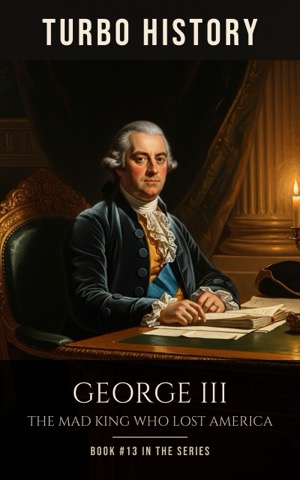
| George III: The Mad King Who Lost America Turbo History · ours | ~6,700 words Under an hour | The whole sixty-year reign in one sitting. The boy nobody prepared for the throne, lost America, and outlived his own mind |
| George III: A Personal History Christopher Hibbert, 1998 | ~463 pages About 13 hours | The best readable one-volume life. Narrative history at a length you will actually finish |
| King George III John Brooke, 1972 | ~411 pages About 12 hours | The classic revisionist life. The book that first made the tyrant reading untenable |
| George III: Madness and Majesty Jeremy Black, 2020 | ~144 pages About 4 hours | The short scholarly version. A serious historian of the reign compressed into an afternoon |
| Journals and Letters Frances Burney, 2001 | ~589 pages About 17 hours | Primary source, and the best eyewitness we have. Court life and the 1788 crisis by someone in the room |
| George III and the Mad-Business Ida Macalpine and Richard Hunter, 1969 | ~407 pages About 12 hours | The famous porphyria case, read as history rather than diagnosis. Where the play and the film came from |
The picks, in detail
01
George III: The Life and Reign of Britain's Most Misunderstood Monarch
Roberts had access to the royal archive on a scale no previous biographer did, and he uses it to argue that George was conscientious, constitutionally scrupulous and far less responsible for losing America than either American myth or British comedy suggests. It is the book that resets the subject, and it won the Elizabeth Longford Prize. It is also 758 pages, it is openly a case for the defence rather than a neutral account, and you should read it knowing that. Published in the United States as The Last King of America.
02
The Strangest Family: The Private Lives of George III, Queen Charlotte and the Hanoverians
Hadlow's subject is George's deliberate attempt to break the Hanoverian pattern of fathers loathing sons and build a loving, domestic, virtuous family, and the slow disaster of watching it fail with fifteen children. It is the most humanly interesting book on this page and it is beautifully written. It is very long, it is thin on politics and the American war, and you will need one of the others alongside it for the reign itself. Published in the United States as A Royal Experiment.
03
George III: The Mad King Who Lost America ours
Every book on this list goes deeper than ours, and most of them are hard work. That is not a criticism, it is the entire point of them. Roberts gives you 758 pages built on the Georgian Papers. Hadlow gives you 704 pages on the family alone. They are good books, and they want weeks of your life.
If you are studying the eighteenth century or sitting an exam on it, buy one of those and give it the time it deserves. We are not pretending to compete with them.
If you are not, ours might suit you better. It starts with a baby born two months early at Norfolk House in June 1738 and baptised the same day because nobody expected him to live, second in line behind a father whose turn looked decades away. It covers the education that made him the first British monarch to study science systematically, his father's sudden death in 1751, the mother and Lord Bute, the marriage he was pushed into, and a twenty-two-year-old inheriting a throne he was not raised for. Then the reign: America, the wars, the ministers, the empire, and the illness that took him out of public life from 1810 and left him blind, deaf and unrecognising at Windsor while his son ruled as regent. The last chapter is about what the reign actually left behind: the constitutional settlement nobody planned, the American constitution written against him, the imperial hangover, and the two opposite myths, the tyrant in America and Farmer George in Britain. We say plainly where the madness argument now stands rather than repeating the porphyria story from the film.
That is what the whole series is for. Love history, but hate how it was taught at school? Same. School turned it into a memory test: names, dates, family trees, exam. The actual story never stood a chance. Turbo History is one figure or one event per book, told in under an hour. The rise, the fall, and why it still matters. Dates included, memorising optional. Sources at the back if you want to go further, and every book on this page is a good place to go next.
04
George III: A Personal History
Hibbert was the most fluent popular historian of his generation and this moves: the childhood, the marriage, the ministers, the illness, all told as story rather than argument. If you want one book and 758 pages is out of the question, take this. It predates the Georgian Papers work, so on the illness and on George's political judgement it is now behind Roberts, and it is more interested in scenes than in causes.
05
King George III
Brooke worked on the History of Parliament and was the first biographer given full run of the king's own papers, and he used them to show a dutiful, hard-working monarch operating inside constitutional limits rather than scheming to break them. Almost everything written since, Roberts included, is arguing with or building on this. It is fifty years old, the prose is austere, and it assumes you already know your way around eighteenth-century politics.
06
George III: Madness and Majesty
Black has written a full-length Yale life of George as well, and this Penguin Monarchs volume distils the reign into something you can read in one sitting on a train. It is genuinely authoritative rather than a potted summary, and it does not duck the American war. At 144 pages it has to state conclusions rather than show you the evidence, so it works better as an overview or a refresher than as your only book.
07
Journals and Letters
Primary source, clearly labelled: Burney was a celebrated novelist who spent five years as Keeper of the Robes to Queen Charlotte, and her account of the king's collapse, including the moment he cornered her in the gardens at Kew, is the single most vivid contemporary record of what the illness looked like from a few feet away. Nothing a historian writes matches it. This Penguin Classics selection covers her whole life, so the court years are only part of it, and eighteenth-century journal prose takes a chapter or two to settle into.
08
George III and the Mad-Business
Two psychiatrists went through the royal physicians' records and concluded George had acute intermittent porphyria, a metabolic disease rather than insanity, and the argument was so appealing that it took over popular understanding for forty years and gave Alan Bennett his play. As a piece of medical detective work on the eighteenth-century treatment of madness it is still fascinating. Its central claim is now largely rejected, since the evidence for porphyria has been picked apart and later analysis of the king's own letters points towards recurrent mania. Read it for what it explains about us, not about him.
Questions people actually ask
What is the best book about George III?
Andrew Roberts's George III (2021), published in America as The Last King of America, is the standard modern life and the first written with the Georgian Papers at Windsor open to researchers. It runs to about 758 pages and it argues a case rather than sitting on the fence. If you want something shorter, Christopher Hibbert's George III: A Personal History is around 463 pages and much easier going.
Where should I start with George III?
Start with Jeremy Black's Penguin Monarchs volume, George III: Madness and Majesty, which covers the whole reign in about 144 pages and is written by a serious historian of the period. Then decide whether you want Roberts for the politics or Janice Hadlow for the family. Our own hour-long version works as an orientation before any of them.
Was George III actually mad, and did he have porphyria?
He suffered repeated episodes of severe mental illness, most famously in 1788 and 1789 and then permanently from 1810, and there is no doubt about that. The porphyria explanation came from Ida Macalpine and Richard Hunter's 1969 book, reached the public through Alan Bennett's play and the film, and is now largely rejected by medical historians. The current leaning is towards a recurrent psychiatric illness with manic features. Nobody can diagnose a man dead two hundred years with certainty, and any book that says otherwise is overselling.
Did George III lose America on his own?
No. He was a constitutional monarch working through ministers and Parliament, and the policies that lost the colonies were parliamentary policies he supported rather than personal decrees. He was stubborn about not conceding independence and that mattered, but the Declaration of Independence blamed him personally because blaming a king was better propaganda than blaming a legislature. Andrew Roberts makes the fullest version of this argument, and John Brooke made it first.
What is the best book on George III's family life?
Janice Hadlow's The Strangest Family, published in America as A Royal Experiment. It is about 704 pages on George and Queen Charlotte's attempt to raise a happy, virtuous family of fifteen children and the slow collapse of that project. For a first-hand view of the same household, Frances Burney's journals from her five years serving the queen are the best contemporary account anyone left.
This book is free sometimes. Want to know when?
George III goes free on Amazon from time to time, along with the rest of the series. Leave your email and we will tell you the moment it does.
More from the series
One figure or one event per book. Under an hour each.