If you want one full biography, read Antonia Fraser's Marie Antoinette: The Journey. If you want the most recent scholarly account of what she actually did politically, read John Hardman's Marie-Antoinette: The Making of a French Queen. If you want to understand how her reputation was manufactured, read Chantal Thomas's The Wicked Queen and Caroline Weber's Queen of Fashion, which between them explain more than any straight life story does. And if you have under an hour rather than a month, ours covers the whole life in one sitting. Everything below is sorted by what you are actually trying to get out of it.
Every book listed here is real, in print or easily found in a library, and worth the time. Reading times are honest estimates from page count at roughly 250 words per minute, so treat them as a guide rather than a promise. One thing to be plain about before you buy anything: almost every damaging story attached to Marie Antoinette was propaganda. The pornographic pamphlets, the orgies, the claim that she bankrupted France single-handed, the charge of incest read out at her trial, and the line about letting them eat cake, which she never said and which was already in circulation before she arrived in France. Modern biography, Fraser and Weber and Hardman especially, is largely a corrective to that campaign, and you should expect these books to spend real time dismantling stories you have heard your whole life.
The short version
Sorted by what you want, not by what is most famous.
| Book | Length | Best for |
|---|---|---|
| Marie Antoinette: The Journey Antonia Fraser, 2001 | ~512 pages About 15 hours | The standard readable life. Sympathetic, thorough, and firm about what was invented |
| Marie-Antoinette: The Making of a French Queen John Hardman, 2019 | ~384 pages About 11 hours | The politics rather than the person. What she actually decided and when |
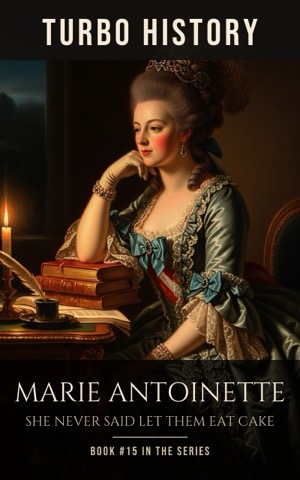
| Marie Antoinette: She Never Said Let Them Eat Cake Turbo History · ours | ~6,000 words Under an hour | The whole life in one sitting. How a fourteen-year-old bride became the most hated woman in Europe |
| Queen of Fashion: What Marie Antoinette Wore to the Revolution Caroline Weber, 2006 | ~432 pages About 12 hours | The specialist angle that explains the hatred. Clothes as politics, not decoration |
| The Wicked Queen: The Origins of the Myth of Marie-Antoinette Chantal Thomas, 1999 | ~255 pages About 7 hours | The propaganda itself. Where the lies came from and what they were for |
| Marie Antoinette: The Last Queen of France Evelyne Lever, 2000 | ~352 pages About 10 hours | The French view, translated. Shorter than Fraser and closer to the French sources |
| The Road from Versailles: Louis XVI, Marie Antoinette, and the Fall of the French Monarchy Munro Price, 2003 | ~425 pages About 12 hours | The last four years in detail. The secret diplomacy, the flight, the endgame |
| Marie Antoinette: The Portrait of an Average Woman Stefan Zweig, 1932 | ~476 pages About 14 hours | The classic, and the best writing on this page. A psychological portrait from between the wars |
| Secrets of Marie Antoinette: A Collection of Letters Marie Antoinette, edited by Olivier Bernier, 1985 | ~326 pages About 9 hours | Her own voice. Primary source, mostly her letters home to her mother |
The picks, in detail
01
Marie Antoinette: The Journey
Fraser tells the whole story from Vienna to the scaffold in strong narrative prose and takes the accusations one by one, showing which were fabricated and how. It is the book most people should read first, and the one Sofia Coppola's film was based on. Fraser is openly sympathetic, which some historians think tips too far, and the political crisis of the 1780s gets less space than the queen's private life.
02
Marie-Antoinette: The Making of a French Queen
Hardman has spent a career on Louis XVI and the last years of the monarchy, and this is the best account of Marie Antoinette as a working political actor, especially in the years when she was drawn into ministerial decisions. It corrects both the frivolous-airhead version and the pure-victim version. It is written for readers who already know the outline of the revolution, and it is heavier on councils and correspondence than on court life.
03
Marie Antoinette: She Never Said Let Them Eat Cake ours
Every book on this list goes deeper than ours, and most of them are hard work. That is not a criticism, it is the entire point of them. Fraser gives you around 512 pages from Vienna to the scaffold. Weber's study of the clothes alone runs to about 432 pages. They are good books, and they want weeks of your life.
If you are studying the French Revolution properly, or sitting an exam on it, buy one of those and give it the time it deserves. We are not pretending to compete with them.
If you are not, ours might suit you better. It starts in Vienna: the birthday nobody wanted to celebrate, growing up Habsburg, the smallpox that killed one sister, rerouted another to Naples, and left her the only daughter for the French marriage, the makeover the Austrian court gave her before shipping her out, and the deal that sealed her fate. Then the life in four movements: rise, expansion, domination, and the final years. There is a chapter on what the rest of the world was doing at the same time, from the Islamic world and China to India, Africa and the Americas. It ends on why she still matters: the libelles as the template for destroying a public woman, the cake line she never said and why it stuck anyway, the show trial and what later regimes learned from it, and the objects and fashion that outlived her.
That is what the whole series is for. Love history, but hate how it was taught at school? Same. School turned it into a memory test: names, dates, family trees, exam. The actual story never stood a chance. Turbo History is one figure or one event per book, told in under an hour. The rise, the fall, and why it still matters. Dates included, memorising optional. Sources at the back if you want to go further, and every book on this page is a good place to go next.
04
Queen of Fashion: What Marie Antoinette Wore to the Revolution
Weber shows that Marie Antoinette's dress was a genuine political instrument, and that the outrage it caused was about power and foreignness rather than fabric. It is the clearest explanation of how a queen's wardrobe ended up being used as evidence against her. It is a study of one theme rather than a life, so read it after Fraser, and the middle chapters assume some familiarity with the court.
05
The Wicked Queen: The Origins of the Myth of Marie-Antoinette
Thomas goes straight to the libelles, the scurrilous pamphlets that built the public image of Marie Antoinette, and analyses how they worked as political weapons rather than gossip. If you want to understand the machinery that destroyed her, this is the book, and it includes translations of the pamphlets themselves. It is literary and cultural analysis rather than biography, the tone is academic, and it will make little sense unless you know the life first.
06
Marie Antoinette: The Last Queen of France
Lever is a French historian of the revolutionary period and her biography draws on material and a scholarly tradition that English-language books often skate past. At around 352 pages it is the most manageable full life here. The English edition is heavily condensed from her original French, so some of the archival texture is lost, and it moves faster than it sometimes should.
07
The Road from Versailles: Louis XVI, Marie Antoinette, and the Fall of the French Monarchy
Price focuses tightly on 1789 to 1793 and on what the king and queen were actually doing behind the scenes, including the secret contacts with foreign courts that later became the case for treason. It is the book that makes the flight to Varennes comprehensible rather than baffling. It is not a life story, so it starts in the middle, and it demands more attention to French politics than most readers expect.
08
Marie Antoinette: The Portrait of an Average Woman
Zweig's argument is that Marie Antoinette was an ordinary woman crushed by an extraordinary situation, and he writes it with a force that no modern biography matches. It is the book that shaped how the twentieth century imagined her. It is also more than ninety years old, its psychology is dated, it trusts some documents that scholars no longer do, and Zweig fills in interior life freely, so enjoy it but check it against Fraser or Hardman.
09
Secrets of Marie Antoinette: A Collection of Letters
This is the real correspondence between Marie Antoinette and Empress Maria Theresa across the 1770s, with the Austrian ambassador's reports alongside it, and it is the closest you will get to hearing her think. The pressure from Vienna, the evasions from Versailles and the anxiety about the unconsummated marriage are all there in her own words. It is a primary source, so it is repetitive, unexplained in places, and it stops long before the revolution.
Questions people actually ask
What is the best book about Marie Antoinette?
Antonia Fraser's Marie Antoinette: The Journey (2001) is the standard full-length life and the best first choice for most readers, at around 512 pages. If you want the most recent scholarship on her political role rather than her private life, John Hardman's Marie-Antoinette: The Making of a French Queen (2019) is the better book. Read Fraser first and Hardman second.
Where should I start with Marie Antoinette?
Start with Antonia Fraser. It is a proper narrative biography, it covers Vienna, Versailles, the revolution and the trial, and it is direct about which of the famous stories are inventions. After that, Caroline Weber's Queen of Fashion or Chantal Thomas's The Wicked Queen will explain how the hostile image was built. Our own hour-long version gives you the whole arc tonight if you want the shape first.
Did Marie Antoinette say let them eat cake?
No. There is no evidence she ever said it, and versions of the story were circulating in France before she arrived in 1770, attached to other royal women. It was pinned to her because it fitted the campaign already being run against her in the pamphlet press. Fraser deals with it directly, and Chantal Thomas's The Wicked Queen explains the wider machinery of invented stories that produced it.
Which book explains why Marie Antoinette was so hated?
Chantal Thomas's The Wicked Queen is the specialist book on exactly this, because it goes to the libelles, the pornographic and political pamphlets that shaped public opinion, and shows how they worked. Caroline Weber's Queen of Fashion covers the same ground from the direction of clothing and public display. Both are best read after a straight biography, since they assume you already know the life.
Is there a book with Marie Antoinette's own letters?
Yes. Secrets of Marie Antoinette, edited by Olivier Bernier, collects her correspondence with her mother Maria Theresa through the 1770s alongside reports from the Austrian ambassador, and it is the most accessible primary source in English. It is genuinely revealing about the marriage and about how much Vienna was still trying to run her. It stops well before the revolution, so use it with a full biography rather than instead of one.
This book is free sometimes. Want to know when?
Marie Antoinette goes free on Amazon from time to time, along with the rest of the series. Leave your email and we will tell you the moment it does.
More from the series
One figure or one event per book. Under an hour each.