If you want the fullest modern life, read Philip Mansel's King of the World. If you want the older biography that historians still argue with, read John B. Wolf's Louis XIV. If you want the one book that explains why everything you think you know about him was designed to be thought, read Peter Burke's The Fabrication of Louis XIV, which is the sharpest book on this page. Louis's own Memoires for the Instruction of the Dauphin let you hear him explaining himself, which is useful and not the same as truthful. And if you have under an hour rather than a fortnight, ours covers the whole reign in one sitting.
Every book listed here is real, in print or easily found in libraries, and worth the time. Reading times are honest estimates from page count at roughly 250 words per minute, so treat them as a guide rather than a promise. The central problem with Louis XIV is that he built his own image on purpose. Versailles, the portraits, the medals, the ballets and a staff of official historians all existed to produce a particular impression of the king, and a lot of it worked so well that it still shapes how he is written about. Peter Burke's book is specifically about that machinery, which is why it is on this list. Read the biographies knowing that the man and the marketing are hard to separate, and that the memoirists who described him, Saint-Simon above all, had agendas of their own.
The short version
Sorted by what you want, not by what is most famous.
| Book | Length | Best for |
|---|---|---|
| Louis XIV John B. Wolf, 1968 | ~678 pages About 19 hours | The heavyweight political life. Louis as his ministers and generals saw him, not as the court gossips did |
| King of the World: The Life of Louis XIV Philip Mansel, 2019 | ~604 pages About 17 hours | The fullest modern life. Court, family, diplomacy and empire in one continuous narrative |
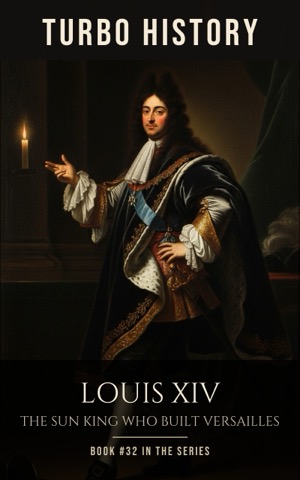
| Louis XIV: The Sun King Who Built Versailles Turbo History · ours | ~5,900 words Under an hour | The whole reign in one sitting. How a frightened child king built the model of absolute power, and what it cost |
| Versailles: A Biography of a Palace Tony Spawforth, 2008 | ~304 pages About 9 hours | The specialist angle. The building as a political instrument, plumbing and smells included |
| Memoires for the Instruction of the Dauphin Louis XIV, translated by Paul Sonnino, 1970 | ~281 pages About 8 hours | The primary source. Louis explaining kingship to his son, in his own voice |
| Louis XIV Richard Wilkinson, 2007 | ~280 pages About 8 hours | The student-shaped short life. Narrative plus the historians' arguments, laid out clearly |
| The Sun King Nancy Mitford, 1966 | ~255 pages About 7 hours | The classic readable one. Versailles as a social world, written by a novelist |
| The Fabrication of Louis XIV Peter Burke, 1992 | ~242 pages About 7 hours | The argument rather than the life. How the image of the Sun King was manufactured and by whom |
The picks, in detail
01
Louis XIV
Wolf went to the state archives rather than the memoirs and built the reign out of letters, decrees and dispatches, which was a genuine break from the tradition that ran on Saint-Simon's anecdotes. It is still the standard against which later biographies are measured on government and war. It is also nearly sixty years old, long, and dry in stretches, and Wolf takes Louis's own account of his motives more seriously than most historians now would.
02
King of the World: The Life of Louis XIV
Mansel is the leading historian of European courts and this is the most up to date full biography in English, drawing on French, British and American research. He is particularly good on Louis as a European and global operator, including the Ottoman and colonial dimensions most books skip. The trade is that the sheer density of names and courtiers can bury the argument, and readers who want a clear thesis rather than a full life will find it diffuse.
03
Louis XIV: The Sun King Who Built Versailles ours
Every book on this list goes deeper than ours, and most of them are hard work. That is not a criticism, it is the entire point of them. Wolf gives you 678 pages of archive-based political history. Mansel gives you 604 pages and a cast of hundreds. They are good books, and they want weeks of your life.
If you are studying this period, or sitting an exam on it, buy one of those instead. Mansel for the life, Wolf for the government and the wars, Burke if the image-making is what you actually care about. We are not pretending to compete with them.
If you are not, ours might suit you better. It starts with the miracle baby born after twenty-three years of a childless marriage, France on fire during the Fronde, and the night the Paris mob came into the palace to check the boy king was still in his bed. That humiliation shapes everything after it. Then the personal rule, the wars, Versailles as a machine for domesticating the nobility, and the long slow ending. It closes on what outlasted him: the centralised French state, French as the language of diplomacy, the template every European monarch copied, and the dark side, which gets its own section covering the optional wars, the famines of 1693-94 and 1709-10 and the Revocation of the Edict of Nantes. There is also a chapter on what the rest of the world was doing while Versailles was being built.
That is what the whole series is for. Love history, but hate how it was taught at school? Same. School turned it into a memory test: names, dates, family trees, exam. The actual story never stood a chance. Turbo History is one figure or one event per book, told in under an hour. The rise, the fall, and why it still matters. Dates included, memorising optional. Sources at the back if you want to go further, and every book on this page is a good place to go next.
04
Versailles: A Biography of a Palace
Spawforth treats Versailles as a working machine rather than a monument: who slept where, who was allowed to sit, what it cost, how filthy it actually was. That physical detail tells you more about how Louis controlled the nobility than any account of his policies. It runs well past Louis into the eighteenth century and the Revolution, so a good part of the book is about a court he never saw.
05
Memoires for the Instruction of the Dauphin
This is a primary source, and an unusually strange one: the king setting out how to rule, what he thought he was doing in the 1660s, and why obedience was owed to him. Sonnino's introduction and notes are essential, because he explains how the text was drafted and revised by secretaries under Louis's direction. Read it as evidence of how Louis wanted to be understood rather than as a record of what he did, and read Burke straight afterwards.
06
Louis XIV
Wilkinson writes for people who need to know not just what happened but what historians disagree about, and each stage of the reign comes with the debate attached. He is openly critical, weighing the cultural achievement against the wars, the Revocation of the Edict of Nantes and the human cost. The textbook structure shows, and if you want a book to enjoy rather than to learn from, Mitford or Spawforth will be more fun.
07
The Sun King
Mitford wrote this for pleasure and it shows: the mistresses, the etiquette, the poisonings, the marriage to Madame de Maintenon, all told with a novelist's ear for character. It is the easiest book here to finish and the best at making the court feel like a real place full of real people. It is also gossip-led, light on government, war and money, and it accepts a good deal of Saint-Simon at face value, so do not use it as your only source.
08
The Fabrication of Louis XIV
Burke takes the portraits, medals, tapestries, ballets, official histories and building programmes and treats them as a public relations operation with staff, budgets and a strategy that changed over the reign. It is the book that changes how you read every other book on this shelf, including the ones written centuries ago. It assumes you already know the outline of the reign, and it is a work of cultural history rather than a story, so read a biography first.
Questions people actually ask
What is the best book about Louis XIV?
Philip Mansel's King of the World (2019) is the fullest and most up to date biography in English, at around 604 pages, and it is the one to buy if you want a single complete life. John B. Wolf's Louis XIV (1968) is longer and older but still the standard on government, diplomacy and war, because Wolf built it from the state papers rather than from court memoirs. Which one suits you depends on whether you want the man and the court or the machinery of the reign.
Where should I start with Louis XIV?
If you want narrative pleasure, start with Nancy Mitford's The Sun King, which is short, funny and brilliant on the social world of Versailles, then correct it with something more serious. If you want to learn properly from the first book, start with Richard Wilkinson's Louis XIV, which is around 280 pages and lays out the historians' disagreements as it goes. Either way, read Peter Burke afterwards.
Which book explains the Louis XIV propaganda machine?
Peter Burke's The Fabrication of Louis XIV, at about 242 pages, is the book on exactly that. It treats the portraits, medals, ballets, official histories and Versailles itself as a coordinated effort to produce an image of the king, and it tracks how the strategy shifted as the reign went on and the wars went badly. It is the single most useful thing you can read for telling the man apart from the marketing.
Did Louis XIV really say the state is me?
Probably not. The line is usually traced to a supposed confrontation with the Parlement of Paris in 1655, but there is no reliable contemporary record of him saying it, and it appears in print long after the fact. It survives because it is a neat summary of what he actually built, which is a good illustration of the wider problem: with Louis, the memorable version and the documented version often are not the same thing. Burke and Wilkinson are both good on this.
Is there a good primary source on Louis XIV?
Yes, two kinds. Louis's own Memoires for the Instruction of the Dauphin, in Paul Sonnino's translation, is the king setting out his theory of rule for his son, and it tells you how he wanted to be seen. The duc de Saint-Simon's memoirs give you the court from the inside, at length and with a grudge, and Lucy Norton's abridged translation is the usual English way in. Neither is neutral, which is what makes them worth reading side by side.
This book is free sometimes. Want to know when?
Louis XIV goes free on Amazon from time to time, along with the rest of the series. Leave your email and we will tell you the moment it does.
More from the series
One figure or one event per book. Under an hour each.