If you want one scholarly life, read Duane Roller's Cleopatra: A Biography, which treats her as a working Hellenistic monarch rather than a romantic figure. If you want the version that reads like a novel, Stacy Schiff's Cleopatra: A Life is the popular choice, with the caveat that it fills the gaps with informed guesswork. Joyce Tyldesley's Cleopatra: Last Queen of Egypt puts her back inside Egypt instead of inside Rome's story about her. Lucy Hughes-Hallett's Cleopatra: Histories, Dreams and Distortions is the best book on this page if you want to understand why the record is so unreliable. And if you have under an hour rather than a fortnight, ours covers the whole life in one sitting.
Every book listed here is real, in print or easily found, and worth the time. Reading times are honest estimates from page count at roughly 250 words per minute. One thing to know before you start. Almost every surviving ancient source on Cleopatra is Roman, written after she lost, by men with a political reason to present her as a foreign seductress who unmanned good Roman soldiers. There is no account from her own court. That means a great deal of popular writing about her is invention wearing the clothes of biography, and the books below are picked partly on how honestly they admit what nobody actually knows.
The short version
Sorted by what you want, not by what is most famous.
| Book | Length | Best for |
|---|---|---|
| Cleopatra: A Biography Duane W. Roller, 2010 | ~272 pages About 8 hours | The definitive scholarly life. Cleopatra as a head of state, not a love story |
| Cleopatra: A Life Stacy Schiff, 2010 | ~368 pages About 10 hours | The one that reads like a novel. Vivid Alexandria, and a good opening argument about the sources |
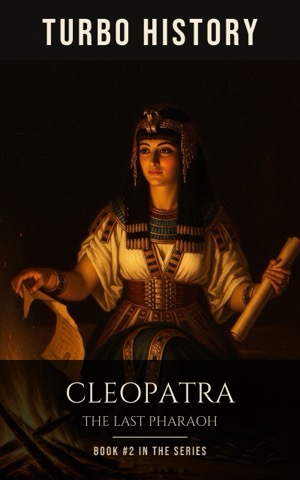
| Cleopatra Turbo History · ours | ~7,400 words Under an hour | The whole life in one sitting. How she kept Egypt independent for twenty-one years, and what it cost |
| Cleopatra: Last Queen of Egypt Joyce Tyldesley, 2008 | ~290 pages About 8 hours | The Egyptological angle. Cleopatra as pharaoh rather than as a character in Roman history |
| Cleopatra: Histories, Dreams and Distortions Lucy Hughes-Hallett, 1990 | ~338 pages About 9 hours | The best book on this page, and not a biography. How every era reinvented her to suit itself |
| Cleopatra: A Sourcebook Prudence J. Jones, 2006 | ~345 pages About 9 hours | The ancient evidence itself. Plutarch, Dio, Horace and the rest, with the propaganda visible |
| Cleopatra: Beyond the Myth Michel Chauveau, translated by David Lorton, 2002 | ~104 pages About 3 hours | The short one. An Egyptologist stripping the story back to what the documents say |
| Cleopatra Michael Grant, 1972 | ~301 pages About 8 hours | The classic. The standard English biography for a generation, still in print |
The picks, in detail
01
Cleopatra: A Biography
Roller is a classicist and he writes about Cleopatra the way he would write about any Hellenistic monarch: territory, revenue, alliances, dynastic politics. He is rigorous about what the evidence supports and he pushes the contested scholarly arguments into appendices, so you can see the fights over the hostile Roman testimony without them wrecking the narrative. The cost is that it is dry, it assumes tolerance for Ptolemaic dynastic detail, and it gives you almost none of the drama people come to Cleopatra for.
02
Cleopatra: A Life
Schiff writes beautifully and her framing, that Cleopatra is famous for all the wrong reasons because Rome wrote the record, is the best popular statement of the source problem there is. It is the book most people enjoy most. The weakness is method: she fills gaps with what Cleopatra would have seen, would have worn, must have felt, and the volume of that reconstruction is substantial. Read it for atmosphere and argument, not as an authority on any particular fact.
03
Cleopatra ours
Every book on this list goes deeper than ours, and most of them are hard work. That is not a criticism, it is the entire point of them. Schiff runs to about 368 pages. Roller is around 272 and packs the scholarly arguments into appendices. They are good books, and they want weeks of your life.
If you are researching Cleopatra properly, or studying the late Republic, or sitting an exam on any of it, buy one of those and give it the time it deserves. We are not pretending to compete with them.
If you are not, ours might suit you better. It starts around 69 BC in the palace at Alexandria, with a debtor king nicknamed the Flute Player, a dynasty three centuries into decline, and a mother who vanishes from the records while her daughter is still an infant. It covers the education at the Musaeum, the languages, and the fact that she learned Egyptian when no Ptolemy before her had bothered. Then the power struggle with her brother, the smuggled arrival in front of Caesar, the Ides of March, Tarsus and Antony, the twins, the Donations of Alexandria, Actium, and August 30 BC. There is a chapter on what else was happening in the world at the time, and a chapter on why it still matters, covering what she genuinely changed, why the seductress version won for two thousand years, and the dark side that most retellings skip: the brother who drowned fleeing Caesar, the sister executed, and the seventeen-year-old son killed because two Caesars were one too many.
That is what the whole series is for. Love history, but hate how it was taught at school? Same. School turned it into a memory test: names, dates, family trees, exam. The actual story never stood a chance. Turbo History is one figure or one event per book, told in under an hour. The rise, the fall, and why it still matters. Dates included, memorising optional. Sources at the back if you want to go further, and every book on this page is a good place to go next.
04
Cleopatra: Last Queen of Egypt
Tyldesley is an Egyptologist, and this is the best readable book that reads Cleopatra from the Egyptian side: temple building, pharaonic ideology, and the fact that she was the only Ptolemy in three centuries who bothered to learn Egyptian. Her whole method is to weigh Egyptian material against the Roman literary line, which is exactly what this subject needs. The cost is that the Roman political and military narrative is comparatively thin, and some of the Egyptological framing is inference rather than proof.
05
Cleopatra: Histories, Dreams and Distortions
Hughes-Hallett traces the Cleopatra myth from Augustan propaganda through Chaucer and Shakespeare to Shaw and Hollywood, and shows that the distortion starts immediately and never stops. It is the sharpest thinking on this shelf and it changes how you read everything else, including the biographies above it. The cost is real: you finish it knowing a great deal about Europe and comparatively little about the queen, and it is dense literary-critical reading rather than narrative.
06
Cleopatra: A Sourcebook
Jones collects the surviving ancient testimony in translation with short introductions, which lets you see for yourself how thin, how late and how partisan the record is. If you have ever wondered how much is actually known about Cleopatra, this is the fastest way to find out, and you can catch the Roman poets in the act. It is a reference volume rather than a book with an argument, so read cover to cover it is repetitive and the linking commentary is brief.
07
Cleopatra: Beyond the Myth
There is no Very Short Introduction on Cleopatra, and this is the closest thing to one. Chauveau works from Egyptian documentary evidence rather than the Roman literary tradition, and appends translated ancient passages so you can see the raw material yourself. At roughly 104 pages the portrait is necessarily skeletal, several episodes get a sentence each, and the English translation is serviceable rather than elegant.
08
Cleopatra
Grant was the great populariser of the ancient world and for decades this was the serious one-volume Cleopatra in English, which is why later books keep arguing with it. It is fluent and it takes her political situation seriously. The cost is age: it predates much of the papyrological and numismatic work the newer books rest on, several judgements have been superseded, and Grant indulges in exactly the psychological guesswork he warns other writers against.
Questions people actually ask
What is the best book about Cleopatra?
Duane Roller's Cleopatra: A Biography (2010) is the best scholarly single volume, treating her as a Hellenistic ruler and being careful about what the sources will bear. If you want something more readable, Stacy Schiff's Cleopatra: A Life is the popular favourite, though it reconstructs a great deal that no ancient source records. Joyce Tyldesley's Cleopatra: Last Queen of Egypt sits between the two.
Why are the ancient sources on Cleopatra unreliable?
Because they are almost all Roman, written after Octavian won, by authors with a stake in the version where a foreign queen corrupted a Roman general. Plutarch, who is the fullest account, was writing well over a century after her death. Nothing survives from her own court. Prudence Jones's Cleopatra: A Sourcebook lets you read the surviving testimony yourself and see how thin it is.
Where should I start with Cleopatra?
Start with Joyce Tyldesley's Cleopatra: Last Queen of Egypt, which is about 290 pages, readable, and grounded in the Egyptian evidence rather than the Roman story. Move to Roller if you want the strictest scholarly account, or to Lucy Hughes-Hallett if you want to understand why almost everything you already thought about Cleopatra came from propaganda and paintings.
Is there a Very Short Introduction to Cleopatra?
No. Oxford's Very Short Introductions series does not have a Cleopatra volume, and any list claiming otherwise is inventing it. The nearest equivalent is Michel Chauveau's Cleopatra: Beyond the Myth, at roughly 104 pages, written by an Egyptologist and including translated ancient passages. Our own hour-long version is shorter still if you want the whole life tonight.
What is the best book on the Cleopatra myth rather than the woman?
Lucy Hughes-Hallett's Cleopatra: Histories, Dreams and Distortions (1990). It follows the myth from Augustan propaganda through medieval and Renaissance literature to nineteenth-century painting and Hollywood, and shows how each era rebuilt her to suit its own anxieties. It is the best book on this page, but it is about reception rather than about her life, so read a biography first.
This book is free sometimes. Want to know when?
Cleopatra goes free on Amazon from time to time, along with the rest of the series. Leave your email and we will tell you the moment it does.
More from the series
One figure or one event per book. Under an hour each.