If you want one full biography, read Adrian Goldsworthy's Caesar: Life of a Colossus, which is the best modern life and the one most people should start with. If you want Caesar in his own words, read The Conquest of Gaul, his account of the war he was fighting at the time. If you want the world around him rather than the man, Tom Holland's Rubicon covers the collapse of the Republic and is the most enjoyable book on this page. If you want only the assassination, Barry Strauss's The Death of Caesar does it in about 352 pages. And if you have under an hour rather than a fortnight, ours covers the whole life in one sitting.
Every book listed here is real, in print or easily found in a library, and worth the time. Reading times are honest estimates from page count at roughly 250 words per minute, so treat them as rough. One caveat specific to Caesar: the ancient evidence is thin and partisan. Our main sources are Caesar's own war reports, which are propaganda he wrote about himself, and later writers like Plutarch and Suetonius working a century or more after the fact. Modern biographers are filling gaps, and the good ones say so. Be suspicious of any book that tells you confidently what Caesar was thinking.
The short version
Sorted by what you want, not by what is most famous.
| Book | Length | Best for |
|---|---|---|
| Caesar: Life of a Colossus Adrian Goldsworthy, 2006 | ~583 pages About 17 hours | The best one-volume life. A military historian who explains Roman politics without slowing down |
| The Conquest of Gaul Julius Caesar, First century BC | ~272 pages About 8 hours | The primary source, and the best-written war report ever filed. Caesar explaining Caesar, in the third person |
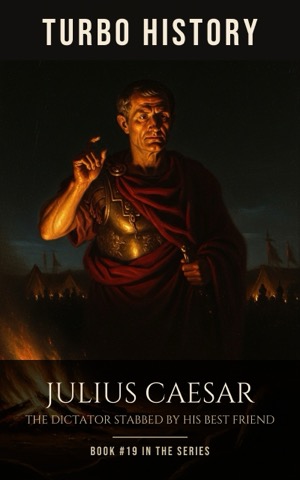
| Julius Caesar: The Dictator Stabbed by His Best Friend Turbo History · ours | ~7,100 words Under an hour | The whole life in one sitting. How a broke patrician took Rome, and what broke when he did |
| Rubicon: The Last Years of the Roman Republic Tom Holland, 2003 | ~408 pages About 12 hours | The world he broke, not the man. The best-written book on this page by a distance |
| Caesar: A Biography Christian Meier, 1995 | ~528 pages About 15 hours | The interpretation rather than the events. A German scholar's argument about why the Republic could not absorb him |
| Caesar: Politician and Statesman Matthias Gelzer, 1968 | ~359 pages About 10 hours | The scholarly classic. The book the later biographies are all arguing with |
| The Death of Caesar: The Story of History's Most Famous Assassination Barry Strauss, 2015 | ~352 pages About 10 hours | One event, examined closely. The conspiracy, the killers and the aftermath |
| Julius Caesar Philip Freeman, 2008 | ~416 pages About 12 hours | The straightforward narrative life. Classicist writing for people who are not classicists |
The picks, in detail
01
Caesar: Life of a Colossus
Goldsworthy is a specialist in the Roman army and it shows in the Gallic and civil war chapters, which are the clearest account of how Caesar actually won available in English. He is also careful to say where the evidence runs out rather than filling the gap with drama. It is long, and the early chapters on late Republican politics demand real attention before the story starts moving.
02
The Conquest of Gaul
This is a primary source and it is short, plain and unnervingly readable, which is exactly why it worked as propaganda when he sent it back to Rome in instalments. Read it for the voice and for the machinery of a Roman army on campaign. Read it with a raised eyebrow too, because he is justifying a war of conquest that killed enormous numbers of people, and he never once says so.
03
Julius Caesar: The Dictator Stabbed by His Best Friend ours
Every book on this list goes deeper than ours, and most of them are hard work. That is not a criticism, it is the entire point of them. Goldsworthy gives you 583 pages of campaign detail and Roman political mechanics. Meier spends 528 pages arguing a single thesis about why the Republic could not contain him. They are good books, and they want weeks of your life.
If you are studying Rome, or writing about it, or sitting an exam on it, buy one of those and give it the time it deserves. We are not pretending to compete with them.
If you are not, ours might suit you better. It starts with a young man from an old patrician family with no money and no influence, on the wrong side of Sulla's purges and lucky to survive them, and includes the business with the pirates. Then the rise, the expansion, the years of domination and the fall, in four clear stages, up to the Ides of March in 44 BC. Then what it all did to the world. The Republic had lasted nearly five centuries and Caesar proved one man with enough loyal soldiers could override it, which is the model Octavian finished and every emperor after him used. The calendar you are reading this on is his, leap year included, and July is named after him. His family name turned into a job title and stayed one until 1946, by way of Kaiser and Tsar. And the dark ledger is in there too: a million dead in Gaul if the ancient sources are believed, numbers modern historians reject, whole tribes enslaved, Vercingetorix kept alive for six years so he could be paraded and then killed, and clemency used as public relations.
That is what the whole series is for. Love history, but hate how it was taught at school? Same. School turned it into a memory test: names, dates, family trees, exam. The actual story never stood a chance. Turbo History is one figure or one event per book, told in under an hour. The rise, the fall, and why it still matters. Dates included, memorising optional. Sources at the back if you want to go further, and every book on this page is a good place to go next.
04
Rubicon: The Last Years of the Roman Republic
Holland tells the story of the Republic's last century as narrative, with Caesar as one figure among Sulla, Pompey, Cicero and Cato, and it is the book most likely to make you care about any of them. If you read it before a biography you will understand why the Rubicon mattered. It is popular history and moves fast over disputed ground, so it is a way in rather than an authority.
05
Caesar: A Biography
Meier's case is that Caesar was an outsider to his own political system, unable to imagine the Republic as anything worth preserving, and the book builds towards that rather than simply recounting a life. It is the most intellectually serious book here. It is a translation, the sentences are heavy going, and it presumes you already know the chronology it is analysing.
06
Caesar: Politician and Statesman
Gelzer's study, first published in German and translated for Harvard, established the modern approach of reading Caesar through the networks and obligations of Roman political life rather than through personality. It is still cited constantly. It is also dense, heavily annotated, written for classicists, and now more than half a century old, so treat it as the foundation rather than the latest word.
07
The Death of Caesar: The Story of History's Most Famous Assassination
Strauss reconstructs the plot and the day itself from the ancient accounts and is good on the conspirators as politicians with their own motives rather than stage villains. He also follows what happened next, which is where the Republic really died. It covers a narrow slice of the life, so you need a biography alongside it, and some of the reconstruction is necessarily informed guesswork.
08
Julius Caesar
Freeman tells the story cleanly from childhood to the Ides of March without the political theory, and it is the easiest full biography here to read in bed. It is a good first book if Goldsworthy looks daunting. The trade is depth: it takes the ancient sources more at face value than Goldsworthy or Meier do, and it will not tell you much about how historians disagree.
Questions people actually ask
What is the best book about Julius Caesar?
Adrian Goldsworthy's Caesar: Life of a Colossus (2006) is the best single-volume biography for most readers. Goldsworthy is a historian of the Roman army, so the military chapters are unusually clear, and he is honest about the limits of the evidence. It runs to about 583 pages. If that is too much, Philip Freeman's Julius Caesar tells the same story more simply.
Should I read Caesar's own writing?
Yes, and it is easier than people expect. The Conquest of Gaul, usually read in the Penguin Classics translation, is about 272 pages of plain, fast prose written by Caesar about his own campaigns. Treat it as a primary source and as propaganda at the same time. He is explaining and justifying a war of conquest to the people back in Rome who would decide his future.
Where should I start with the fall of the Roman Republic?
Start with Tom Holland's Rubicon. It covers the last century of the Republic as a story, with Sulla, Pompey, Cicero, Cato and Caesar all in it, and it explains why crossing a small river in 49 BC was such a serious act. It is popular history and it moves quickly over arguments specialists are still having, so follow it with Goldsworthy or Christian Meier.
What is the best book about the assassination of Caesar?
Barry Strauss's The Death of Caesar (2015) is the one to read. It reconstructs the conspiracy, the killing and the civil wars that followed, and it treats Brutus, Cassius and Decimus as politicians making calculations rather than as characters from Shakespeare. It is about 352 pages and works best after you have read a full biography.
What is the best short book about Julius Caesar?
There is no great short modern biography of Caesar in the way there is for some figures, which is partly why we wrote ours. The nearest thing is Caesar's own Conquest of Gaul at about 272 pages, though it covers only the Gallic campaigns. Our own hour-long version covers the whole life, the assassination and what survived him, including the calendar and the title.
This book is free sometimes. Want to know when?
Julius Caesar goes free on Amazon from time to time, along with the rest of the series. Leave your email and we will tell you the moment it does.
More from the series
One figure or one event per book. Under an hour each.