If you want one readable narrative of the whole war, read John Keegan's The First World War. If you want the war beyond the Western Front, read Hew Strachan's single-volume The First World War. If you want to argue about how it started, read Christopher Clark's The Sleepwalkers against Fritz Fischer's Germany's Aims in the First World War, because they do not agree and neither one has won. Barbara Tuchman's The Guns of August is still the best-written account of the first month. And if you have under an hour rather than a month, ours covers the whole war in one sitting.
Every book listed here is real, in print or easily found, and worth the time. Reading times are honest estimates from page count at roughly 250 words per minute. The causes of this war are genuinely contested and always have been. Fritz Fischer put the blame squarely on Germany, Christopher Clark spreads it across every capital in Europe, and Margaret MacMillan lands somewhere between them. We say which book argues what rather than pretending there is a settled answer.
The short version
Sorted by what you want, not by what is most famous.
| Book | Length | Best for |
|---|---|---|
| The First World War John Keegan, 1998 | ~475 pages About 14 hours | The best readable one-volume narrative. Strong on what the fighting was actually like |
| The First World War Hew Strachan, 2003 | ~368 pages About 10 hours | The global war in one volume. Africa, the Balkans and the Ottoman fronts taken seriously |
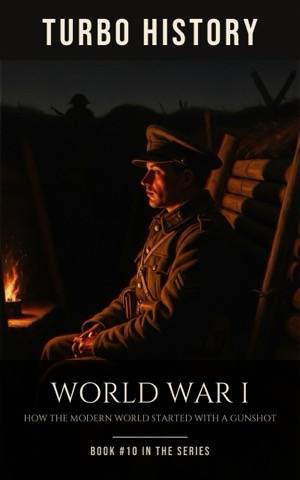
| World War I: How the Modern World Started With a Gunshot Turbo History · ours | ~6,200 words Under an hour | The whole war in one sitting. How it started, how it was fought, and what it left behind |
| The Sleepwalkers: How Europe Went to War in 1914 Christopher Clark, 2012 | ~697 pages About 20 hours | The causes argued the modern way. How Europe walked in with no single guilty party |
| Germany's Aims in the First World War Fritz Fischer, 1967 | ~652 pages About 19 hours | The opposite case, made first. Germany as the deliberate aggressor |
| The War That Ended Peace: The Road to 1914 Margaret MacMillan, 2013 | ~739 pages About 21 hours | The road to 1914 told through people. Kaisers, ministers and generals making choices |
| The Guns of August Barbara W. Tuchman, 1962 | ~511 pages About 15 hours | The classic. The first month of the war, written better than anyone has managed since |
| Good-Bye to All That Robert Graves, 1929 | ~280 pages About 8 hours | The war from inside it. A young officer's memoir with the disillusion still raw |
| The First World War: A Very Short Introduction Michael Howard, 2002 | ~134 pages About 4 hours | The shortest credible overview. A major historian compressing the entire war |
The picks, in detail
01
The First World War
Keegan was a military historian who could write, and this is the standard general narrative: the battles explained clearly, the terrain and the technology given their due, the soldier's experience never lost under the staff maps. It is the book to hand someone who knows nothing yet. He is thinner on diplomacy and on the war outside Europe, so treat it as a military history rather than a full account of the conflict.
02
The First World War
Strachan was writing a projected three-volume academic history and distilled the argument into this, which is why it covers so much ground so quickly. If Keegan left you thinking the war was mostly France and Belgium, this corrects that. The compression is the price: it moves fast and expects you to hold a lot of names and places at once.
03
World War I: How the Modern World Started With a Gunshot ours
Every book on this list goes deeper than ours, and most of them are hard work. That is not a criticism, it is the entire point of them. Clark gives you 697 pages and you still finish it arguing about who started it. MacMillan gives you 739 and stops in August 1914. They are good books, and they want weeks of your life.
If you are studying this, or sitting an exam on it, buy one of those and give it the time it deserves. We are not pretending to compete with them.
If you are not, ours might suit you better. It starts with the machinery already in place before anyone fired a shot: Bismarck's alliance system, the Kaiser who let the Reinsurance Treaty lapse, the naval race that HMS Dreadnought reset to zero in 1906, and the Balkans. Then Sarajevo, and the five weeks it took to turn an assassination almost nobody cared about into a continental war. Then the Schlieffen Plan coming apart, the trenches setting, Verdun and the Somme, 1917 when everything shifted, Germany's last roll of the dice and the Hundred Days that finished it. There is a chapter on what the rest of the world was doing while Europe bled, from Japan helping itself to German possessions to the fighting in Africa and the collapse of the Ottoman Empire. It ends on what the war actually changed: four empires gone, the borders drawn in Paris and across the Middle East, the League of Nations that had no teeth, and the myths, lions led by donkeys and the stab in the back, with what the evidence says about each.
That is what the whole series is for. Love history, but hate how it was taught at school? Same. School turned it into a memory test: names, dates, family trees, exam. The actual story never stood a chance. Turbo History is one figure or one event per book, told in under an hour. The rise, the fall, and why it still matters. Dates included, memorising optional. Sources at the back if you want to go further, and every book on this page is a good place to go next.
04
The Sleepwalkers: How Europe Went to War in 1914
Clark reconstructs the decision-making in every capital and concludes that no one government set out to cause the war, which is a direct challenge to the older German-guilt case. The research is enormous and the material on Serbia alone changes how the July crisis reads. It is long, thick with diplomats, and you are a couple of hundred pages in before you reach 1914 at all.
05
Germany's Aims in the First World War
Fischer went into the German archives and argued that Berlin wanted its war and held expansionist aims running from 1914 through to 1939, which set off a decade of furious argument among German historians when it appeared in German in 1961. Read it because most of what has been written on the causes since is a reply to it, Clark included. It is a translated academic monograph from the 1960s and it reads like one, so it is heavy going and better sampled than swallowed whole.
06
The War That Ended Peace: The Road to 1914
MacMillan cares about who made which decision and why, so the pre-war decades arrive as a cast of characters rather than a list of treaties. It is the most enjoyable of the origins books and it insists throughout that the war was a choice, not a machine running itself. It is also over 700 pages and it stops at the outbreak, so it is not a history of the war.
07
The Guns of August
Tuchman won a Pulitzer for this and the prose still carries you through mobilisation, the invasion of Belgium and the Marne. It is the book that made a generation of readers care about 1914. It is now over sixty years old and parts of its explanation, especially the idea of railway timetables locking everyone in, have been picked apart since, so enjoy the narrative and get your causation elsewhere.
08
Good-Bye to All That
Graves went to France at nineteen, was reported dead after the Somme, and wrote this a decade later to be finished with the whole subject. The trench detail is sharp and the tone is dry rather than mournful, which is why it has outlasted most of its shelf. He revised it heavily in 1957 and his accuracy has been argued over ever since, so read it as a memoir and not as evidence.
09
The First World War: A Very Short Introduction
Howard was one of the leading military historians of his generation and this is him laying the war out at minimum length, from causes to consequences. If you want one evening and a reliable frame to hang later reading on, this is it. It is genuinely compressed, so nothing gets room to breathe and no battle gets more than a few paragraphs.
Questions people actually ask
What is the best book about World War 1?
John Keegan's The First World War (1998) is the best single narrative of the whole conflict, at roughly 475 pages and strong on how the fighting actually worked. If you want the war outside France and Belgium given equal weight, Hew Strachan's one-volume The First World War is shorter and more global. Neither one settles the argument about the causes, which is a separate reading list.
Where should I start with World War 1?
Start with Michael Howard's Very Short Introduction, about 134 pages, to get the shape of the war in one evening. Then go to Keegan for the full narrative, or straight to Christopher Clark if the causes are what interest you. Starting with a 700 page origins book is how people give up on this subject.
What is the best book on the causes of World War 1?
There is no consensus answer, because the serious books argue different cases. Fritz Fischer's Germany's Aims in the First World War puts deliberate intent on Berlin and started the whole modern debate. Christopher Clark's The Sleepwalkers spreads responsibility across every capital and refuses to name a culprit. Margaret MacMillan's The War That Ended Peace sits between them and focuses on the people making the decisions. Read Clark and Fischer together and treat any book claiming the question is closed with suspicion.
What is the best short book about World War 1?
Michael Howard's The First World War: A Very Short Introduction, at about 134 pages, is the shortest credible overview by a serious historian. Hew Strachan's single-volume The First World War, at about 368 pages, is the next step up and covers far more ground than its length suggests. Our own hour-long version covers the whole war if you want the shape of it tonight.
Is there a good first-hand account of World War 1?
Robert Graves's Good-Bye to All That (1929) is the best known British trench memoir, written by a young officer of the Royal Welch Fusiliers who was reported dead after the Somme. It is vivid, dry and about 280 pages. Bear in mind that Graves revised it substantially in 1957 and that his factual accuracy has been questioned for decades, so read it as literature rather than as documentary record.
This book is free sometimes. Want to know when?
World War I goes free on Amazon from time to time, along with the rest of the series. Leave your email and we will tell you the moment it does.
More from the series
One figure or one event per book. Under an hour each.