If you want one book that covers the whole war, read Antony Beevor's The Second World War. If you want the war as people lived it, read Max Hastings' Inferno. If you have under an hour rather than a month, our own Turbo History covers the whole thing in one sitting. Everything below is sorted by what you are actually trying to get out of it.
Every book listed here is real, in print, and genuinely worth the time. Reading times are honest estimates based on page count at roughly 250 words per minute.
The short version
Sorted by what you want, not by what is most famous.
| Book | Length | Best for |
|---|---|---|
| The Second World War Antony Beevor, 2012 | ~880 pages About 25 hours | The complete war at full depth. Every theatre, every year, one authoritative narrative |
| Inferno: The World at War, 1939-1945 Max Hastings, 2011 | ~750 pages About 21 hours | The war as ordinary people lived it. Soldiers, civilians and the moral mess in between |
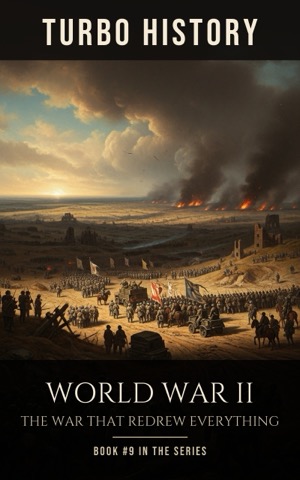
| World War II: The War That Redrew Everything Turbo History · ours | ~7,200 words Under an hour | The whole war in one sitting. How it started, the four battles that decided it, and the parts of the map it still draws today |
| The Rise and Fall of the Third Reich William L. Shirer, 1960 | ~1,250 pages About 35 hours | How Germany got there. The politics, the personalities and the drift into catastrophe, watched first hand |
| Stalingrad Antony Beevor, 1998 | ~500 pages About 14 hours | One campaign in forensic detail. The battle that broke the German army and turned the Eastern Front |
| With the Old Breed E. B. Sledge, 1981 | ~350 pages About 9 hours | The Pacific from inside a rifle company. What the fighting actually did to the men doing it |
| Hiroshima John Hersey, 1946 | ~150 pages About 3 hours | One morning, six lives. The shortest book here and the one you will not shake off |
| The Diary of a Young Girl Anne Frank, 1947 | ~300 pages About 7 hours | The human cost in a single voice. Two years in hiding, written as it happened, not in hindsight |
| The Storm of War Andrew Roberts, 2009 | ~700 pages About 20 hours | Why Germany lost, argued rather than narrated. Nazi ideology as a strategic weakness |
The picks, in detail
01
The Second World War
Beevor writes narrative history better than almost anyone alive. This is the book to read if you want one authoritative account that covers every theatre without turning into a textbook. It is long, but it never feels like homework.
02
Inferno: The World at War, 1939-1945
Hastings keeps cutting from generals to civilians and back. If Beevor tells you what happened, Hastings tells you what it felt like, and he is unsentimental about which side did what.
03
World War II: The War That Redrew Everything ours
Every book on this list goes deeper than ours, and most of them are hard work. That is not a criticism, it is the entire point of them. Beevor gives you 880 pages. Shirer gives you 1,250. They are superb books, and they want weeks of your life and a memory for detail.
If you are studying this, that is exactly the right trade. If there is an exam at the end, or you need to know which army was where in the spring of 1943, buy one of those and give it the time it deserves. We are not pretending to compete with them.
If you are not sitting a test, ours might suit you better. It runs from the wreckage of 1919 to the outbreak in 1939, through the four turning points that actually decided the thing (Midway, Stalingrad, El Alamein, Kursk), to the end in Europe and the Pacific and what it cost. Then a chapter on what the war left behind and why you still live in it: the Security Council veto, the line across Korea, nuclear deterrence, the end of the European empires. And a chapter putting the good-war myth against the record, including the parts the myth leaves out.
That is what the whole series is for. Love history, but hate how it was taught at school? Same. School turned it into a memory test: names, dates, family trees, exam. The actual story never stood a chance. Turbo History is one figure or one event per book, told in under an hour. The rise, the fall, and why it still matters. Dates included, memorising optional. Sources at the back if you want to go further, and every book on this page is a good place to go next.
04
The Rise and Fall of the Third Reich
Shirer was an American journalist in Berlin through the 1930s, so he watched a lot of this happen. Some of the scholarship has dated, but nothing else has that eyewitness authority.
05
Stalingrad
The book that made Beevor's name. If you only read about one campaign on the Eastern Front, where the war was really decided, read this one.
06
With the Old Breed
Sledge was a US Marine at Peleliu and Okinawa and wrote it down plainly afterwards. It is the least glamorous war book you will ever read, which is exactly why it is the truest.
07
Hiroshima
Hersey followed six survivors through the morning of 6 August 1945 and simply reported what happened to them. Published a year after the event. Still the standard by which this kind of writing is judged.
08
The Diary of a Young Girl
You probably met this at school and may have forgotten it is genuinely extraordinary writing by a genuinely extraordinary teenager. Read as an adult, it lands completely differently.
09
The Storm of War
Roberts has a thesis: Nazi ideology repeatedly overruled military sense, and that is what cost Hitler the war. Read it after Beevor, when you want an argument rather than an account.
Questions people actually ask
What is the single best book about World War 2?
For one book covering the entire war, Antony Beevor's The Second World War (2012). It is comprehensive, well sourced and genuinely readable. If 880 pages is not realistic right now, start with something shorter and come back to it.
Where should I start if I know nothing about WW2?
Do not start with a 900 page doorstop, because most people do not finish them. Start with a short overview to get the shape of the war, then pick the theatre or the person that grabbed you and go deep. Our own under-an-hour overview was built for exactly this, and the books above are where to go next.
What is the best short book about World War 2?
John Hersey's Hiroshima is about 150 pages and unforgettable, though it covers one event rather than the war. For a short overview of the whole conflict you are looking at either a Very Short Introduction or our own Turbo History, both of which take under an hour.
Should I read fiction or non-fiction about WW2?
Non-fiction first, if you want to actually understand it. The war does not need dramatising and the real accounts are stranger than the invented ones. Read the history, then the novels will land far harder.
Which WW2 book is best for the Eastern Front?
Antony Beevor's Stalingrad. The Eastern Front is where the majority of German casualties happened and where the war was effectively decided, and most Western readers underestimate it badly.
This book is free sometimes. Want to know when?
World War II goes free on Amazon from time to time, along with the rest of the series. Leave your email and we will tell you the moment it does.
More from the series
One figure or one event per book. Under an hour each.