The standard account is Edmund Morris's three-volume life: The Rise of Theodore Roosevelt, Theodore Rex and Colonel Roosevelt. They are three separate books, not one book in three printings, and together they run to roughly 2,500 pages. If you want the whole life in one volume, H. W. Brands's T.R.: The Last Romantic does it. If you want the best-written book here rather than the most complete, read David McCullough's Mornings on Horseback, which covers only the first twenty-eight years. And if you have under an hour rather than a season, ours covers the whole life in one sitting.
Every book listed here is real, in print or easily found, and worth the time. Reading times are honest estimates from page count at roughly 250 words per minute, and page counts vary a little between editions. Edmund Morris wrote three separate volumes covering three different stretches of Roosevelt's life, and we list them separately rather than pretending they are one book, because buying the wrong one is the most common mistake people make with this subject.
The short version
Sorted by what you want, not by what is most famous.
| Book | Length | Best for |
|---|---|---|
| The Rise of Theodore Roosevelt Edmund Morris, 1979 | ~920 pages About 18 hours | Volume one of the standard modern life. Birth to the presidency, including the Dakotas and the Rough Riders |
| Theodore Rex Edmund Morris, 2001 | ~770 pages About 15 hours | Volume two, the presidency in full. Trust-busting, Panama and the arrival of American power abroad |
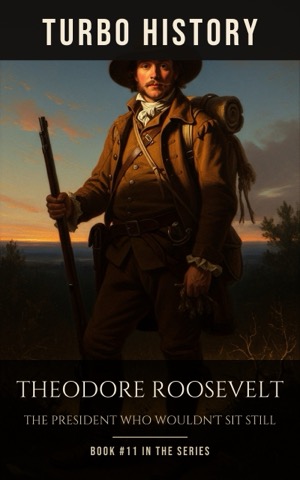
| Theodore Roosevelt: The President Who Wouldn't Sit Still Turbo History · ours | ~6,300 words Under an hour | The whole life in one sitting. The asthmatic kid, the youngest president, and the wreckage he left behind |
| Colonel Roosevelt Edmund Morris, 2010 | ~770 pages About 15 hours | Volume three, the long aftermath of power. The African safari, the Bull Moose campaign and the death of Quentin |
| T.R.: The Last Romantic H. W. Brands, 1997 | ~900 pages About 18 hours | The whole life in one volume. Built on Roosevelt's own letters, for readers who would rather not buy three books |
| Mornings on Horseback: The Story of an Extraordinary Family, a Vanished Way of Life, and the Unique Child Who Became Theodore Roosevelt David McCullough, 1981 | ~370 pages About 8 hours | The making of the man, in the best-written book on this page. Childhood, asthma, money and grief |
| The Bully Pulpit: Theodore Roosevelt, William Howard Taft, and the Golden Age of Journalism Doris Kearns Goodwin, 2013 | ~910 pages About 18 hours | The politics of the Progressive era, told through a friendship. How Roosevelt and Taft turned on each other |
| The River of Doubt: Theodore Roosevelt's Darkest Journey Candice Millard, 2005 | ~430 pages About 9 hours | One extraordinary episode told properly. The 1914 Amazon expedition that nearly killed him, as pure adventure |
| Theodore Roosevelt: The American Presidents Series Louis Auchincloss, 2001 | ~150 pages About 3 hours | The whole career in one afternoon. A short, opinionated life by a novelist, for readers deciding what to commit to |
The picks, in detail
01
The Rise of Theodore Roosevelt
This is the book that won both the Pulitzer and the National Book Award, and it is the best written of Morris's three volumes. The Dakota ranching chapters and the Cuba campaign are as good as narrative history gets. It is very long and Morris lingers on detail, so budget weeks rather than evenings, and note that it stops dead in 1901.
02
Theodore Rex
Published twenty-two years after volume one, this covers 1901 to 1909 only and is the most substantial account of what Roosevelt actually did in office. If you care about the policy rather than the adventure, this is the one. It is also the driest of the three, because governing generates more paperwork than cattle ranching, and it assumes you have already read The Rise.
03
Theodore Roosevelt: The President Who Wouldn't Sit Still ours
Every book on this list goes deeper than ours, and most of them are hard work. That is not a criticism, it is the entire point of them. Edmund Morris took three volumes and roughly 2,500 pages to tell this life, which is about forty-eight hours of reading. Doris Kearns Goodwin needs about 910 pages just to cover Roosevelt alongside Taft. They are good books, and they want a season of your life.
If you are studying Roosevelt properly, or sitting an exam on the Progressive era, buy one of those and give it the time it deserves. Start with Morris or Brands. We are not pretending to compete with them.
If you are not, ours might suit you better. It starts with an asthmatic boy who kept a dead seal's head from a Broadway market in his bedroom, a father who told him to make his body, and the worst year of his life at Harvard when that father died at forty-six. Then the Assembly seat at twenty-three, the rise through the machine, Kettle Hill, the governorship, and the youngest president in American history. Then the trust-busting, the 230 million acres put under federal protection, the Panama Canal, the Nobel Peace Prize, the split with Taft, the Bull Moose campaign, the bullet he took in Milwaukee and spoke through for ninety minutes, the Amazon river that broke his health, and Quentin shot down over France in 1918. There is a section on the dark side, because Brownsville, the exclusion of Black delegates in 1912, the Philippines and his talk of race suicide are all part of the record, and leaving them out would make the story a lie.
That is what the whole series is for. Love history, but hate how it was taught at school? Same. School turned it into a memory test: names, dates, family trees, exam. The actual story never stood a chance. Turbo History is one figure or one event per book, told in under an hour. The rise, the fall, and why it still matters. Dates included, memorising optional. Sources at the back if you want to go further, and every book on this page is a good place to go next.
04
Colonel Roosevelt
The final volume covers 1909 to 1919 and it is the saddest and most human of the three: the split with Taft, the third-party run, the Amazon expedition that wrecked his health, and the son shot down over France. Read on its own it would be confusing, since Morris assumes everything the first two volumes established. Treat it as the end of a long journey rather than a starting point.
05
T.R.: The Last Romantic
Brands covers cradle to grave in a single book, leaning heavily on the correspondence, which makes it unusually direct about what Roosevelt thought at the time rather than what he said later. It is the sensible choice if you want completeness without committing to Morris. It is still nearly nine hundred pages, and Brands is a plainer stylist, so it is thorough rather than thrilling.
06
Mornings on Horseback: The Story of an Extraordinary Family, a Vanished Way of Life, and the Unique Child Who Became Theodore Roosevelt
McCullough covers only the first twenty-eight years, and the narrowness is exactly what makes it good: the asthma attacks, the father, the family fortune, and the loss that shaped everything after. It won the National Book Award and it is the easiest full-length book here to finish. It stops before almost everything Roosevelt is famous for, so you will need something else afterwards.
07
The Bully Pulpit: Theodore Roosevelt, William Howard Taft, and the Golden Age of Journalism
Goodwin runs Roosevelt and Taft in parallel and adds the muckraking journalists of McClure's, which explains how reform actually got done rather than just who signed what. The collapse of the friendship is the strongest thread in the book. It is enormous, and the journalism sections slow the story badly in the middle third.
08
The River of Doubt: Theodore Roosevelt's Darkest Journey
Millard tells the story of the Brazilian river journey that left Roosevelt with malaria, a leg infection and fifty pounds lost, and it is gripping from the first page. It is the best book here for a reader who normally avoids presidential biography. It covers about a year of his life and almost nothing else, so it is a companion piece rather than a biography.
09
Theodore Roosevelt: The American Presidents Series
Part of the American Presidents series, this does exactly what it sets out to do: gives you the shape of the life and the presidency in an afternoon. It is the fastest orientation on this page other than ours. It is thin on evidence and Auchincloss states his judgements without much argument, so do not make it your only source.
Questions people actually ask
What is the best book about Theodore Roosevelt?
Edmund Morris's trilogy is the standard: The Rise of Theodore Roosevelt (1979), Theodore Rex (2001) and Colonel Roosevelt (2010). They are three separate books covering different periods, not one book in three printings, and reading only the first gets you nothing after 1901. If three volumes and roughly forty-eight hours of reading is too much, H. W. Brands's T.R.: The Last Romantic gives you the whole life in one.
Where should I start with Theodore Roosevelt?
Start with David McCullough's Mornings on Horseback if you want a great book that is not a marathon, or Louis Auchincloss's short American Presidents volume if you want the outline first. Then move to Morris's The Rise of Theodore Roosevelt. Starting with Theodore Rex is a common mistake, because it begins the moment McKinley dies and assumes you already know the man.
What is the best short book about Theodore Roosevelt?
Louis Auchincloss's Theodore Roosevelt in the American Presidents series, at around 150 pages, is the best genuinely short option and takes about three hours. Mornings on Horseback is longer at roughly 370 pages but is a much better book, if only on the first half of his life. Our own hour-long version covers the whole life if you want the shape of it tonight.
Do I have to read all three Edmund Morris volumes?
No, and many people do not. The Rise stands alone reasonably well as the story of how he was made, and Colonel Roosevelt is the most emotionally powerful but makes little sense without the others. If you only want the presidency, read Theodore Rex, but read a short life such as Auchincloss first so you know who arrives in the White House.
Which book covers Roosevelt's Amazon expedition?
Candice Millard's The River of Doubt is the book, and it is the best single-episode Roosevelt narrative in print. Morris covers the same journey in Colonel Roosevelt but in far less depth, since he has ten other years to get through. If you are reading only one Roosevelt book for pleasure rather than study, this is a strong candidate.
This book is free sometimes. Want to know when?
Theodore Roosevelt goes free on Amazon from time to time, along with the rest of the series. Leave your email and we will tell you the moment it does.
More from the series
One figure or one event per book. Under an hour each.