If you want the definitive modern life, read David Blight's Frederick Douglass: Prophet of Freedom, which won the Pulitzer and runs to over 900 pages. If you want Douglass in his own words, start with his 1845 Narrative, which is short enough to finish in an evening. If you want one argument rather than one life, James Oakes's The Radical and the Republican is the sharpest thing written on Douglass and Lincoln. And if you have under an hour rather than a fortnight, ours covers the whole life in one sitting. Everything below is sorted by what you are actually trying to get out of it.
Every book listed here is real, in print or easily found in a library, and worth the time. Reading times are honest estimates from page count at roughly 250 words per minute, so treat them as rough. One thing worth knowing before you start: Douglass wrote his own life three times, in 1845, 1855 and 1881, and the versions do not always agree. He was a working campaigner shaping his story for the argument of the moment, not a man filing an affidavit. That is not a reason to distrust him, but it is why the modern biographers spend so much time checking him against other records.
The short version
Sorted by what you want, not by what is most famous.
| Book | Length | Best for |
|---|---|---|
| Frederick Douglass: Prophet of Freedom David W. Blight, 2018 | ~912 pages About 26 hours | The definitive modern life. Decades of research turned into one continuous narrative |
| Narrative of the Life of Frederick Douglass, an American Slave Frederick Douglass, 1845 | ~125 pages About 4 hours | The primary source, and the one everyone means. Written at twenty-seven, while he was still legally a fugitive |
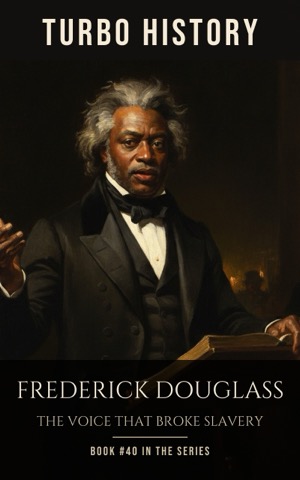
| Frederick Douglass: The Voice That Broke Slavery Turbo History · ours | ~5,700 words Under an hour | The whole life in one sitting. How he taught himself to read, how he escaped, and what he forced the country to admit |
| My Bondage and My Freedom Frederick Douglass, 1855 | ~464 pages About 13 hours | The primary source with the gloves off. Douglass ten years older, free, and no longer managed by white abolitionists |
| Frederick Douglass William S. McFeely, 1991 | ~465 pages About 13 hours | The readable one-volume life. The standard biography before Blight, and still the easier read |
| The Radical and the Republican: Frederick Douglass, Abraham Lincoln, and the Triumph of Antislavery Politics James Oakes, 2007 | ~328 pages About 9 hours | The argument rather than the life. How an outsider and a politician moved each other |
| Women in the World of Frederick Douglass Leigh Fought, 2017 | ~424 pages About 12 hours | The specialist angle that changes the picture. Anna Murray, his daughters, and the women who ran his household and his cause |
| The Mind of Frederick Douglass Waldo E. Martin Jr., 1984 | ~333 pages About 10 hours | Douglass as a thinker, not a symbol. His ideas about race, self-help and America arranged as a system |
| Frederick Douglass: Reformer and Statesman L. Diane Barnes, 2013 | ~224 pages About 6 hours | The short scholarly life. Written for students, with primary documents attached |
The picks, in detail
01
Frederick Douglass: Prophet of Freedom
Blight had access to a private collection of Douglass material that earlier biographers never saw, and he uses it to reconstruct the last thirty years of the life properly rather than rushing to the finish after emancipation. He also takes Douglass seriously as a religious thinker, which is where the title comes from. The cost is bulk: at over 900 pages this is a commitment, and the middle sections on Reconstruction politics move slowly.
02
Narrative of the Life of Frederick Douglass, an American Slave
This is a primary source and the single most important short book on this page. Douglass wrote it to prove he had really been enslaved, so it is precise about names, places and owners in a way that made it dangerous for him to publish. It is deliberately controlled and leaves a lot out, including how he escaped, so read it as a campaign document as well as a memoir.
03
Frederick Douglass: The Voice That Broke Slavery ours
Every book on this list goes deeper than ours, and most of them are hard work. That is not a criticism, it is the entire point of them. Blight gives you 912 pages built on a private archive nobody had used before. Fought spends 424 pages reconstructing the women whose names barely survive in the record. They are good books, and they want weeks of your life.
If you are studying Douglass, or writing about him, or sitting an exam on him, buy one of those and give it the time it deserves. We are not pretending to compete with them.
If you are not, ours might suit you better. It starts on Maryland's Eastern Shore with a boy whose birthday nobody recorded, a mother who walked twelve miles at night to see him and died when he was seven, and a grandmother who raised him and then handed him over at six. Then Baltimore, where Sophia Auld started teaching him the alphabet until her husband stopped her, and Frederick worked out from the ban itself that reading was the way out. Then the Columbian Orator, traded bread for lessons, Covey the slave breaker, and the two hour fight in the barn that Covey never reported. Then the escape in 1838, the marriage to Anna Murray, and the public life: the 1845 book that sold 11,000 copies in three years, the break with Garrison over whether the Constitution was worth saving, Seneca Falls in 1848, and the Fourth of July speech in 1852. It ends on the part that gets left out, which is that he spent his last decades watching Reconstruction get dismantled and said so plainly.
That is what the whole series is for. Love history, but hate how it was taught at school? Same. School turned it into a memory test: names, dates, family trees, exam. The actual story never stood a chance. Turbo History is one figure or one event per book, told in under an hour. The rise, the fall, and why it still matters. Dates included, memorising optional. Sources at the back if you want to go further, and every book on this page is a good place to go next.
04
My Bondage and My Freedom
The second autobiography is nearly four times the length of the first and much more interesting on his split with William Lloyd Garrison and on what the abolitionist movement actually asked of him. The prose is grander and more self-conscious than the 1845 book. Some readers find that a gain and others find it a loss, and it does repeat a lot of the Narrative before it gets to new material.
05
Frederick Douglass
McFeely writes narrative history well and this stayed the standard life for nearly thirty years. It is particularly good on Douglass the family man and on the private cost of a public career. It is older than Blight, some of its speculation about Douglass's personal life has been challenged since, and it gives less weight to his political thought.
06
The Radical and the Republican: Frederick Douglass, Abraham Lincoln, and the Triumph of Antislavery Politics
Oakes tracks two men who started far apart and converged, and he refuses to make either one the hero. It is the best short book on why Douglass changed his mind about the Constitution and about voting, which is the most consequential thing he ever did. It assumes you already know the basic chronology of the 1850s, so it is not a first book.
07
Women in the World of Frederick Douglass
Fought reconstructs the women around Douglass from scraps of evidence, especially his first wife Anna Murray, who was free, funded his escape and left almost no written record. It is the best correction to reading Douglass as a self-made man operating alone. It is a scholarly monograph and reads like one, and it presumes you know the outline of his career already.
08
The Mind of Frederick Douglass
Martin was the first to treat Douglass's writing as a body of thought worth analysing rather than a source of quotable lines, and the book is still cited for it. It is honest about the contradictions, including where Douglass's faith in individual effort sat awkwardly with what he knew about power. It is intellectual history, organised by theme rather than chronology, and it is dry.
09
Frederick Douglass: Reformer and Statesman
Barnes gives you the whole career in a couple of hundred pages and then prints a selection of Douglass's own speeches and letters at the back, which is a useful pairing. It is the fastest way for an adult to get a sourced overview without committing to Blight. It is a textbook in tone, so it explains rather than tells, and it will feel flat next to McFeely.
Questions people actually ask
What is the best book about Frederick Douglass?
David Blight's Frederick Douglass: Prophet of Freedom (2018) is the standard modern life and won the Pulitzer Prize for History. It used a private collection of Douglass papers that earlier biographers could not get to, and it is unusually strong on his last thirty years. If 912 pages is too much, William McFeely's Frederick Douglass is the shorter and more fluent alternative.
Which Frederick Douglass autobiography should I read?
Start with the 1845 Narrative of the Life of Frederick Douglass. It is about 125 pages, it is the one that made him famous, and it is the version he wrote while still a fugitive. Read My Bondage and My Freedom (1855) next if you want more, because it is longer, angrier about the abolitionist movement itself, and covers his break with William Lloyd Garrison. His third book, Life and Times, takes the story to the end of his career but is the least gripping of the three.
What is the best short book about Frederick Douglass?
Douglass's own 1845 Narrative, at roughly 125 pages, is the best short book about him by some distance and it is a primary source. For a modern short account, L. Diane Barnes's Frederick Douglass: Reformer and Statesman is about 224 pages and prints selected documents at the back. Our own hour-long version covers the whole life if you want the shape of it tonight.
What should I read about Douglass and Lincoln?
James Oakes's The Radical and the Republican is the one to read. It follows Douglass and Lincoln as two men who began with very different views of slavery and moved towards each other under pressure, and it does not flatter either. It is about 328 pages and assumes some background knowledge of 1850s American politics.
Is there a book about the people around Douglass?
Yes. Leigh Fought's Women in the World of Frederick Douglass rebuilds the lives of his mother, his grandmother, his first wife Anna Murray, his daughters and his political allies from very thin evidence. It is the best answer to the version of Douglass that treats him as a man who did it all alone. It is a scholarly book, so read a straight biography first.
This book is free sometimes. Want to know when?
Frederick Douglass goes free on Amazon from time to time, along with the rest of the series. Leave your email and we will tell you the moment it does.
More from the series
One figure or one event per book. Under an hour each.