If you want one modern biography, read Kenneth Silverman's Edgar A. Poe: Mournful and Never-Ending Remembrance. If you want the book that first cleared away the lies, read Arthur Hobson Quinn's Edgar Allan Poe: A Critical Biography, which is still the most thorough life ever written. If you want something short, Peter Ackroyd's Poe: A Life Cut Short runs to about 176 pages. And if you have under an hour rather than a fortnight, ours covers the whole life in one sitting. Everything below is sorted by what you are actually trying to get out of it.
Every book listed here is real, in print or easily found, and worth the time. Reading times are honest estimates from page count at roughly 250 words per minute. If you came here looking for Poe's own stories and poems rather than books about his life, this is not that list, and any bookshop will serve you better. There is one thing you need to know before you read anything about Poe. Rufus Griswold, a rival who became his literary executor, published a pseudonymous obituary, signed Ludwig, two days after Poe died in 1849 and then a memoir in 1850 that used forged letters to present him as a depraved drunk and drug addict. It was the only full account available for years, so it became the standard one, and the drunk-and-degenerate image it invented stuck for more than a century. Arthur Hobson Quinn and Kenneth Silverman are the biographers who did the work of taking it apart, which is why they are at the top of this list.
The short version
Sorted by what you want, not by what is most famous.
| Book | Length | Best for |
|---|---|---|
| Edgar A. Poe: Mournful and Never-Ending Remembrance Kenneth Silverman, 1991 | ~564 pages About 16 hours | The standard modern life. Careful with the evidence and serious about the grief |
| Edgar Allan Poe: A Critical Biography Arthur Hobson Quinn, 1941 | ~761 pages About 22 hours | The definitive documentary life. The book that exposed the forgeries |
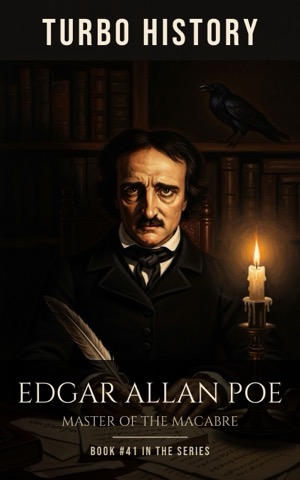
| Edgar Allan Poe: Master of the Macabre Turbo History · ours | ~4,800 words Under an hour | The whole life in one sitting. The orphan, the magazine hack, the inventor of detective fiction, and the smear that outlived him |
| Edgar Allan Poe: His Life and Legacy Jeffrey Meyers, 1992 | ~348 pages About 10 hours | The most readable full-length life. Half biography, half afterlife |
| Poe: A Life Cut Short Peter Ackroyd, 2008 | ~176 pages About 5 hours | The fastest full-length introduction. An evening or two, and it does not pretend to more |
| The Reason for the Darkness of the Night: Edgar Allan Poe and the Forging of American Science John Tresch, 2021 | ~448 pages About 13 hours | The argument rather than the life story. Poe as a writer obsessed with science |
| The Man of the Crowd: Edgar Allan Poe and the City Scott Peeples, 2020 | ~224 pages About 6 hours | Short, modern and unusual. The four cities that made him, in place of a cradle-to-grave narrative |
The picks, in detail
01
Edgar A. Poe: Mournful and Never-Ending Remembrance
Silverman writes the life around bereavement, starting with a mother dead of tuberculosis before Poe was three, and traces how loss runs through the work without turning it into cheap psychology. It is the biography most scholars point people to first. It is long, the tone is measured rather than gripping, and the literary analysis is lighter than in some critical studies.
02
Edgar Allan Poe: A Critical Biography
Quinn went back to the letters and printed Griswold's alterations side by side with the originals, which is how the world found out how much had been fabricated. Eighty years on it is still the fullest account of what Poe did and when. It is enormous, written in a formal 1940s academic register, and it predates decades of later scholarship, so it is a reference book rather than a weekend read.
03
Edgar Allan Poe: Master of the Macabre ours
Every book on this list goes deeper than ours, and most of them are hard work. That is not a criticism, it is the entire point of them. Quinn gives you 761 pages of documentary biography. Silverman gives you 564 pages built on the letters. They are good books, and they want weeks of your life.
If you are studying Poe, writing about him, or sitting an exam on him, buy one of those instead. Give it the time it deserves. We are not pretending to compete with them.
If you are not, ours might suit you better. It starts with a father who walked out and an actress mother dead by the time he was three, then a Richmond merchant who took him in without ever adopting him, five years at school in England, a university career ended by gambling debts, an enlistment in the army under a false name, West Point briefly, and a brother dead young. Then the working life: the magazine boom he tried to ride, the international copyright hole that meant American writers could not get paid, the feuds, the reviewing, the invention of the detective story, the fame that arrived with The Raven and paid him almost nothing. It ends in Baltimore in October 1849, found semiconscious in clothes that were not his, dead four days later with the medical records lost, and then with Griswold, the obituary, the forged letters, and a hundred years of the wrong Poe. There is a section on the parts that do not get defended, including his marriage to a thirteen-year-old cousin, because the myth has been polished at both ends and the real person is more interesting than either version.
That is what the whole series is for. Love history, but hate how it was taught at school? Same. School turned it into a memory test: names, dates, family trees, exam. The actual story never stood a chance. Turbo History is one figure or one event per book, told in under an hour. The rise, the fall, and why it still matters. Dates included, memorising optional. Sources at the back if you want to go further, and every book on this page is a good place to go next.
04
Edgar Allan Poe: His Life and Legacy
Meyers moves quickly, is good on the magazine world Poe was trying to survive in, and devotes a substantial closing section to Poe's influence on later writers from Baudelaire onwards. It is the easiest of the serious adult biographies to finish. He is more willing than Silverman to state a conclusion where the evidence is thin, particularly about the drinking and the death, so read him against Quinn.
05
Poe: A Life Cut Short
Ackroyd compresses the whole life into a brief, stylish narrative and is honest that Poe was a professional writer wrecked by an industry that barely paid. It is the quickest way to get the sequence of events straight. It is a synthesis of other people's research with no new material, and at this length the Baltimore death and the Griswold aftermath get only a few pages each.
06
The Reason for the Darkness of the Night: Edgar Allan Poe and the Forging of American Science
Tresch is a historian of science and shows Poe moving through a world of lectures, hoaxes, telescopes and new theories, which explains the cryptography, the balloon hoax, the detective stories and the strange cosmological essay Eureka. It genuinely changes how you read him. It is a thesis book, so it assumes you already know the outline of the life and it gives less room to the domestic side.
07
The Man of the Crowd: Edgar Allan Poe and the City
Peeples organises Poe's life around Richmond, Baltimore, Philadelphia and New York, and around the constant moving between cheap rooms, which turns out to explain a great deal about what he wrote and why he never got ahead. It is concise, well sourced and pleasant to read. It is deliberately not a complete biography, so pair it with Silverman if this is your first Poe book.
Questions people actually ask
What is the best Edgar Allan Poe biography?
Kenneth Silverman's Edgar A. Poe: Mournful and Never-Ending Remembrance (1991) is the usual first recommendation, at around 564 pages, and it is careful with the evidence. Arthur Hobson Quinn's Edgar Allan Poe: A Critical Biography from 1941 is still the most thorough ever written at roughly 761 pages, and it is the book that proved how much had been forged. Jeffrey Meyers is the easiest to read of the three.
Was Poe really a drunk and a drug addict?
Partly, and much less than the legend says. Poe did lose jobs through drinking and he did fall apart after his wife Virginia died, but the drug addiction was largely invented. Rufus Griswold, his literary executor, wrote a hostile obituary in 1849 and a memoir in 1850 that used forged letters to build the image of a depraved genius, and because it was the only full account for years it became the accepted one. Quinn's biography prints the originals against Griswold's versions.
Where should I start reading about Poe's life?
Start with Peter Ackroyd's Poe: A Life Cut Short if you want something you can finish in two evenings, or Scott Peeples's The Man of the Crowd if you would rather have a short modern book with a fresh angle. Then go to Silverman for the full life. Leave Quinn until you want to check something in detail.
How did Edgar Allan Poe die?
Nobody knows. He was found semiconscious on a Baltimore street on 3 October 1849, wearing clothes that were not his, and died in hospital four days later without ever explaining what had happened. All the medical records, including the death certificate, have been lost. Theories have included alcohol withdrawal, heart disease, epilepsy, rabies and cooping, a form of election fraud in which men were seized, drugged and made to vote repeatedly. Silverman and Quinn both treat the question as unresolved, and any book claiming certainty is overselling.
Is there a good book about Poe beyond the horror stories?
Yes. John Tresch's The Reason for the Darkness of the Night puts Poe inside the scientific culture of his day, which explains the cryptography, the hoaxes, the detective fiction and Eureka far better than the tortured-genius framing ever did. Read a straight biography first, then this one, because it is an argument rather than a life story.
This book is free sometimes. Want to know when?
Edgar Allan Poe goes free on Amazon from time to time, along with the rest of the series. Leave your email and we will tell you the moment it does.
More from the series
One figure or one event per book. Under an hour each.