If you want one full biography, read Miranda Seymour's Mary Shelley, which is the standard modern life. If you want her placed alongside her mother, read Charlotte Gordon's Romantic Outlaws. If you want something short enough to finish this week, read Fiona Sampson's In Search of Mary Shelley or Muriel Spark's Mary Shelley, the book that started the rescue in the first place. And if you have under an hour rather than a fortnight, ours covers the whole life in one sitting. Everything below is sorted by what you are actually trying to get out of it.
Every book listed here is real, in print or easily found, and worth the time. Reading times are honest estimates from page count at roughly 250 words per minute. If you came here looking for Frankenstein or her other novels rather than books about her life, this is not that list, and any bookshop will serve you better. One thing to expect from all of these: Mary Shelley spent a century being reduced to one book begun at eighteen and to the role of Percy Shelley's wife, and modern biography is largely a correction of that. Charlotte Gordon's Romantic Outlaws is a dual biography, telling Mary Shelley's life in chapters that alternate with her mother Mary Wollstonecraft's, which sounds like a gimmick and is not, because Wollstonecraft died days after giving birth to her and the daughter grew up reading her way to a mother she never met.
The short version
Sorted by what you want, not by what is most famous.
| Book | Length | Best for |
|---|---|---|
| Mary Shelley Miranda Seymour, 2000 | ~655 pages About 19 hours | The standard full life. The whole thirty-year career, not just the famous summer |
| Romantic Outlaws: The Extraordinary Lives of Mary Wollstonecraft and Mary Shelley Charlotte Gordon, 2015 | ~672 pages About 19 hours | Mother and daughter together. The best book for understanding why Mary Shelley turned out the way she did |
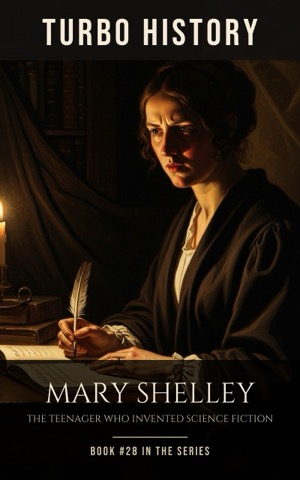
| Mary Shelley: The Teenager Who Invented Science Fiction Turbo History · ours | ~6,200 words Under an hour | The whole life in one sitting. Not just the ghost story summer, but the thirty years of work that came after |
| Mary Shelley: Romance and Reality Emily W. Sunstein, 1989 | ~478 pages About 14 hours | The scholarly turning point. The first modern biography to treat her as a subject in her own right |
| Mary Shelley: Her Life, Her Fiction, Her Monsters Anne K. Mellor, 1988 | ~275 pages About 8 hours | The books rather than the life. Why Frankenstein means what it means |
| In Search of Mary Shelley: The Girl Who Wrote Frankenstein Fiona Sampson, 2018 | ~336 pages About 10 hours | The most readable modern life. A poet writing about a young woman rather than a monument |
| Mary Shelley: A Biography Muriel Spark, 1987 | ~248 pages About 7 hours | The shortest serious life, and a piece of history in itself. The novelist who started the rehabilitation |
The picks, in detail
01
Mary Shelley
Seymour gives proper weight to the four decades after Frankenstein: the widowhood, the editing of Percy's poems under a father-in-law who forbade a biography, the novels nobody read, the blackmailers. It is the most complete account of Mary Shelley as a working professional writer. It is also the longest book on this page by a distance, and the middle years move slowly because her life did.
02
Romantic Outlaws: The Extraordinary Lives of Mary Wollstonecraft and Mary Shelley
Gordon alternates chapters between Wollstonecraft and the daughter who never knew her, so the two lives comment on each other: the same arguments about women, marriage and independence, fought forty years apart. It won the National Book Critics Circle award for biography and it deserves it. The structure means you get roughly half a book about Mary Shelley for your 672 pages, which is either the point or a frustration depending on what you came for.
03
Mary Shelley: The Teenager Who Invented Science Fiction ours
Every book on this list goes deeper than ours, and most of them are hard work. That is not a criticism, it is the entire point of them. Seymour gives you 655 pages on a single life. Gordon gives you 672 pages on two. They are good books, and they want weeks of your life.
If you are studying Mary Shelley, writing about her, or sitting an exam on her, buy one of those instead. Give it the time it deserves. We are not pretending to compete with them.
If you are not, ours might suit you better. It starts with a mother dead within days of the birth, a father who published a memoir so frank it destroyed his wife's reputation for a generation, a stepmother the children could not stand, and an education that came from her father's library and his visitors rather than from school. Then the poet waiting at Godwin's house, the elopement at sixteen, and the frozen summer of 1816, which was frozen because Tambora had erupted on the other side of the world. It keeps going where the popular version stops: the dead children, Percy's drowning, the father-in-law who paid her an allowance on condition she never write a biography, the fifteen years of novels and encyclopedia work and literary annuals, the 1839 edition of Percy's poems where she smuggled his life into the notes, three separate blackmail attempts in the 1840s, and her death at fifty-three. There is a section on how thoroughly she was written out of her own book, and what the manuscripts actually show about who wrote what.
That is what the whole series is for. Love history, but hate how it was taught at school? Same. School turned it into a memory test: names, dates, family trees, exam. The actual story never stood a chance. Turbo History is one figure or one event per book, told in under an hour. The rise, the fall, and why it still matters. Dates included, memorising optional. Sources at the back if you want to go further, and every book on this page is a good place to go next.
04
Mary Shelley: Romance and Reality
Sunstein worked through the letters and journals and built the case that Mary Shelley was a serious, politically engaged writer rather than a footnote to her husband. Much of what later biographers assume was argued here first. It is older, denser and more academic in tone than Seymour, and it is a book making a case as much as telling a story.
05
Mary Shelley: Her Life, Her Fiction, Her Monsters
Mellor reads the fiction against the biography and is especially good on the Frankenstein manuscripts, showing what Percy actually changed and how little of the argument was his. If you have ever been told he really wrote it, this is the book that settles it. It is literary criticism, so it assumes you know the novels and it is written for students rather than for pleasure.
06
In Search of Mary Shelley: The Girl Who Wrote Frankenstein
Sampson is very good on what it actually felt like to be sixteen, pregnant, running around Europe with a married poet, and burying child after child. She writes close to the emotional texture of the letters and journals. She is lighter on the later career and on the politics than Seymour, and the present-tense, speculative passages will annoy readers who want strict biography.
07
Mary Shelley: A Biography
Spark first published this in 1951, as Child of Light, when Mary Shelley was still filed under Percy Shelley's wife, and revised it decades later. Half of it is biography and half is criticism of the novels, and the writing is crisp in the way you would expect from Spark. It predates most of the modern scholarship, so use it for the argument and the prose rather than as your source of fact.
Questions people actually ask
What is the best Mary Shelley biography?
Miranda Seymour's Mary Shelley (2000) is the standard full-length life, at around 655 pages, and it is the only one that gives the thirty years after Frankenstein their proper weight. If you want something shorter, Fiona Sampson's In Search of Mary Shelley is about 336 pages and much easier going, though it concentrates on the early years.
Where should I start reading about Mary Shelley?
Start with Fiona Sampson if you want readable, or Muriel Spark if you want short. Both will give you the shape of the life. Move to Seymour when you want the full account, and to Charlotte Gordon's Romantic Outlaws when you want to understand the mother she never met and how much of Wollstonecraft's argument she inherited.
Is Romantic Outlaws about Mary Shelley or Mary Wollstonecraft?
Both, in alternating chapters. Charlotte Gordon tells Wollstonecraft's life and her daughter's side by side, so that the same struggles over independence, money and reputation appear twice in two generations. It is an excellent book, but roughly half of its 672 pages are about the mother, so it is not the right choice if you only want Mary Shelley.
Did Percy Shelley write Frankenstein?
No. He made edits, as any close reader would, and the surviving manuscripts show exactly where. Anne Mellor's Mary Shelley: Her Life, Her Fiction, Her Monsters goes through them and shows that the structure, the voice and the argument are Mary Shelley's. The assumption that he wrote it says more about how women writers were treated than about the book.
What did Mary Shelley write besides Frankenstein?
Five more novels, including The Last Man in 1826 and Falkner in 1837, plus travel writing, short stories for the literary annuals, biographical essays for Lardner's Cabinet Cyclopaedia, and the 1839 edition of Percy Shelley's poems whose notes are effectively the biography she was forbidden to write. Most of it was out of print until the 1980s. Miranda Seymour's biography is the best guide to that later career.
This book is free sometimes. Want to know when?
Mary Shelley goes free on Amazon from time to time, along with the rest of the series. Leave your email and we will tell you the moment it does.
More from the series
One figure or one event per book. Under an hour each.