If you want the documented facts and nothing else, read Samuel Schoenbaum's William Shakespeare: A Compact Documentary Life. If you want those facts turned into a readable life, read Park Honan's Shakespeare: A Life. If you want the single best book on this page, read James Shapiro's 1599, which takes one year and rebuilds the whole world around it. And if you have under an hour rather than a fortnight, ours covers the whole life in one sitting. Everything below is sorted by what you are actually trying to get out of it.
Every book listed here is real, in print or easily found, and worth the time. Reading times are honest estimates from page count at roughly 250 words per minute. If you came here looking for Shakespeare's own plays and sonnets rather than books about his life, this is not that list, and any bookshop will serve you better. Two warnings before you buy. First, almost nothing about his inner life is documented, so a great deal of Shakespeare biography is educated guesswork, and we say which books are guessing: Stephen Greenblatt's Will in the World is openly speculative and is best read as an argument rather than a record. Second, the theories that someone else wrote the plays are not taken seriously by scholars, and we have not listed any book that promotes one. James Shapiro's Contested Will is here instead, because it explains where those theories came from and why they do not hold.
The short version
Sorted by what you want, not by what is most famous.
| Book | Length | Best for |
|---|---|---|
| William Shakespeare: A Compact Documentary Life Samuel Schoenbaum, 1977 | ~376 pages About 11 hours | The evidence, and only the evidence. The book every other Shakespeare biography is built on |
| Shakespeare: A Life Park Honan, 1998 | ~479 pages About 14 hours | The fullest responsible biography. Documented life plus the world it sat in |
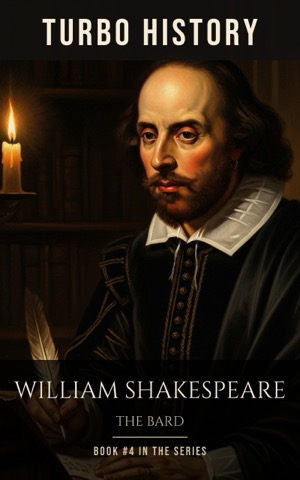
| William Shakespeare Turbo History · ours | ~5,800 words Under an hour | The whole life in one sitting. A glover's son from Stratford who ended up owning a share of the biggest theatre in London |
| 1599: A Year in the Life of William Shakespeare James Shapiro, 2005 | ~352 pages About 10 hours | The best book on this page. One year, four plays, and the England around them |
| Will in the World: How Shakespeare Became Shakespeare Stephen Greenblatt, 2004 | ~438 pages About 12 hours | The most enjoyable read on the shelf, as long as you know what you are holding |
| Ungentle Shakespeare: Scenes from His Life Katherine Duncan-Jones, 2001 | ~322 pages About 9 hours | The unflattering version. Shakespeare as a sharp operator rather than a gentle genius |
| The Lodger: Shakespeare on Silver Street Charles Nicholl, 2007 | ~307 pages About 9 hours | One documented episode, followed all the way down. What his ordinary London life looked like |
| Contested Will: Who Wrote Shakespeare? James Shapiro, 2010 | ~339 pages About 10 hours | The authorship question settled properly. Why the doubts began and why they fail |
| Shakespeare: The World as Stage Bill Bryson, 2007 | ~199 pages About 6 hours | The fastest honest introduction. Short, funny and unusually careful about what is unknown |
The picks, in detail
01
William Shakespeare: A Compact Documentary Life
Schoenbaum went back to the surviving documents, the baptismal register, the marriage bond, the lawsuits, the will, and reproduced them alongside a sober account of what they can and cannot prove. It is the reference point for the whole field and it will inoculate you against most of the nonsense written about Shakespeare. It is also cool and unstoried by design, so it gives you a career rather than a person.
02
Shakespeare: A Life
Honan stays close to the record but is willing to reconstruct the Stratford of the 1570s, the schooling, the acting companies and the property deals in real detail. It is the best single book if you want a complete life without being sold a theory. The length and the density are the price, and the middle chapters on London company politics ask a lot of a casual reader.
03
William Shakespeare ours
Every book on this list goes deeper than ours, and most of them are hard work. That is not a criticism, it is the entire point of them. Honan gives you 479 pages of documented life. Greenblatt gives you 438 pages of argument about what that life felt like. They are good books, and they want weeks of your life.
If you are studying Shakespeare, teaching him, or sitting an exam on him, buy one of those instead. Give it the time it deserves. We are not pretending to compete with them.
If you are not, ours might suit you better. It starts with a glover's son in Stratford, a grammar school education in Latin, a father whose finances collapsed, and a rushed marriage at eighteen to a woman eight years older. Then the lost years nobody can account for, the arrival in London, the class rage of the university-educated playwrights who resented him, the plague closures that shaped his career, and the business side that made him rich: shares in the company, shares in the Globe, property back home. It ends with the late romances, the cannon that burned the Globe down in 1613, the will and the second best bed, and the First Folio in 1623 that saved half the plays from disappearing. There is a section on the parts that have aged badly, Shylock, the Shrew, Caliban, because the plays are too good to keep pretending those problems are not in them.
That is what the whole series is for. Love history, but hate how it was taught at school? Same. School turned it into a memory test: names, dates, family trees, exam. The actual story never stood a chance. Turbo History is one figure or one event per book, told in under an hour. The rise, the fall, and why it still matters. Dates included, memorising optional. Sources at the back if you want to go further, and every book on this page is a good place to go next.
04
1599: A Year in the Life of William Shakespeare
Shapiro takes the year Shakespeare wrote Henry V, Julius Caesar and As You Like It and drafted Hamlet, and reconstructs the politics, the Irish war, the censorship and the new Globe playhouse that shaped them. It solves the biography problem by writing about the world rather than pretending to know the man. It is not a cradle to grave life, so it will not work as your only book about him.
05
Will in the World: How Shakespeare Became Shakespeare
Greenblatt is a first-rate scholar writing an openly imaginative book: he asks what it would have felt like to be this man and answers with informed conjecture about his father, his faith, his marriage and his grief. It is gripping and it makes the plays feel connected to a life. It is also speculation dressed in confident prose, and other scholars have said so loudly, so read it after Schoenbaum rather than before.
06
Ungentle Shakespeare: Scenes from His Life
Duncan-Jones takes the same documents everyone else uses and reads them less charitably: the tax defaults, the grain hoarding, the coat of arms, the money lending, the absent husband. It is a useful antidote to the tendency to assume a great writer must have been a nice man. She sometimes pushes the hostile reading further than the evidence forces her to, so treat it as one lens among several.
07
The Lodger: Shakespeare on Silver Street
In 1612 Shakespeare gave evidence in a lawsuit about a dowry, and it is the only surviving record of his spoken words. Nicholl uses it to reconstruct the household he lodged with, the French immigrant wig-makers, the street, the neighbours, the year. It is narrow on purpose, so you learn an enormous amount about his daily surroundings and almost nothing about the plays.
08
Contested Will: Who Wrote Shakespeare?
Shapiro treats the Bacon and Oxford theories as a historical phenomenon: he shows they only appear in the nineteenth century, traces why Freud, Mark Twain and Helen Keller found them attractive, then lays out the contemporary evidence that Shakespeare of Stratford wrote the plays. It is the one book to read if someone has been telling you the real author was an earl. If you were never tempted by the theories, the long middle section on Victorian believers may feel like a detour.
09
Shakespeare: The World as Stage
Bryson's whole approach is to separate the handful of documented facts from the mountain of assertion, and he is very entertaining about how little we actually have. For a book this short it is remarkably free of invention. It is a summary rather than a work of research, so it will not tell you anything the scholars do not already agree on.
Questions people actually ask
What is the best book about William Shakespeare's life?
Park Honan's Shakespeare: A Life (1998) is the best complete biography, at around 479 pages, because it stays close to the evidence while still telling a story. Samuel Schoenbaum's Compact Documentary Life is the stricter option if you only want what the documents prove. If you want one book that is a pleasure to read, James Shapiro's 1599 is better than either, though it covers a single year.
Why is so little known about Shakespeare?
Because he was a working commercial playwright, not a public figure, and nobody at the time thought his private papers were worth keeping. What survives is mostly legal and financial: baptism, marriage, lawsuits, property purchases, a will, and one deposition. There are no letters and no diary. That gap is why so much Shakespeare biography is speculation, and why Schoenbaum's documentary approach still matters.
Did Shakespeare really write the plays?
Yes. The alternative candidates, Bacon, the Earl of Oxford, Marlowe and the rest, are not taken seriously by Shakespeare scholars, and the doubts only appear more than two hundred years after his death. James Shapiro's Contested Will explains where the theories came from, why they appealed to people like Mark Twain and Freud, and why the contemporary evidence, including the testimony of the colleagues who published the First Folio, points to the man from Stratford.
Is Will in the World accurate?
It is written by a serious scholar, but it is openly speculative. Greenblatt reconstructs Shakespeare's feelings about his father, his religion and his marriage from thin evidence, and reviewers in the field criticised him for it. Read it for the pleasure and the argument, but read Schoenbaum or Honan first so you can tell which parts are documented and which are Greenblatt imagining.
What is the best short book about Shakespeare?
Bill Bryson's Shakespeare: The World as Stage, at about 199 pages, is the best short one and unusually honest about how much is unknown. Charles Nicholl's The Lodger is also compact but covers only one episode of his London life. Our own hour-long version covers the whole arc if you want the shape of it tonight.
This book is free sometimes. Want to know when?
William Shakespeare goes free on Amazon from time to time, along with the rest of the series. Leave your email and we will tell you the moment it does.
More from the series
One figure or one event per book. Under an hour each.