If you want one full biography, read Robert K. Massie's Catherine the Great: Portrait of a Woman. If you want the scholarship rather than the narrative, read Isabel de Madariaga's Russia in the Age of Catherine the Great, which is still the standard account of the reign. If you want Catherine in her own words, her memoirs exist and are worth reading. If you want the short version done properly, Madariaga also wrote a 240-page one. And if you have under an hour rather than a fortnight, ours covers the whole life in one sitting.
Every book listed here is real, in print or easily found through a library, and worth the time. Reading times are honest estimates from page count, not measured. Two things are worth saying plainly before you start. Her memoirs are a genuine primary source, written by Catherine herself and revised in 1794, though they stop before she took the throne. And the horse story is a fabrication. She died of a stroke in November 1796, documented by her doctors and her court, and the bestiality rumour was propaganda pushed by her enemies after her death. A great deal of what has been written about her sex life is invention of the same kind, produced because a powerful woman was easier to attack that way than to argue with. The books below that handle her lovers seriously do so from letters and court records, not from satire.
The short version
Sorted by what you want, not by what is most famous.
| Book | Length | Best for |
|---|---|---|
| Catherine the Great: Portrait of a Woman Robert K. Massie, 2011 | ~656 pages About 19 hours | The best readable one-volume life. Narrative biography by a writer who knows how to hold a reader |
| Russia in the Age of Catherine the Great Isabel de Madariaga, 1981 | ~698 pages About 20 hours | The definitive scholarly account. The reign rather than the woman, done properly |
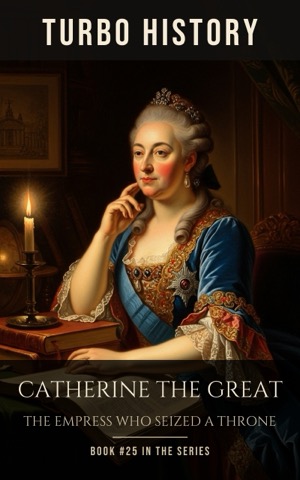
| Catherine the Great: The Empress Who Seized a Throne Turbo History · ours | ~6,600 words Under an hour | The whole life in one sitting. Broke German princess to empress, and what she actually built |
| Catherine the Great: A Short History Isabel de Madariaga, 1990 | ~240 pages About 7 hours | The same authority in a tenth of the space. The short serious book on the reign |
| The Memoirs of Catherine the Great Catherine the Great, translated by Mark Cruse and Hilde Hoogenboom, 2006 | ~368 pages About 10 hours | Primary source. Catherine's own account of her first fifteen years in Russia |
| Prince of Princes: The Life of Potemkin Simon Sebag Montefiore, 2000 | ~634 pages About 18 hours | The specialist angle. The partnership with Potemkin that ran the south |
| Catherine the Great: Life and Legend John T. Alexander, 1989 | ~418 pages About 12 hours | The evidence-first academic life. Careful about what can and cannot be proved |
| Catherine the Great: Love, Sex and Power Virginia Rounding, 2006 | ~566 pages About 16 hours | Her private life taken seriously. Court life, favourites and the women around her |
The picks, in detail
01
Catherine the Great: Portrait of a Woman
Massie is the most fluent storyteller who has taken Catherine on, and he is especially good on the first eighteen years, the arrival in Russia at fourteen and the marriage to Peter that nearly destroyed her. He leans on her memoirs heavily, which makes the early chapters vivid and also means you are partly reading her own version of events. It is long, it is light on the machinery of government, and readers who want the politics of the reign will find it thin after 1762.
02
Russia in the Age of Catherine the Great
This is the book other historians cite. Madariaga worked through the Russian administrative record and reconstructed what Catherine actually did: the provincial reform of 1775, the legislative commission, the wars, the finances, the charters. It is a history of a reign, not a life story, so the personal material is sparse and the prose is dense. Read it when you already know the outline and want to know whether the outline is true.
03
Catherine the Great: The Empress Who Seized a Throne ours
Every book on this list goes deeper than ours, and most of them are hard work. That is not a criticism, it is the entire point of them. Madariaga gives you 698 pages of the administrative record. Massie gives you 656 pages of narrative built largely on Catherine's own memoirs. They are good books, and they want weeks of your life.
If you are studying this properly, or sitting an exam on it, buy one of those and give it the time it deserves. We are not pretending to compete with them.
If you are not, ours might suit you better. It starts in a cold castle in Stettin in 1729 with a minor prince's daughter whose family had bloodlines and no money, then the arranged match to a second cousin she disliked on sight, seventeen years of surviving a court that could have destroyed her, and the coup of 1762. Then the reign itself: the southern wars and the Black Sea ports, the partitions of Poland, the provincial reform of 1775, the legislative commission that talked for a year and produced nothing, Pugachev's rebellion, the Smolny Institute, and the collection that became the Hermitage. It is honest about the rest of it, the serfs handed out in their tens of thousands as gifts, the Pale of Settlement, the crackdown after the French Revolution. It covers the death properly, including where the horse story came from and why it stuck.
That is what the whole series is for. Love history, but hate how it was taught at school? Same. School turned it into a memory test: names, dates, family trees, exam. The actual story never stood a chance. Turbo History is one figure or one event per book, told in under an hour. The rise, the fall, and why it still matters. Dates included, memorising optional. Sources at the back if you want to go further, and every book on this page is a good place to go next.
04
Catherine the Great: A Short History
Madariaga condensed her own research into a book you can finish in a couple of evenings, and she is explicit about separating what is documented from what is rumour. If you only ever read one academic book on Catherine, this is the efficient choice. It assumes some background in eighteenth-century Europe and it moves fast, so a few passages will feel like summary rather than explanation.
05
The Memoirs of Catherine the Great
This is the real thing: Catherine writing about her arrival in 1744, the court of Empress Elizabeth, and the marriage to Peter, in a version she revised in 1794. The Cruse and Hoogenboom translation went back to manuscripts in her own hand and comes with a long introduction explaining how the text survived. Two warnings. It stops before the coup, so there is nothing here about her reign. And she is writing to justify herself, so treat it as testimony from an interested party rather than as neutral evidence.
06
Prince of Princes: The Life of Potemkin
Montefiore went into the archives for the letters between Catherine and Grigory Potemkin, and the result is the best account of how the two of them actually governed together, including the annexation of Crimea and the founding of the Black Sea cities. It also does the useful job of treating her relationship with him as a political fact rather than as gossip. It is a double biography, so Potemkin takes up as much room as Catherine, and the middle sections on court intrigue are heavy going.
07
Catherine the Great: Life and Legend
Alexander wrote this for Oxford and spends real effort on where the legends came from, which makes it the best corrective if you have absorbed the scandal version of Catherine. He is strong on the plague of 1771, the Pugachev rebellion and the health and medical record. It is drier than Massie and organised more by theme than by story, so it works better as a second book than a first.
08
Catherine the Great: Love, Sex and Power
Rounding uses letters and court diaries to build up daily life at Catherine's court, and she is good on the people usually left out, the ladies-in-waiting, the secretaries, the household. The title promises scandal and the book largely refuses to deliver it, which is a point in its favour. It is slow, the cast is enormous, and if you want the wars and the reforms you will be waiting a long time for them.
Questions people actually ask
What is the best book about Catherine the Great?
It depends which book you want. Robert K. Massie's Catherine the Great: Portrait of a Woman (2011) is the best-written full-length life and the easiest to finish. Isabel de Madariaga's Russia in the Age of Catherine the Great (1981) is the standard scholarly account and the one historians cite, but it is a history of the reign rather than a biography and it runs to nearly 700 pages.
Where should I start with Catherine the Great?
Start with Massie if you want a story, or with Madariaga's Catherine the Great: A Short History if you want the facts in 240 pages. Massie will give you the childhood, the marriage and the coup in narrative form. Madariaga's short book will give you the reign and is careful to say where the evidence stops. Either one leaves you ready for the bigger books.
Did Catherine the Great write her own memoirs?
Yes. She wrote several versions and revised one of them in 1794, and it is a genuine primary source. The Cruse and Hoogenboom translation, published by Modern Library, works from manuscripts in her own hand. Two limits are worth knowing: the text runs from her arrival in Russia in 1744 to roughly 1759, so it stops before she seized the throne, and she was writing to defend her own conduct, so it is testimony rather than neutral record.
Is the story about Catherine the Great and a horse true?
No. She died of a stroke in November 1796. Her doctors, her courtiers and her household all documented it, which makes her cause of death one of the least disputed facts about her. The bestiality story was invented and spread after her death by people who wanted to damage her reputation, recycling an older slander, and it survived because a scandalous story about a powerful woman travels further than a medical record. Much of the rest of what has been written about her sexual life is the same kind of invention.
What is the best short book about Catherine the Great?
Isabel de Madariaga's Catherine the Great: A Short History, at about 240 pages, is the best short serious book and it is written by the person who wrote the definitive long one. If you want something shorter still, our own hour-long version covers the whole life, from Stettin to the Winter Palace, in one sitting.
This book is free sometimes. Want to know when?
Catherine the Great goes free on Amazon from time to time, along with the rest of the series. Leave your email and we will tell you the moment it does.
More from the series
One figure or one event per book. Under an hour each.