If you read one book about Rasputin, make it Douglas Smith's Rasputin (2016), which is built on archives in seven countries and takes apart most of what you think you know. Joseph Fuhrmann's Rasputin: The Untold Story is the shorter scholarly alternative if 815 pages is too much. Frances Welch's Rasputin: A Short Life gives you the whole arc in about 200 pages. Edvard Radzinsky's The Rasputin File is the most gripping, though it trusts the old police interrogations further than Smith does. And if you have under an hour rather than a fortnight, ours covers the whole life in one sitting.
Every book listed here is real, in print or easily found, and worth the time. Reading times are honest estimates from page count at roughly 250 words per minute. You should know before you start that the Rasputin shelf is more polluted than almost any other in modern history. Most of the famous stories, including the cakes, the poison and the unkillable body in the river, come from hostile memoirs, wartime propaganda and the killers' own published accounts, not from evidence. The autopsy found three gunshot wounds and no poison. We have marked which books below are built on documents and which are built on legend, because on this subject the difference matters more than usual.
The short version
Sorted by what you want, not by what is most famous.
| Book | Length | Best for |
|---|---|---|
| Rasputin: Faith, Power, and the Twilight of the Romanovs Douglas Smith, 2016 | ~815 pages About 23 hours | The definitive modern life. Archives in seven countries, and the myth stripped out line by line |
| Rasputin: The Untold Story Joseph T. Fuhrmann, 2013 | ~320 pages About 9 hours | The scholarly life at a manageable length. Soviet-era archive material without the doorstop |
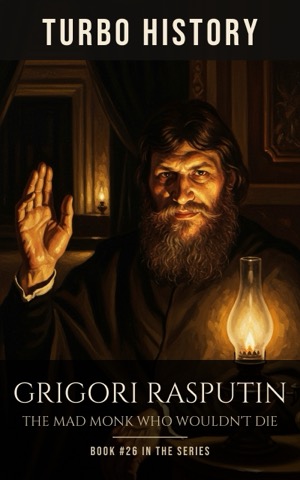
| Grigori Rasputin: The Peasant They Called the Mad Monk Turbo History · ours | ~6,400 words Under an hour | The whole life in one sitting. Who he actually was, what he actually did, and why the rumours mattered more than the man |
| The Rasputin File Edvard Radzinsky, 2000 | ~524 pages About 15 hours | The most readable full account. Built around a lost 1917 interrogation file that resurfaced at auction |
| Nicholas and Alexandra Robert K. Massie, 1967 | ~613 pages About 17 hours | The classic that made the story famous. Rasputin seen through the family that needed him |
| The Life and Times of Grigorii Rasputin Alex de Jonge, 1982 | ~368 pages About 10 hours | Rasputin placed in his own religious world. Siberian peasant faith rather than court scandal |
| Rasputin: A Short Life Frances Welch, 2014 | ~210 pages About 6 hours | The fastest full-length option. The whole life in a couple of evenings |
| Lost Splendour Felix Yusupov, 1953 | ~300 pages About 8 hours | Primary source, and the origin of the legend. The murderer's own account, written to be believed |
The picks, in detail
01
Rasputin: Faith, Power, and the Twilight of the Romanovs
Smith went back to the primary documents in Russian and other archives and rebuilt the story from them, which means he can show you exactly where each famous anecdote came from and who had a reason to invent it. It is the only book here that treats the sensational literature itself as evidence of something. The cost is size: 815 pages is a serious commitment, and the level of detail on Petersburg court politics will exhaust anyone who just wants the story.
02
Rasputin: The Untold Story
Fuhrmann spent decades on Rasputin and used files that only opened after 1991, and this is the compressed result: sober, sourced, and roughly a third the length of Smith. If you want a historian rather than a storyteller but cannot face 815 pages, start here. It is drier than Radzinsky and the prose is flat in places, and Smith has since superseded it on several points.
03
Grigori Rasputin: The Peasant They Called the Mad Monk ours
Every book on this list goes deeper than ours, and most of them are hard work. That is not a criticism, it is the entire point of them. Smith gives you 815 pages built on archives in seven countries. Radzinsky gives you 524 pages of recovered witness testimony to weigh up. They are good books, and they want weeks of your life.
If you are studying this period or sitting an exam on it, buy one of those and give it the time it deserves. We are not pretending to compete with them.
If you are not, ours might suit you better. It starts in Pokrovskoye with a barely literate Siberian peasant and the pilgrimage that turned him into a wandering holy man, then follows him into Saint Petersburg in the winter of 1904-05, into the salons, and in November 1905 into a first meeting with Nicholas and Alexandra. It covers the haemophiliac heir, the telegram sent to Siberia in 1912 and the recovery one of the attending doctors called inexplicable, the bribes and the affairs and the governesses who were dismissed for complaining, the war years when Nicholas left for the front and Alexandra ran the empire, the stabbing in 1914, and then the murder: Yusupov's version, and the autopsy that contradicts it. The last chapter is about what the myth did, which is the part that actually mattered, since the throne outlived him by about eleven weeks. There is a section on what he really was, because the gap between the legend and the man cuts both ways.
That is what the whole series is for. Love history, but hate how it was taught at school? Same. School turned it into a memory test: names, dates, family trees, exam. The actual story never stood a chance. Turbo History is one figure or one event per book, told in under an hour. The rise, the fall, and why it still matters. Dates included, memorising optional. Sources at the back if you want to go further, and every book on this page is a good place to go next.
04
The Rasputin File
Radzinsky writes like a dramatist, because he is one, and the book is driven by the recovered file of witness testimony taken from Rasputin's circle just after the revolution. It is the version most likely to keep you turning pages. Treat it with care: he takes the testimony at close to face value where Smith shows much of it was gossip, score-settling or told to please the interrogators.
05
Nicholas and Alexandra
Massie wrote this after his own son was diagnosed with haemophilia, and the book's real subject is what an incurable child does to a marriage and then to an empire. It explains the one thing nothing else explains as well: why Alexandra could not let Rasputin go. It is sixty years old, it is warmer towards Nicholas and Alexandra than most historians now are, and Rasputin is a supporting character here rather than the subject.
06
The Life and Times of Grigorii Rasputin
De Jonge is good on the thing most books skip: the wandering-pilgrim tradition Rasputin came out of, and why a semi-literate Siberian holy man was legible to Russians in a way he is not to us. It gives the mysticism a serious hearing instead of treating it as a con trick. It predates the Soviet archives entirely, so on the court years and the murder it is working from the same compromised memoirs everyone else used before 1991.
07
Rasputin: A Short Life
Welch is a good writer on late imperial Russia and this is a brisk, wry, well-shaped account that does not pad. If you want a proper book rather than an article and you want it finished this week, this is the one. It is a summary by design, so it cannot show you the documentary working, and it repeats a few of the standard death-night set pieces more readily than Smith would.
08
Lost Splendour
Primary source, clearly labelled: this is the memoir of the prince who lured Rasputin to his cellar, and it is where the poisoned cakes, the wine, the refusal to die and most of the rest of the famous story actually come from. Reading it is the quickest way to understand how the myth was manufactured, because you can watch a man building his own legend in real time. Do not read it as history. Read Smith first, then read this and see how much of it the evidence supports.
Questions people actually ask
What is the best book about Rasputin?
Douglas Smith's Rasputin: Faith, Power, and the Twilight of the Romanovs (2016) is the standard modern life and the only one built from the ground up on archives in seven countries. It is about 815 pages, so it is a commitment. If that is too much, Joseph Fuhrmann's Rasputin: The Untold Story covers similar ground in around 320 pages.
Where should I start with Rasputin?
Start with Frances Welch's Rasputin: A Short Life if you want the shape of the story in a couple of evenings, or Edvard Radzinsky's The Rasputin File if you want something longer that reads like a thriller. Then go to Douglas Smith, who will correct both of them. Our own hour-long version works as an orientation before any of these.
Are the stories about Rasputin's death true?
Mostly no. The poisoned cakes, the wine that did nothing, the body that would not die and the drowning all come from Felix Yusupov's own memoirs and the accounts of his fellow conspirators, written to make a squalid political murder sound like an exorcism. Dr Dmitry Kosorotov's autopsy found three gunshot wounds, including a close-range shot to the head, no poison and no water in the lungs. Douglas Smith lays out the evidence in full.
Which Rasputin books are actually reliable?
Douglas Smith and Joseph T. Fuhrmann are the two serious modern biographers, both working from Russian archive material. Alex de Jonge is sound on the religious background but predates the archives. Edvard Radzinsky is worth reading but takes his witnesses too much at their word. Felix Yusupov's Lost Splendour is a primary source and a piece of self-justification, not history. Anything promising the secret sex life of the mad monk is recycling 1917 propaganda.
Did Rasputin really control the Russian government?
He had real influence, particularly after 1915 when Nicholas left for the front and Alexandra was running things at home, and ministers were appointed and dismissed partly on whether he approved. But the wholesale takeover people imagined was fantasy, and Nicholas ignored much of the advice Alexandra passed on. What destroyed the monarchy was that the public believed the fantasy. Smith is the best book on the difference between the two.
This book is free sometimes. Want to know when?
Grigori Rasputin goes free on Amazon from time to time, along with the rest of the series. Leave your email and we will tell you the moment it does.
More from the series
One figure or one event per book. Under an hour each.