If you want one full biography, read Susan Quinn's Marie Curie: A Life, which is the fullest modern account and the first to use the letters properly. If you want the same story at half the length and just as honest, read Barbara Goldsmith's Obsessive Genius. Dava Sobel's The Elements of Marie Curie is the best recent book and the best on the women she trained. Eve Curie's Madame Curie is the famous one, written by her daughter, and it is beautiful and not to be trusted on the difficult parts. And if you have under an hour rather than a fortnight, ours covers the whole life in one sitting.
Every book listed here is real, in print or easily found, and worth the time. Reading times are honest estimates from page count at roughly 250 words per minute. One warning about this shelf in particular. Eve Curie's 1937 Madame Curie is still the best-selling life of her mother and it is a lovely piece of writing, but it is a daughter's monument: it plays down the affair with Paul Langevin that nearly destroyed her, and it is soft on the radiation that killed her. Susan Quinn and Barbara Goldsmith, working from letters and notebooks that were sealed for decades, are the honest ones. And a detail readers always want confirmed, because it sounds invented: Curie's notebooks really are still radioactive. They are kept in lead-lined boxes at the Bibliotheque nationale de France, and you sign a waiver to handle them. Radium-226 has a half-life of about 1,600 years, so a century has barely touched them.
The short version
Sorted by what you want, not by what is most famous.
| Book | Length | Best for |
|---|---|---|
| Marie Curie: A Life Susan Quinn, 1995 | ~509 pages About 15 hours | The definitive modern life. The full woman, including the parts the family kept quiet |
| Obsessive Genius: The Inner World of Marie Curie Barbara Goldsmith, 2005 | ~256 pages About 7 hours | The best short adult biography. Honest about the scandal and the radiation, and half the length of Quinn |
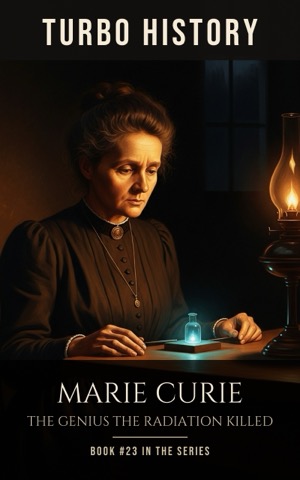
| Marie Curie: The Genius the Radiation Killed Turbo History · ours | ~5,800 words Under an hour | The whole life in one sitting. Occupied Warsaw to two Nobel Prizes, and what the radium cost her |
| The Elements of Marie Curie: How the Glow of Radium Lit a Path for Women in Science Dava Sobel, 2024 | ~336 pages About 10 hours | The best recent book, and the widest lens. Curie plus the dozens of women she trained |
| Madame Curie: A Biography Eve Curie, 1937 | ~412 pages About 12 hours | The classic, and the source of the legend. Written by her younger daughter three years after she died |
| Marie Curie and Her Daughters: The Private Lives of Science's First Family Shelley Emling, 2012 | ~219 pages About 6 hours | The later years and the family. Irene, Eve, and the American tours that rebuilt her reputation |
| Pierre Curie, with Autobiographical Notes Marie Curie, 1923 | ~242 pages About 7 hours | Primary source, in her own voice. Her memoir of Pierre plus a short account of her own life |
| Radioactive: Marie and Pierre Curie, A Tale of Love and Fallout Lauren Redniss, 2010 | ~208 pages About 3 hours | The fastest and strangest way in. A visual book that connects the discovery to what came after it |
The picks, in detail
01
Marie Curie: A Life
Quinn was the first biographer to work through the family papers and the letters Curie wrote to Pierre after his death, and the result is the most complete portrait we have: the Polish childhood, the science, the grief, the Langevin affair and the press campaign that followed it. It is honest where the earlier books were protective. At around 509 pages it is a proper undertaking, and the middle stretch on French academic politics is heavy going if you came for the science.
02
Obsessive Genius: The Inner World of Marie Curie
Goldsmith used diaries and notebooks that had been sealed for over sixty years and built a compact, unsentimental account of a woman who worked herself and her health into the ground. It gives you the substance of Quinn in roughly half the pages and it is the single best value on this page. The compression costs you depth on the physics, and the psychological framing is more assertive than the evidence sometimes supports.
03
Marie Curie: The Genius the Radiation Killed ours
Every book on this list goes deeper than ours, and most of them are hard work. That is not a criticism, it is the entire point of them. Quinn gives you 509 pages built on the family papers. Eve Curie gives you 412 pages written by someone who was in the room. They are good books, and they want weeks of your life.
If you are studying the history of science or sitting an exam on it, buy one of those and give it the time it deserves. We are not pretending to compete with them.
If you are not, ours might suit you better. It starts in Warsaw in 1867, in a Poland that officially did not exist, with a family whose money had been confiscated for backing the wrong uprising and a father who taught physics at the dining table because the Russian authorities had banned lab work in Polish schools. Then her mother's death, the gold medal, the collapse, the illegal Flying University, the years as a governess, the engagement his parents broke off, and the deal with her sister that finally got her to Paris. From there: the discovery years, the shed, the pitchblende, the field being invented around her, the prizes, and the world that stayed hostile to women throughout. It covers the war and the mobile X-ray units that treated over a million wounded men. The last chapter is about what we actually inherited, from radiotherapy and brachytherapy to nuclear weapons, and there is a section on the dark side: the radium-dial workers, the aplastic anaemia that killed her, and the papers that are still too radioactive to handle without protective gear.
That is what the whole series is for. Love history, but hate how it was taught at school? Same. School turned it into a memory test: names, dates, family trees, exam. The actual story never stood a chance. Turbo History is one figure or one event per book, told in under an hour. The rise, the fall, and why it still matters. Dates included, memorising optional. Sources at the back if you want to go further, and every book on this page is a good place to go next.
04
The Elements of Marie Curie: How the Glow of Radium Lit a Path for Women in Science
Sobel writes science better than any of the other authors here and her angle is genuinely new: the laboratory Curie built employed more than sixty scientists, many of them women who went on to their own careers, and this follows them out as well as following her. It is the freshest thing written on the subject in years. It is not a conventional cradle-to-grave life, so if you want the straight chronology first, read Goldsmith or Quinn before this.
05
Madame Curie: A Biography
Eve Curie was a professional writer and this is a genuinely wonderful book: the shed, the pitchblende, the glow in the dark, all of it rendered by someone who was there. It is also the reason the saintly version of Marie Curie exists. It skirts the Langevin affair, softens the illness, and presents a monument rather than a person, so read it after Quinn or Goldsmith and enjoy it for what it is.
06
Marie Curie and Her Daughters: The Private Lives of Science's First Family
Emling picks the story up around 1911, after the scandal, and follows Curie through her relationship with her two very different daughters and the fundraising trips to America that turned her back into a public figure. It covers ground the big biographies rush. It is a specialist slice rather than a life, it is light on the science, and it will not make sense as your first book.
07
Pierre Curie, with Autobiographical Notes
Primary source, clearly labelled: Curie wrote this biography of her husband and appended autobiographical notes she had produced for an American magazine, so you get her account of the shed years, the discovery and the marriage in her own restrained words. Nothing else lets you hear her directly at any length. She is guarded, she says almost nothing about the difficult years after Pierre's death, and it was written partly to serve a fundraising tour, so read it as evidence rather than as the full story.
08
Radioactive: Marie and Pierre Curie, A Tale of Love and Fallout
Redniss tells the story in cyanotype prints and fragments of text, and threads the Curies' work forward to Hiroshima, weapons testing and nuclear medicine, which no conventional biography does as directly. It was a National Book Award finalist and the cover glows in the dark. It is impressionistic rather than thorough, the chronology skips, and anyone wanting a straightforward account of who did what and when should look elsewhere.
Questions people actually ask
What is the best book about Marie Curie?
Susan Quinn's Marie Curie: A Life (1995) is the fullest modern biography and the first to use the family letters properly, including the ones she wrote to Pierre after his death. It runs to about 509 pages. If that is more than you want, Barbara Goldsmith's Obsessive Genius covers the same life honestly in around 256 pages.
Where should I start with Marie Curie?
Start with Barbara Goldsmith's Obsessive Genius. It is short, it is well sourced, and it does not tidy up the affair or the radiation sickness. Go to Susan Quinn afterwards if you want the full length, or to Dava Sobel's The Elements of Marie Curie if you want the science and the women she trained. Our own hour-long version works as an orientation before any of them.
Is Eve Curie's Madame Curie still worth reading?
Yes, but not first and not on its own. Her daughter wrote it three years after Marie died and it is a lovely book, which is exactly why it shaped the saintly public image for decades. It plays down the Langevin affair and the press campaign that followed, and it is gentle about the radiation exposure. Read Quinn or Goldsmith first, then read it as a period piece by someone who was there.
Are Marie Curie's notebooks really still radioactive?
Yes. Her notebooks and many of her personal possessions are contaminated with radium-226, which has a half-life of about 1,600 years, so almost none of it has decayed in the century since she handled them. The papers are stored in lead-lined boxes at the Bibliotheque nationale de France and researchers sign a waiver and wear protective equipment to consult them. She kept radioactive samples in her pockets and her desk drawer because she liked the glow.
What is the best book on the science rather than the life?
Dava Sobel's The Elements of Marie Curie is the best written on the actual physics and chemistry, and it also follows the researchers who came out of her laboratory. For a shorter and stranger route, Lauren Redniss's Radioactive connects the discovery directly to nuclear weapons and nuclear medicine. Curie's own Pierre Curie is the primary source if you want her description of the work in her own words.
This book is free sometimes. Want to know when?
Marie Curie goes free on Amazon from time to time, along with the rest of the series. Leave your email and we will tell you the moment it does.
More from the series
One figure or one event per book. Under an hour each.