If you want one reliable biography, read W. Bernard Carlson's Tesla: Inventor of the Electrical Age, which is the only major Tesla book built properly from the notebooks and patents. If you want the fuller story with the money and the personalities in it, read Marc Seifer's Wizard, but read it sceptically. If you want the man rather than the machines, Margaret Cheney's Tesla: Man Out of Time is still the most enjoyable. If you have absorbed the internet version of Tesla and want the claims checked, Christopher Cooper's The Truth About Tesla does that in about 200 pages. And if you have under an hour rather than a fortnight, ours covers the whole life in one sitting.
Read this before you buy anything: Tesla has the worst signal-to-noise ratio of any figure in the history of science. He made large public claims late in life that he never demonstrated, and since his death in 1943 an entire industry has grown up around free energy, death rays and suppressed patents. A great deal of what is sold as Tesla biography is built on that mythology rather than on documents, and some of it is on the same shelves as the real thing. Every book listed here is part of the serious literature, is real, and is easy to find. Reading times are honest estimates from page count at roughly 250 words per minute. Where a book leans towards the legend, such as O'Neill and parts of Seifer, we say so rather than quietly recommending it.
The short version
Sorted by what you want, not by what is most famous.
| Book | Length | Best for |
|---|---|---|
| Tesla: Inventor of the Electrical Age W. Bernard Carlson, 2013 | ~500 pages About 10 hours | The one Tesla biography written to academic standards. Built from the notebooks and patents rather than the legend |
| Wizard: The Life and Times of Nikola Tesla: Biography of a Genius Marc J. Seifer, 1996 | ~540 pages About 11 hours | The fullest life story with the money and the personalities attached. Best read sceptically, with Carlson beside you |
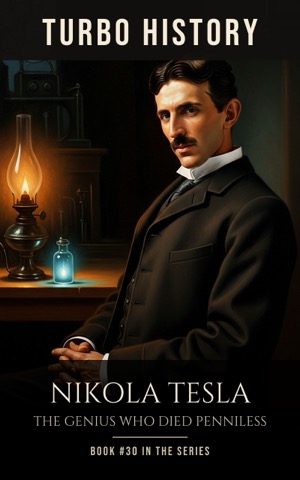
| Nikola Tesla: The Genius Who Died Penniless Turbo History · ours | ~6,400 words Under an hour | The whole life in one sitting. How he built the grid the world runs on, and how he ended up broke in a hotel room |
| Tesla: Man Out of Time Margaret Cheney, 1981 | ~400 pages About 8 hours | The man rather than the machines. The book that reads most like a novel and revived popular interest in him |
| Empires of Light: Edison, Tesla, Westinghouse, and the Race to Electrify the World Jill Jonnes, 2003 | ~420 pages About 8 to 9 hours | The war of the currents as a business and publicity fight. Tesla placed among his rivals rather than alone |
| The Truth About Tesla: The Myth of the Lone Genius in the History of Innovation Christopher Cooper, 2015 | ~200 pages About 4 hours | The myths checked one by one. For anyone who has absorbed the internet version and wants the receipts |
| My Inventions: The Autobiography of Nikola Tesla Nikola Tesla, 1919 | ~110 pages About 2 hours | Tesla in his own voice. The fastest way to understand why he fascinates people, and how he wanted to be seen |
| AC/DC: The Savage Tale of the First Standards War Tom McNichol, 2006 | ~200 pages About 4 hours | The current war explained quickly. The easiest way in for anyone who found the big biographies too slow to start |
| Prodigal Genius: The Life of Nikola Tesla John J. O'Neill, 1944 | ~326 pages About 6 to 7 hours | Where the Tesla legend came from. A first-hand impression by a journalist who actually knew him |
The picks, in detail
01
Tesla: Inventor of the Electrical Age
Carlson is a historian of technology and he works from Tesla's own notebooks and patent records, so this is the book that separates what Tesla did from what people say he did. It explains the induction motor and the wireless work clearly enough that a non-engineer can follow it. The cost is pace, since it is more analytical than dramatic, and the middle chapters on Colorado Springs and Wardenclyffe are heavy going.
02
Wizard: The Life and Times of Nikola Tesla: Biography of a Genius
Seifer spent years in the archives and this is still the most detailed account of Tesla's dealings with Westinghouse, Morgan and Marconi, plus the long decline into hotel rooms and press conferences. It is the richest narrative on this list. It is also the most credulous of the serious books, since Seifer takes Tesla's later claims about death rays and interplanetary signals further than most historians will, so read those sections with care.
03
Nikola Tesla: The Genius Who Died Penniless ours
Every book on this list goes deeper than ours, and most of them are hard work. That is not a criticism, it is the entire point of them. Carlson gives you 500 pages of patents, notebooks and careful engineering history. Seifer gives you about 540 pages of archive work on the money and the lawsuits. They are good books, and they want weeks of your life.
If you are studying Tesla properly, or sitting an exam on the history of technology, buy one of those and give it the time it deserves. Carlson is the one to buy. We are not pretending to compete with him.
If you are not, ours might suit you better. It starts in a Croatian village with a lightning storm, a dead older brother he never stopped being measured against, and nine months of a cholera bed that changed his father's mind about the priesthood. Then the dropout years, the vision in a Budapest park, Paris, Edison, the bonus that never came, and the winter he spent digging ditches for two dollars a day. Then the motor, the Westinghouse deal, the royalty contract he tore up, Niagara Falls, the showman years, and Wardenclyffe collapsing in 1905. It ends with the hotel circuit, the birthday press conferences, the pigeons, and the 1943 Supreme Court decision, five and a half months after his death, that struck down Marconi's key patent claims. There is a section on the dark side, because he rejected relativity, denied the electron, and spent his last decades ranting at Einstein while his real achievements got buried under crackpot mythology. The real man is stranger and better than the internet version.
That is what the whole series is for. Love history, but hate how it was taught at school? Same. School turned it into a memory test: names, dates, family trees, exam. The actual story never stood a chance. Turbo History is one figure or one event per book, told in under an hour. The rise, the fall, and why it still matters. Dates included, memorising optional. Sources at the back if you want to go further, and every book on this page is a good place to go next.
04
Tesla: Man Out of Time
Cheney's book brought Tesla back into public view and it is still the most enjoyable account of his character: the phobias, the pigeons, the hotel rooms, the showmanship. She is good on how strange he actually was without turning him into a saint. The technical explanations are thin and some of the sourcing is loose by modern standards, so treat it as portrait rather than reference.
05
Empires of Light: Edison, Tesla, Westinghouse, and the Race to Electrify the World
Tesla shares this book with Edison and Westinghouse, and that is the point, because it shows the industrial fight he was one part of, including the grim electric chair publicity campaign. Jonnes writes well and the Chicago World's Fair chapters are excellent. If you want a Tesla-only biography this is not it, and he drops out of view for long stretches.
06
The Truth About Tesla: The Myth of the Lone Genius in the History of Innovation
Cooper goes after the popular claims directly: that Tesla single-handedly invented AC, that he alone invented radio, that Morgan destroyed him out of greed. It is a useful corrective, it is illustrated, and it is short. It is argumentative rather than a full life story, and at times Cooper over-corrects, so it works best as a second book rather than a first.
07
My Inventions: The Autobiography of Nikola Tesla
Written as a series of magazine articles in 1919 and collected in book form later, this is short, odd and revealing: the visions, the childhood, the moment he claimed to see the rotating magnetic field in a Budapest park. Nothing else gets you as close to how his mind worked. It is also self-serving and unreliable on dates and credit, so read it as testimony rather than as history.
08
AC/DC: The Savage Tale of the First Standards War
A brisk journalistic account of how the AC versus DC fight was won and lost, with Tesla as a major but not sole player. It is the gentlest entry point on this list and it does not pretend to be more than that. Specialists will find it thin, and Tesla's later life is barely covered at all.
09
Prodigal Genius: The Life of Nikola Tesla
The first Tesla biography, written by a science journalist who was a friend, so it preserves detail and atmosphere no later writer could get. It is also the source of much of the mythology, including the more mystical material, and it has no real sourcing. Read it as a historical document about how the legend was made, not as an accurate account of what Tesla achieved.
Questions people actually ask
What is the best book about Nikola Tesla?
W. Bernard Carlson's Tesla: Inventor of the Electrical Age (2013) is the best single book, because it is the one built from the primary sources and it explains the engineering properly. If you want a more novelistic life, Marc Seifer's Wizard is fuller on the people and the money. Most readers end up wanting both, with Carlson as the fact check on Seifer.
Where should I start with Nikola Tesla?
Start with Tom McNichol's AC/DC or Margaret Cheney's Tesla: Man Out of Time, depending on whether you want the technology fight or the man. Then go to Carlson for the serious version. Do not start with anything you found on a list of suppressed inventions, because that is where most people go wrong with this subject.
What is the best short book about Nikola Tesla?
Tesla's own My Inventions, at roughly 110 pages, is the shortest thing worth reading and takes about two hours. It is unreliable, but it tells you exactly how Tesla wanted to be seen. If you want something short and factual instead, Christopher Cooper's The Truth About Tesla runs to about 200 pages, and our own hour-long version covers the whole life if you want the shape of it tonight.
Why are so many Tesla books unreliable?
Tesla made large public claims late in life that he never demonstrated, and after his death in 1943 a whole industry grew up around free energy, death rays and suppressed patents. A lot of what is sold as Tesla biography is built on that material rather than on documents. Stick to Carlson, Jonnes and Cooper, read Seifer and Cheney with care, and treat any book promising secret or hidden Tesla knowledge as fiction.
Which book covers the Edison and Tesla rivalry best?
Jill Jonnes's Empires of Light is the best account, because it gives Westinghouse his proper place instead of reducing the story to two men. Tom McNichol's AC/DC covers the same ground in half the length. Be aware that the popular version of the rivalry is exaggerated: Tesla worked for Edison only briefly, and the commercial fight was mainly Edison against Westinghouse.
This book is free sometimes. Want to know when?
Nikola Tesla goes free on Amazon from time to time, along with the rest of the series. Leave your email and we will tell you the moment it does.
More from the series
One figure or one event per book. Under an hour each.