Five minds.The rules rewritten, five times.

Five people who changed what was known, and were mostly difficult company while they did it. Read in order and you watch science stop being a private hobby and become an industry.

5 books  ·  about 5 hours end to end  ·  £2.99 / $2.99 each  ·  free with Kindle Unlimited

Leonardo da Vinci book coverIsaac Newton book coverMarie Curie book coverNikola Tesla book coverAlbert Einstein book cover

Leonardo worked alone, sold his services to whoever was paying, and published nothing. Newton wrote the most important book of his century, and only because a friend nagged him into it and then paid the printer. Curie processed ore by hand in a converted shed and won Nobel Prizes in two different sciences. Tesla had the physics right and the commercial instincts of a man who died in a hotel room owing money. Einstein published four papers in one year that broke physics open, then spent decades arguing with what followed. Five centuries, five temperaments, one steadily more organised enterprise.

The order is chronological, and it is also the order in which the work becomes impossible to do alone. By Curie the equipment costs real money and the material is quietly killing the person handling it. By Einstein an idea needs journals, conferences and an eclipse expedition on the other side of the world before anyone will accept it. Each book is a life rather than a physics lesson, but that shift is unmissable once the five are read together.

Five books, an hour each, so roughly five hours. There are no equations in any of them, and none will teach you relativity or radioactivity properly. What they will do is tell you who these people actually were, and each one ends with the fuller books if you want the science itself done at length.

The reading path

5 books, in the order that makes each one hit harder than it would alone.

01

Leonardo da Vinci: The Genius Who Left Everything Unfinished book cover

Leonardo da Vinci - The Genius Who Left Everything Unfinished

He starts the path because he is what curiosity looks like before there is a method to attach it to. Thousands of notebook pages on anatomy, water, flight and gearing, written in mirror script and left unpublished, so almost none of it reached anybody for centuries. Fewer than twenty finished paintings. He dissected around thirty human bodies and drew the workings of the heart valves better than anyone would manage for four hundred years.

Read the book
02

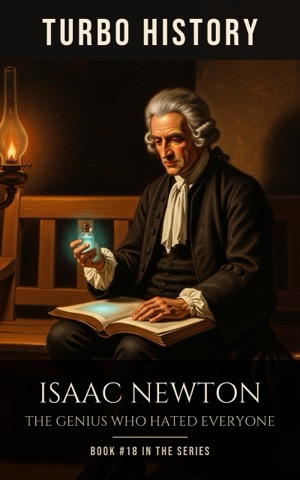
Isaac Newton: The Genius Who Hated Everyone book cover

Isaac Newton - The Genius Who Hated Everyone

Second, because he is the first man here whose work is published, checked and built on, which is the entire difference. The Principia in 1687 gave the world gravity, the laws of motion and the mathematics for both. He also spent more of his life on alchemy and biblical chronology than on physics, ran the Royal Mint and had counterfeiters hanged, and pursued Hooke and Leibniz with a spite that outlasted both men.

Read the book

03

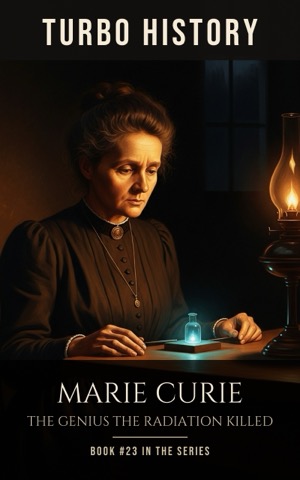
Marie Curie: The Genius the Radiation Killed book cover

Marie Curie - The Genius the Radiation Killed

Third, because this is where the work starts costing the person doing it. Shut out of university in Poland, she studied in secret classes, then boiled tonnes of pitchblende by hand in an unheated shed to isolate radium. The Nobel Prize in Physics came in 1903 and one in Chemistry in 1911, and she remains the only person to win in two different sciences. She died of aplastic anaemia, and her notebooks are still too radioactive to handle unprotected.

Read the book

04

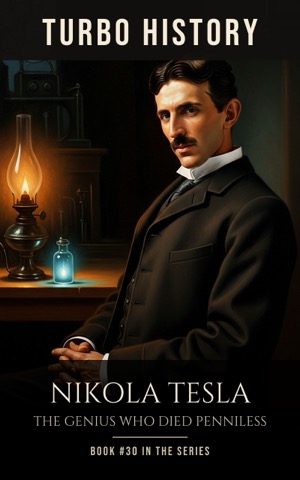
Nikola Tesla: The Genius Who Died Penniless book cover

Nikola Tesla - The Genius Who Died Penniless

Fourth, because being right and being paid turn out to be unrelated, and he is the clearest proof of it. The alternating-current system carrying electricity into your house is largely his, and he tore up the royalty agreement that would have made him one of the richest men alive. Around three hundred patents, a remote-controlled boat demonstrated in 1898 that nobody knew what to do with, and a death in a New York hotel in 1943 surrounded by debts and pigeons.

Read the book

05

Albert Einstein: The Mind That Bent Space and Time book cover

Albert Einstein - The Mind That Bent Space and Time

Last, because he closes the collection the way Leonardo opens it: one person thinking, except now the whole apparatus of modern science exists to check the answer. Four papers in 1905, written around a day job in a patent office. General relativity in 1915, confirmed by an eclipse expedition in 1919, which is the exact moment a physicist becomes a household name. The Nobel arrived in 1921, and not for relativity.

Read the book
End of the path

Five lives, five hundred years, and a straight line from notebooks nobody read to a surname that became a synonym for genius. Leonardo also sits in the Artists path, where the same unfinished work reads as an entirely different problem.

Fair warning

These are not academic books. You will not find footnotes to chase, family trees to memorise, or ten pages on the logistics of a treaty. Every book ends with a page of proper ones to go to next if you want that depth. If you want the story and the big picture in an hour, you are home.

Scientists and Inventors books go free most weekends.

Most weekends one Turbo History book goes completely free on Amazon, and often it is one of these. Leave your email and we will tell you which one, before it goes back to full price.

If you liked Scientists and Inventors

Same series, same hour, next to the ones you have just read.