If you want one big illustrated life, read Walter Isaacson's Leonardo da Vinci. If you want the man rather than the myth, read Charles Nicholl's The Flights of the Mind. If you want the leading scholar on how the science and the art were one project, read Martin Kemp. And if you have under an hour rather than a fortnight, ours covers the whole life in one sitting.
Every book listed here is real, in print, and worth the time. Reading times are honest estimates from page count at roughly 250 words per minute. Page counts vary between editions, particularly for Kenneth Clark, so treat them as approximate rather than exact.
The short version
Sorted by what you want, not by what is most famous.
| Book | Length | Best for |
|---|---|---|
| Leonardo da Vinci Walter Isaacson, 2017 | ~624 pages About 12 hours | The big illustrated life. The notebooks explained rather than just quoted |
| Leonardo da Vinci: The Flights of the Mind Charles Nicholl, 2004 | ~620 pages About 12 hours | The man rather than the myth. Biography built from scraps of archival evidence |
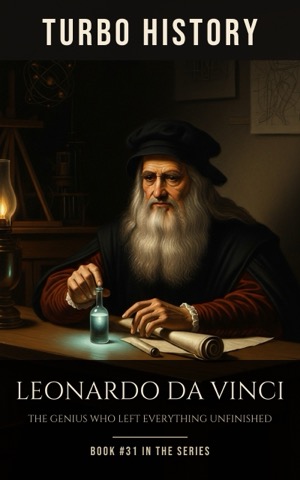
| Leonardo da Vinci: The Genius Who Left Everything Unfinished Turbo History · ours | ~7,800 words Under an hour | The whole life in one sitting. The workshop, the notebooks, and why so little of it got finished |
| Leonardo da Vinci: The Marvellous Works of Nature and Man Martin Kemp, 1981 | ~380 pages About 8 hours | The leading scholar's account. Science and art treated as a single enterprise |
| Leonardo Martin Kemp, 2004 | ~330 pages in the 2011 revised edition About 7 hours | Kemp's scholarship at manageable length. Compact, thematic, and still saying something new |
| Leonardo da Vinci: An Account of His Development as an Artist Kenneth Clark, 1939 | ~270 pages in the revised Penguin edition About 5 hours | The classic short study of the paintings. Elegant, confident art criticism |
| Leonardo and the Last Supper Ross King, 2012 | ~350 pages About 7 hours | One painting told in depth. Milan under Ludovico Sforza brought to life |
| Notebooks Leonardo da Vinci, selected and edited by Irma A. Richter, 1952 | ~420 pages About 8 hours, though it is built for dipping into | Leonardo in his own words. Arranged by theme, better browsed than read straight |
The picks, in detail
01
Leonardo da Vinci
Isaacson works through thousands of notebook pages and turns them into a clear narrative about how Leonardo's curiosity fed his painting. The colour illustrations matter, and the book is genuinely easy to read for its size. It is also repetitive about Leonardo's genius, and art historians grumble that it adds little new, so take it as excellent synthesis rather than original scholarship.
02
Leonardo da Vinci: The Flights of the Mind
Nicholl is a detective of a biographer, chasing tax records, court documents and marginal jottings to reconstruct Leonardo's daily life, his household and his moods. It is the most humanly convincing portrait available. It is also digressive and slow in places, and it spends less time on the paintings as paintings than an art-focused reader might want.
03
Leonardo da Vinci: The Genius Who Left Everything Unfinished ours
Every book on this list goes deeper than ours, and most of them are hard work. That is not a criticism, it is the entire point of them. Isaacson runs to about 624 pages and Nicholl to about 620. Kemp will take you through the optics and the anatomy as a single theory of nature. They are good books, and they want weeks of your life.
If you are studying this, that is exactly the right trade. If there is an exam at the end, or you need to argue about attributions, buy one of those and give it the time it deserves. We are not pretending to compete with them.
If you are not, ours might suit you better. It starts with an illegitimate boy from a small town who could not take the career his father's class assumed, goes into the Verrocchio workshop, and hits the first commissions and the first problems: the pattern of starting brilliantly and not finishing that followed him for fifty years. Then Milan and the Sforza years, the peak, and the last years in France. There is a chapter on the world that made him possible, including the French invasion that upended Italy and the fact that every artist in Florence was trying to beat every other. It ends on the method that actually changed things, the notebooks nobody read for centuries, what we genuinely got from him rather than what the legend claims, and a section called The Dark Side, because we do not tidy him up.
That is what the whole series is for. Love history, but hate how it was taught at school? Same. School turned it into a memory test: names, dates, family trees, exam. The actual story never stood a chance. Turbo History is one figure or one event per book, told in under an hour. The rise, the fall, and why it still matters. Dates included, memorising optional. Sources at the back if you want to go further, and every book on this page is a good place to go next.
04
Leonardo da Vinci: The Marvellous Works of Nature and Man
Kemp has spent a career on Leonardo and this is his central book, revised in 2006. It explains the underlying theory of nature that connects the anatomy, the optics, the engineering and the pictures. It is written for an informed audience, the argument is close-packed, and you will get more from it if you already know the basic biography.
05
Leonardo
This is Kemp writing for a wider readership, thematic rather than chronological, and much lighter to carry than his big study. The revised edition takes in two newly attributed works. Because it is organised by theme it does not give you a clean life story, so it works better as a second book than a first.
06
Leonardo da Vinci: An Account of His Development as an Artist
Clark's book has stayed in print for over eighty years because he writes about looking at pictures better than almost anyone. It is short, clear and full of judgements you can argue with. Some of the attributions and assumptions are dated, and Clark has little interest in the engineering and anatomy that occupy modern accounts.
07
Leonardo and the Last Supper
King narrows the focus to the years around the Last Supper and uses it to explain Leonardo's technique, his patrons and his habit of not finishing things. The political background of 1490s Milan is handled well and the pace is good. It is deliberately narrow, so it will not serve as a general introduction to Leonardo's life.
08
Notebooks
This Oxford selection arranges the notebooks by theme, covering painting, anatomy, water, flight, fables and more, with editorial commentary to give context. Reading Leonardo raw is a different experience from reading about him: fragmentary, repetitive and occasionally startling. Do not expect coherence, because the notebooks were never meant to be a book.
Questions people actually ask
What is the best book about Leonardo da Vinci?
For most readers it is Walter Isaacson's Leonardo da Vinci, which combines the notebooks, the paintings and the life into one readable illustrated volume. If you want scholarship rather than synthesis, Martin Kemp's Leonardo da Vinci: The Marvellous Works of Nature and Man is the more authoritative book. Charles Nicholl's Flights of the Mind is the best on Leonardo as a person.
Where should I start with Leonardo da Vinci?
Start with Isaacson if you want narrative momentum and pictures, or with Kenneth Clark if you mainly care about the paintings. Clark is under 300 pages and still the clearest short guide to how the art developed. Save Kemp for when you want the science and the art explained as a single project.
What is the best short book about Leonardo da Vinci?
Kenneth Clark's Leonardo da Vinci, at around 270 pages, is the classic short study and reads quickly. Martin Kemp's Leonardo is slightly longer but more up to date and includes recent attributions. Our own version covers the whole life in under an hour if you want the shape of it tonight.
Should I read Leonardo's notebooks?
Yes, but as a companion rather than a starting point, and in a curated selection such as the Oxford edition edited by Irma Richter. The notebooks are fragmentary and unedited, so they reward browsing rather than straight reading. Reading a biography first gives you the context that makes the fragments make sense.
Which book is best on Leonardo the scientist and engineer?
Martin Kemp's The Marvellous Works of Nature and Man is the strongest account of how the anatomy, optics and mechanics connect to the painting. Isaacson also covers this ground well and much more easily, if less rigorously. Kemp assumes a reasonably informed reader, so it is worth doing a general biography first.
This book is free sometimes. Want to know when?
Leonardo da Vinci goes free on Amazon from time to time, along with the rest of the series. Leave your email and we will tell you the moment it does.
More from the series
One figure or one event per book. Under an hour each.