If you want one full biography, read David Herbert Donald's Lincoln. If you want the deepest account there is and have a month spare, read Michael Burlingame's two-volume Abraham Lincoln: A Life. If you want the presidency told as a story you cannot put down, read Doris Kearns Goodwin's Team of Rivals, and if you want the hardest question handled properly, read Eric Foner's The Fiery Trial on Lincoln and slavery. And if you have under an hour rather than a month, ours covers the whole life in one sitting. Everything below is sorted by what you are actually trying to get out of it.
Every book listed here is real, in print or easily found, and worth the time. Reading times are honest estimates from page count at roughly 250 words per minute. Be warned that the Burlingame is close to two thousand pages across two volumes, which is a genuine commitment rather than a figure of speech, and that page counts vary between editions.
The short version
Sorted by what you want, not by what is most famous.
| Book | Length | Best for |
|---|---|---|
| Abraham Lincoln: A Life Michael Burlingame, 2008 | ~1,976 pages across two volumes About 55 hours | The complete life at maximum depth. Every year, every quarrel, every source Burlingame could find |
| Lincoln David Herbert Donald, 1995 | ~714 pages About 20 hours | The one-volume standard. A single clear argument about a man who let events act on him |
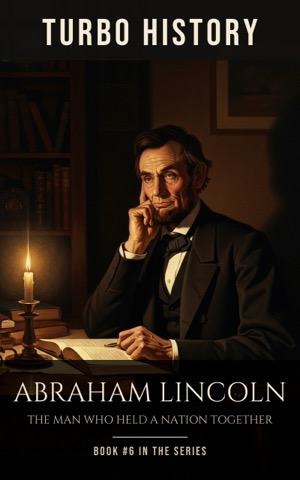
| Abraham Lincoln Turbo History · ours | ~7,400 words Under an hour | The whole life in one sitting. Cabin to Ford's Theatre, including what he changed and what he got wrong |
| Team of Rivals: The Political Genius of Abraham Lincoln Doris Kearns Goodwin, 2005 | ~944 pages About 26 hours | Lincoln through his cabinet. Group biography that shows the political skill in action |
| A. Lincoln: A Biography Ronald C. White Jr., 2009 | ~800 pages About 22 hours | The inner life and the writing. How a self-taught lawyer became the best writer among American presidents |
| The Fiery Trial: Abraham Lincoln and American Slavery Eric Foner, 2010 | ~450 pages About 12 hours | The single hardest question, handled properly. What Lincoln actually thought about slavery and race, and when |
| Lincoln's Melancholy: How Depression Challenged a President and Fueled His Greatness Joshua Wolf Shenk, 2005 | ~360 pages About 10 hours | The specialist angle that changes the whole picture. Lifelong depression as fact, not metaphor |
| Lincoln at Gettysburg: The Words That Remade America Garry Wills, 1992 | ~320 pages About 9 hours | Two hundred and seventy-two words, unpacked completely. A short book with an outsized argument |
| Abraham Lincoln James M. McPherson, 2009 | ~96 pages About 3 hours | The whole life in one sitting. A leading Civil War historian compressing without dumbing down |
The picks, in detail
01
Abraham Lincoln: A Life
This is the modern scholarly doorstop, two volumes from Johns Hopkins that draw on decades of digging in newspapers, letters and interview notes earlier biographers never used. Nothing else comes close on sheer evidence, and Burlingame is not shy about judging people. The cost is real: it is close to two thousand pages, the detail is relentless, and the prose is workmanlike rather than elegant.
02
Lincoln
Donald built the book around Lincoln's own line that he did not control events but confessed events controlled him, and he sticks to what Lincoln could plausibly have known at each moment. That discipline makes it the most honest single-volume life we have. It is long and deliberately unheroic, so readers who want inspiration will find it cool to the touch.
03
Abraham Lincoln ours
Every book on this list goes deeper than ours, and most of them are hard work. That is not a criticism, it is the entire point of them. Burlingame gives you roughly 1,976 pages across two volumes. Donald gives you 714 pages and expects you to think about every one of them. They are excellent books, and they want weeks of your life.
If you are studying Lincoln, sitting an exam, or writing about him, buy one of those and give it the time it deserves. We are not pretending to compete with them.
If you are not, ours might suit you better. It starts in the one-room Kentucky cabin, with his mother dead of milk sickness when he was nine, his sister dead in childbirth when he was eighteen, and a father who hired him out to neighbours and kept the wages. It covers the flatboat trips to New Orleans and the slave markets he saw there, the self-taught law books, the bar in 1836, then the rise through Illinois politics to the presidency, the war, emancipation and the assassination. There is a chapter on what else was happening in the world at the same time, in Europe, China, India, Africa and the rest of the Americas, so he is not floating in a vacuum. And it ends on what actually changed: secession settled by force, the Thirteenth Amendment, the Gettysburg Address rewriting what the country was for. There is a full section on the dark side too, the suspended habeas corpus, the limits of the Emancipation Proclamation, his support for colonisation, his own words in the Douglas debates, and the thirty-eight Dakota men he sent to the gallows.
That is what the whole series is for. Love history, but hate how it was taught at school? Same. School turned it into a memory test: names, dates, family trees, exam. The actual story never stood a chance. Turbo History is one figure or one event per book, told in under an hour. The rise, the fall, and why it still matters. Dates included, memorising optional. Sources at the back if you want to go further, and every book on this page is a good place to go next.
04
Team of Rivals: The Political Genius of Abraham Lincoln
Goodwin tells the story through Seward, Chase and Bates as well as Lincoln, which is the best way anyone has found to show what his political judgement actually looked like day to day. It reads like a novel and it is the reason a lot of people care about Lincoln at all. Be aware that it is generous to its subject and skips lightly over the first fifty years of his life.
05
A. Lincoln: A Biography
White is very good on Lincoln's language, his religious thinking and his moral development, and he takes the prairie lawyer years seriously instead of rushing to 1860. If you finished Donald and wanted more interior life, this is the follow-up. It is warmer towards Lincoln than Donald or Burlingame, and at 800 pages it asks for real commitment.
06
The Fiery Trial: Abraham Lincoln and American Slavery
Foner tracks Lincoln's views year by year and refuses both the saint and the cynic version, showing a man whose position genuinely moved under pressure from abolitionists and from Black Americans themselves. It won the Pulitzer and it is the book to read if you have heard the argument that Lincoln was no friend of emancipation. It assumes some background on the 1850s, so it is not a first book.
07
Lincoln's Melancholy: How Depression Challenged a President and Fueled His Greatness
Shenk gathers the contemporary evidence for Lincoln's severe and recurring depression and traces how he lived with it across forty years. It is careful about the sources and avoids diagnosing at long range more than the evidence allows. The claim in the subtitle, that the illness fed the greatness, is the weakest part, and you can take the book's evidence without buying its thesis.
08
Lincoln at Gettysburg: The Words That Remade America
Wills takes the Gettysburg Address apart and argues that it quietly rewrote what the American founding meant, replacing the Constitution's compromises with the Declaration's promise. It won the Pulitzer and it is the most intellectually exciting short book on Lincoln. It is dense for its length, with detours into Greek funeral oratory and nineteenth-century rhetoric that some readers will skim.
09
Abraham Lincoln
McPherson wrote this for the Lincoln bicentennial and it is the best short introduction in print: the full arc from Kentucky to Ford's Theatre, with the war leadership handled by someone who has spent a career on it. The annotated bibliography at the back tells you where to go next. At 96 pages it is a sketch, so it states conclusions rather than arguing them.
Questions people actually ask
What is the best book about Abraham Lincoln?
For a single volume, David Herbert Donald's Lincoln (1995) is still the standard: about 714 pages, tightly argued, and disciplined about only using what Lincoln could have known at the time. If you want the most complete account regardless of length, it is Michael Burlingame's two-volume Abraham Lincoln: A Life, which runs close to two thousand pages. Team of Rivals is the most enjoyable but it is a book about Lincoln and his cabinet, not a full life.
Where should I start with Abraham Lincoln?
Start with James McPherson's Abraham Lincoln, a 96-page overview that gives you the shape of the life in an evening. Then go to Donald's Lincoln for the full biography, or to Goodwin's Team of Rivals if you would rather be pulled along by narrative. Leave Burlingame until you know you want the deep version.
What is the best short book about Abraham Lincoln?
McPherson's Abraham Lincoln (2009) at about 96 pages is the best true short biography. If you want a short book that argues something rather than summarising, read Garry Wills's Lincoln at Gettysburg, roughly 320 pages and worth every one of them. Our own hour-long version covers the whole life if you want the shape of it tonight.
Which Lincoln book should I read about slavery and emancipation?
Eric Foner's The Fiery Trial, which won the Pulitzer in 2011. It follows Lincoln's thinking year by year and shows a man whose views on slavery and racial equality changed under pressure rather than arriving fully formed. It is the honest middle ground between the emancipator myth and the argument that he did not care, and it will spoil you for simpler accounts.
Is Team of Rivals a good biography of Lincoln?
It is a very good book but not really a biography. Goodwin covers Lincoln alongside Seward, Chase and Bates, which is brilliant for showing his political skill in the White House years, but the first five decades of his life go by quickly. Read it for the presidency and pair it with Donald or Ronald White for the rest of the life.
This book is free sometimes. Want to know when?
Abraham Lincoln goes free on Amazon from time to time, along with the rest of the series. Leave your email and we will tell you the moment it does.
More from the series
One figure or one event per book. Under an hour each.