If you want one big modern life, read Ron Chernow's Grant. If you want the same story at two thirds the length and with a sharper eye on the presidency, read Jean Edward Smith's Grant or Ronald C. White's American Ulysses. If you only ever read one thing Grant touched, make it his own Personal Memoirs, finished days before he died and still one of the best books any American has written. Joan Waugh's U.S. Grant: American Hero, American Myth explains why his reputation was destroyed and then rebuilt. And if you have under an hour rather than a month, ours covers the whole life in one sitting.
Every book listed here is real, in print or easily found second hand, and worth the time. Reading times are honest estimates from page count. One thing worth knowing before you start: Grant's reputation was wrecked a generation after his death by Lost Cause writers and the Dunning School historians who followed them, and for about seventy years he was filed as a butcher on the battlefield and a fool in the White House. Serious scholarship since the 1980s has largely reversed that, which is why the recent books on this page read so differently from anything written before about 1960. Older books are still worth reading, but read them knowing which argument they are inside.
The short version
Sorted by what you want, not by what is most famous.
| Book | Length | Best for |
|---|---|---|
| Grant Ron Chernow, 2017 | ~1,104 pages About 31 hours | The fullest modern life. One continuous narrative from Ohio tannery to deathbed manuscript |
| American Ulysses: A Life of Ulysses S. Grant Ronald C. White, 2016 | ~880 pages About 25 hours | The archive-first modern life. Seven years of primary research, strong on the man rather than the myth |
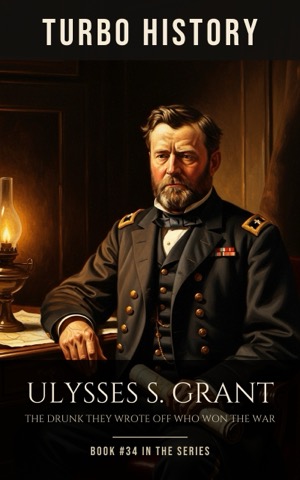
| Ulysses S. Grant: The Drunk They Wrote Off Who Won the War Turbo History · ours | ~7,900 words Under an hour | The whole life in one sitting. Failure, Vicksburg, Appomattox, the Klan prosecutions, and why his name was dragged through the mud for seventy years |
| Grant Jean Edward Smith, 2001 | ~781 pages About 22 hours | The best single volume on Grant as president. The book that turned the rehabilitation into a case |
| Personal Memoirs Ulysses S. Grant, 1885 | ~704 pages About 20 hours | Grant in his own voice. Written while dying of throat cancer to keep his family out of poverty |
| Grant Takes Command Bruce Catton, 1969 | ~556 pages About 16 hours | The classic on Grant as a general. Vicksburg to Appomattox, written by the best Civil War prose stylist there is |
| U.S. Grant: American Hero, American Myth Joan Waugh, 2009 | ~373 pages About 11 hours | The argument rather than the life. How Grant went from national hero to national joke and back |
| Ulysses S. Grant: The American Presidents Series Josiah Bunting III, 2004 | ~208 pages About 6 hours | The short serious version. A brief, sympathetic account focused on the eight years in office |
The picks, in detail
01
Grant
Chernow is a narrative biographer rather than a Civil War specialist, and the result is the most readable long Grant book there is, unusually frank about the drinking without turning the whole life into a drink problem. It gives Reconstruction and the fight against the Klan the space they deserve, which older books did not. The cost is bulk: 1,104 pages is a month of evenings, and military historians have argued that the battle chapters are the weakest part of it.
02
American Ulysses: A Life of Ulysses S. Grant
White worked through the papers for seven years and found material earlier biographers had not used, and he is particularly good on Grant's religion, his marriage and his silences. It came out a year before Chernow and covers much of the same ground with a quieter voice. It is still nearly 900 pages, and it is less dramatic than Chernow, so if you want propulsion rather than patience this is not the one.
03
Ulysses S. Grant: The Drunk They Wrote Off Who Won the War ours
Every book on this list goes deeper than ours, and most of them are hard work. That is not a criticism, it is the entire point of them. Chernow gives you 1,104 pages. Jean Edward Smith gives you 781. They are good books, and they want a month of your life.
If you are studying Grant, writing about him, or sitting an exam on the Civil War or Reconstruction, buy one of those and give it the time it deserves. We are not pretending to compete with them.
If you are not, ours might suit you better. It starts with the name he never used, a boy who was good with horses and bad at everything his father wanted, seven years of failure that ended with him selling firewood on a St Louis street corner, and then the war that turned him into the man who took Vicksburg and finally cornered Lee. The second half is the part most people have never been told: the Justice Department created to prosecute the Klan, the federal troops sent south, the Fifteenth Amendment, the Civil Rights Act of 1875, and then the North losing interest and Reconstruction dying. It does not tidy up the dark side either, and there is a section on his catastrophic Indian policy, the Whiskey Ring and the friends he refused to believe were crooks, plus a chapter on why his reputation collapsed for seventy years and what changed.
That is what the whole series is for. Love history, but hate how it was taught at school? Same. School turned it into a memory test: names, dates, family trees, exam. The actual story never stood a chance. Turbo History is one figure or one event per book, told in under an hour. The rise, the fall, and why it still matters. Dates included, memorising optional. Sources at the back if you want to go further, and every book on this page is a good place to go next.
04
Grant
Smith was a political scientist and biographer of judges and generals, and his argument is blunt: Grant was a badly underrated president who used federal power for civil rights harder than anyone until the 1960s. This was a Pulitzer finalist and it set the terms most later books argue inside. It is drier than Chernow and the campaign narrative is compressed, so read it for the presidency rather than the war.
05
Personal Memoirs
This is the primary source and it is also, by common agreement, one of the great American books: plain, exact, entirely without self-pity, and famously admired by Mark Twain who published it and by writers ever since. He wrote it broke and in agony and finished days before he died. Be clear about what it is not: it stops at the end of the war, says almost nothing about the presidency, and it is Grant's own account of disputes he was a party to, so check the contested bits against a modern biography.
06
Grant Takes Command
Catton knew how to write a campaign, and this volume takes Grant from mid 1863 to the surrender with a clarity about logistics and command decisions that the general biographies skate over. If your interest is how Grant actually won, start here rather than with Chernow. It is one part of a trilogy so it assumes you know the earlier years, and being written in the 1960s it has nothing useful on the presidency.
07
U.S. Grant: American Hero, American Myth
Waugh does not retell the biography, she tracks the reputation: the enormous funeral, the tomb, the Lost Cause counterattack, the Dunning School, the long slump and the recent recovery. It is the single most useful book on this page for understanding why people disagree about Grant so violently. It assumes you already know the chronology, so read it second rather than first.
08
Ulysses S. Grant: The American Presidents Series
Bunting was a soldier and a college head before he was a writer, and he gets a defence of Grant's presidency into roughly 200 pages without padding. If you want an adult short book rather than a doorstop, this is the obvious one. It is a series volume with a strict length limit, so the war years are handled quickly and the scandals get less scrutiny than a critic would want.
Questions people actually ask
What is the best book about Ulysses S. Grant?
Ron Chernow's Grant (2017) is the standard recommendation: the fullest modern life, well written, and honest about the drinking. If 1,104 pages is too much, Jean Edward Smith's Grant (2001) covers the same ground in 781 pages and is better on the presidency. Ronald C. White's American Ulysses is the third option and is the most heavily researched of the three.
Are Grant's Personal Memoirs worth reading?
Yes, and they are the best written thing on this page. Grant wrote them while dying of throat cancer, to leave his family something after a swindler wiped out his savings, and finished days before his death in 1885. The prose is plain and exact and the book has been admired by writers ever since. The catch is that it ends with the Civil War and tells you nothing about his presidency, so it is a companion to a biography rather than a replacement for one.
Why was Grant considered a bad president for so long?
Because the people who wrote the history had reasons to say so. Lost Cause writers needed the general who beat Lee to be a butcher and a drunk, and the Dunning School historians who dominated Reconstruction scholarship into the twentieth century treated his defence of Black voting rights as the great mistake of the era. His administration's real corruption scandals gave them material. Joan Waugh's U.S. Grant: American Hero, American Myth traces exactly how that happened and how it was undone.
What is the best short book about Ulysses S. Grant?
Josiah Bunting's Ulysses S. Grant in the American Presidents Series, at roughly 208 pages, is the shortest serious adult book and concentrates on the presidency. Joan Waugh's book is about 373 pages and is short by Grant standards while being far more interesting than a summary. Our own hour-long version covers the whole life if you want the shape of it tonight.
What should I read about Grant as a general rather than a president?
Bruce Catton's Grant Takes Command is still the best account of Grant at war, taking him from Vicksburg through to Appomattox with real clarity about supply, movement and command. Read Grant's own Personal Memoirs alongside it for his version of the same campaigns. Skip the presidency books entirely if the war is all you want, since they compress it.
This book is free sometimes. Want to know when?
Ulysses S. Grant goes free on Amazon from time to time, along with the rest of the series. Leave your email and we will tell you the moment it does.
More from the series
One figure or one event per book. Under an hour each.