If you want one full biography, read A. N. Wilson's Victoria: A Life. If you want the modern one built on fresh archive work, read Julia Baird's Victoria: The Queen. If you want to understand why the Victoria we think we know is partly a construction, read Yvonne Ward's Censoring Queen Victoria, which is the most useful short book on this page. And if you have under an hour rather than a month, ours covers the whole reign in one sitting. Everything below is sorted by what you are actually trying to get out of it.
Every book listed here is real, in print or easily found in a library, and worth the time. Reading times are honest estimates from page count at roughly 250 words per minute, so treat them as a guide rather than a promise. One thing to know before you start: Victoria's family managed her image hard after she died. Her youngest daughter Beatrice copied out the journals and destroyed the originals, cutting whatever she thought unsuitable, and the first published editions of the letters were selected by two courtiers with their own ideas about what a queen should sound like. A large amount of Victoria survives, but a lot of it reaches us already edited, and the books below disagree about how much that matters.
The short version
Sorted by what you want, not by what is most famous.
| Book | Length | Best for |
|---|---|---|
| Victoria: A Life A. N. Wilson, 2014 | ~656 pages About 19 hours | The best readable one-volume life. Strong on the politics without losing the person |
| Victoria: The Queen: An Intimate Biography of the Woman Who Ruled an Empire Julia Baird, 2016 | ~768 pages About 22 hours | The fullest modern life. New archive material and a serious look at what the family suppressed |
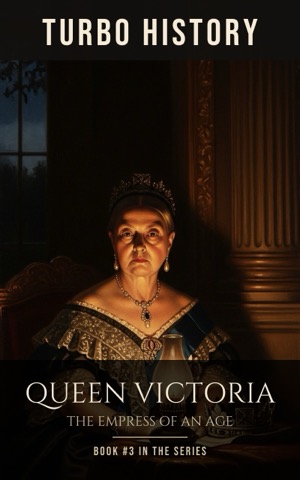
| Queen Victoria Turbo History · ours | ~6,800 words Under an hour | The whole reign in one sitting. How a sheltered girl became the name of an era, and what her empire cost |
| Queen Victoria: A Personal History Christopher Hibbert, 2000 | ~557 pages About 16 hours | The daily texture of her life. Household, servants, food, temper, family rows |
| Queen Victoria: Daughter, Wife, Mother, Widow Lucy Worsley, 2018 | ~528 pages About 15 hours | A different structure. Twenty-four single days, each opened up into the whole life |
| Victoria R.I. Elizabeth Longford, 1964 | ~635 pages About 18 hours | The classic that every later biographer argues with. First serious use of the Royal Archives |
| Censoring Queen Victoria: How Two Gentlemen Edited a Queen and Created an Icon Yvonne M. Ward, 2014 | ~224 pages About 6 hours | The specialist angle that changes everything else. How the published Victoria was manufactured |
| Victoria: Queen, Matriarch, Empress Jane Ridley, 2015 | ~160 pages About 4 hours | The fastest serious print introduction. A real historian's summary in one evening |
| Leaves from the Journal of Our Life in the Highlands Queen Victoria, 1868 | ~315 pages About 9 hours | Victoria in her own words. Primary source, published by her, in her lifetime |
The picks, in detail
01
Victoria: A Life
Wilson writes fast, opinionated narrative and is very good at placing Victoria inside the century she gave her name to, rather than treating her as a private woman who happened to wear a crown. He is sharp on Albert, on the prime ministers, and on how much power she actually had. The cost is length and tone, since it runs to about 656 pages and Wilson editorialises, so you are always reading his verdict alongside the evidence.
02
Victoria: The Queen: An Intimate Biography of the Woman Who Ruled an Empire
Baird went back to documents earlier biographers had not used and is direct about the censorship of the journals and the reworking of Victoria's reputation after 1901. It balances the political reign against the marriage, the pregnancies and the widowhood better than almost anything else on this list. It is also the longest book here at around 768 pages, and the middle stretch of the reign moves slowly.
03
Queen Victoria ours
Every book on this list goes deeper than ours, and most of them are hard work. That is not a criticism, it is the entire point of them. Baird gives you around 768 pages built on documents nobody had used properly before. Longford's classic runs to about 635 pages of Royal Archives material. They are good books, and they want weeks of your life.
If you are studying Victoria properly, or sitting an exam on the nineteenth century, buy one of those and give it the time it deserves. We are not pretending to compete with them.
If you are not, ours might suit you better. It starts with the succession crisis that made her birth matter, the deaths that cleared her path to the throne, and the Kensington System that controlled her childhood. Then Albert, the accession at eighteen, and the reign itself in four movements: rise, expansion, domination, and the long final years. There is a chapter on what the rest of the world was doing while she reigned, from China and India to Africa and the Americas. It ends on why she still matters: the makeover she gave the monarchy, the grandchildren she placed on half of Europe's thrones who then led their countries into the First World War, the empire she made respectable, the Irish famine that got her the name the Famine Queen, and the haemophilia she passed down her own bloodline.
That is what the whole series is for. Love history, but hate how it was taught at school? Same. School turned it into a memory test: names, dates, family trees, exam. The actual story never stood a chance. Turbo History is one figure or one event per book, told in under an hour. The rise, the fall, and why it still matters. Dates included, memorising optional. Sources at the back if you want to go further, and every book on this page is a good place to go next.
04
Queen Victoria: A Personal History
Hibbert was a professional popular historian and this is him at full strength: anecdote-rich, quotable, and built out of letters and diaries rather than policy papers. If you want to know what Victoria was actually like to be near, this is the book. It is deliberately personal rather than political, so you will finish it knowing her household better than her governments.
05
Queen Victoria: Daughter, Wife, Mother, Widow
Worsley picks a set of specific days and works outward from each one, which makes a long reign feel navigable and keeps the pace up. She is good on how Victoria performed womanhood in public and on the gap between the image and the letters. The structure is also the weakness, since it skips, so you get depth in patches rather than a continuous account of the reign.
06
Victoria R.I.
Longford had access to the Royal Archives and produced the book that set the shape of modern Victoria biography, winning the James Tait Black Memorial Prize for it. It is still an excellent narrative and its handling of Albert and of the long widowhood holds up. It is sixty years old, its instincts about empire and about Victoria's servants are of their time, and later writers have corrected it in places.
07
Censoring Queen Victoria: How Two Gentlemen Edited a Queen and Created an Icon
Ward looks at Viscount Esher and Arthur Benson, the two men who selected and edited Victoria's letters for publication after her death, and shows what they left out and why. It is the book that explains why so much writing about Victoria repeats the same narrow set of quotations. It is a narrow study rather than a life, so read it second, once you already know the chronology.
08
Victoria: Queen, Matriarch, Empress
Ridley wrote a major life of Edward VII, so this Penguin Monarchs volume is a specialist compressing what she knows rather than a beginner's summary. It gives you the arc, the arguments and a clear line on Victoria's political role in very few pages. It assumes you want the verdict more than the detail, so the famous episodes get a paragraph where other books give a chapter.
09
Leaves from the Journal of Our Life in the Highlands
This is a genuine primary source: extracts from her own Highland journals, chosen and released by her, and a bestseller when it appeared. The voice is plain, enthusiastic and often funny about weather, ponies and picnics, and it shows exactly the domestic image she wanted the public to have. Treat it as evidence of self-presentation rather than an unguarded diary, because she picked what went in and John Brown looms over what she left out.
Questions people actually ask
What is the best book about Queen Victoria?
For one full-length life, A. N. Wilson's Victoria: A Life (2014) is the best balance of readability and coverage of the reign, at around 656 pages. If you want the most recent research and a franker account of what the family suppressed after her death, Julia Baird's Victoria: The Queen (2016) is the one, though it is closer to 768 pages. Elizabeth Longford's Victoria R.I. is still the classic both of them are arguing with.
Where should I start with Queen Victoria?
Start with A. N. Wilson's Victoria: A Life. It moves, it covers the whole sixty-three years, and it keeps the politics and the private life in the same frame. If 656 pages is too much for a first attempt, Jane Ridley's Victoria: Queen, Matriarch, Empress does the job in about 160 pages, and our own hour-long version covers the shape of the reign tonight.
What is the best short book about Queen Victoria?
Jane Ridley's Victoria: Queen, Matriarch, Empress, at roughly 160 pages, is the best short print option and it is written by a serious historian of the period rather than a summariser. Yvonne Ward's Censoring Queen Victoria is also short at about 224 pages, but it is a specialist study of how her letters were edited rather than a life story. Ours takes under an hour if you want the whole reign in one go.
Are Queen Victoria's own journals reliable?
Only up to a point, and this is the single most important thing to know about reading her. Victoria wrote an enormous amount, but after her death her youngest daughter Beatrice copied the journals out by hand, edited as she went, and destroyed the originals. The first published volumes of letters were also selected by two courtiers, Viscount Esher and Arthur Benson, who had firm views about what a queen should be seen to say. Yvonne Ward's Censoring Queen Victoria is the book that lays this out.
Which book covers Victoria and the British Empire?
None of the standard biographies is primarily an empire book, which is worth knowing before you buy one. Wilson and Baird both handle the imperial reign and the title of Empress of India seriously within a life of Victoria, and Baird is the more critical of the two. If the empire is your main interest, read a general history of Victorian imperialism alongside a biography rather than expecting one book to do both.
This book is free sometimes. Want to know when?
Queen Victoria goes free on Amazon from time to time, along with the rest of the series. Leave your email and we will tell you the moment it does.
More from the series
One figure or one event per book. Under an hour each.