If you want one book, read Adrian Goldsworthy's The Fall of Carthage, which covers the whole conflict in clear modern prose. If you want a life of the man himself, read Eve MacDonald's Hannibal: A Hellenistic Life. If you want the shortest reliable version, Dexter Hoyos does it in about 176 pages. And if you have under an hour rather than a fortnight, ours covers the whole story in one sitting.
Every book listed here is real and worth the time. Reading times are honest estimates from page count at roughly 250 words per minute. One thing worth saying up front: Carthage lost, and its own literature was destroyed, so almost every surviving account of Hannibal was written by his enemies. The two ancient sources below are included and clearly labelled as primary sources, because judging the evidence yourself is part of the fun here.
The short version
Sorted by what you want, not by what is most famous.
| Book | Length | Best for |
|---|---|---|
| The Fall of Carthage: The Punic Wars 265-146 BC Adrian Goldsworthy, 2000 | ~416 pages About 8 hours | The whole conflict in modern prose. Hannibal placed inside the war that made him |
| Hannibal: A Hellenistic Life Eve MacDonald, 2015 | ~320 pages About 6 hours | The modern biography. Archaeology as well as texts, and Carthage on its own terms |
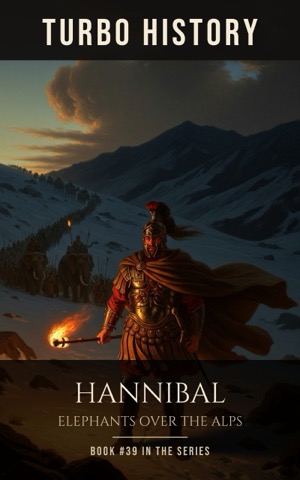
| Hannibal: Elephants Over the Alps Turbo History · ours | ~7,100 words Under an hour | The whole campaign in one sitting. The Alps, Cannae, and why winning every battle still lost him the war |
| Hannibal's War: A Military History of the Second Punic War J. F. Lazenby, 1978 | ~340 pages About 7 hours | The scholarly military account. Routes, numbers and battlefield reconstructions weighed properly |
| Hannibal Serge Lancel, 1995, English translation 1998 | ~250 pages About 5 hours | A compact life from a Carthage archaeologist. Strong on the Punic world behind the general |
| Hannibal: Rome's Greatest Enemy Dexter Hoyos, 2008 | ~176 pages About 4 hours | The shortest reliable overview. A specialist's verdict without a long book |
| The Rise of the Roman Empire Polybius, translated by Ian Scott-Kilvert, c. 150 BC, this translation 1979 | ~576 pages About 11 hours | Primary source. The account closest to the events, by someone who spoke to people who were there |
| The War with Hannibal Livy, translated by Aubrey de Selincourt, c. 25 BC, this translation 1965 | ~720 pages About 14 hours | Primary source. The dramatic ancient narrative that shaped how Europe imagined Hannibal |
| Carthage Must Be Destroyed: The Rise and Fall of an Ancient Civilization Richard Miles, 2010 | ~560 pages About 11 hours | Carthage itself rather than Hannibal alone. How the losing side has been remembered |
The picks, in detail
01
The Fall of Carthage: The Punic Wars 265-146 BC
Goldsworthy is a Roman army specialist who writes clearly, and this covers all three Punic Wars with sane judgements about numbers, logistics and battle tactics. It is the best single starting point on Hannibal even though it is not a biography of him. The Roman perspective dominates, partly because the sources do, so Carthage stays somewhat in shadow.
02
Hannibal: A Hellenistic Life
MacDonald sets Hannibal in the Hellenistic world rather than treating him only as Rome's nemesis, and uses material evidence to fill gaps the literary sources leave. It is the most current single-volume life in English. Because the evidence is genuinely thin, she is often careful and provisional where readers might want certainty, which some find frustrating.
03
Hannibal: Elephants Over the Alps ours
Every book on this list goes deeper than ours, and most of them are hard work. That is not a criticism, it is the entire point of them. Livy runs to about 720 pages and Miles to about 560. Lazenby will take you through disputed march routes and troop numbers line by line. They are good books, and they want weeks of your life.
If you are studying this, that is exactly the right trade. If there is an exam at the end, or you need to know which pass he crossed and what the evidence for it is, buy one of those and give it the time it deserves. We are not pretending to compete with them.
If you are not, ours might suit you better. It runs from Carthage after the first war with Rome and the oath a boy is said to have sworn to his father, through the march over the Alps, to Cannae, one of the most studied battles in military history and still the model for encircling a larger enemy. Then it asks the question that actually matters: how a general who beat Rome repeatedly in the field still lost, what happened when the war followed him home to Zama, and how a man who terrified a republic ended up dying in exile. It closes on what he changed, including the uncomfortable fact that Rome learned more from losing to him than he ever gained from winning.
That is what the whole series is for. Love history, but hate how it was taught at school? Same. School turned it into a memory test: names, dates, family trees, exam. The actual story never stood a chance. Turbo History is one figure or one event per book, told in under an hour. The rise, the fall, and why it still matters. Dates included, memorising optional. Sources at the back if you want to go further, and every book on this page is a good place to go next.
04
Hannibal's War: A Military History of the Second Punic War
Lazenby wrote the first serious English-language study devoted to the Second Punic War in nearly a century, and it remains a reference point for the campaigns. He weighs Polybius against Livy carefully and is honest about what cannot be known. It is written for classicists, so the prose is dry and it assumes familiarity with the ancient sources.
05
Hannibal
Lancel excavated at Carthage and brings that knowledge to a short, well-judged biography, published in French in 1995 and in English translation in 1998. He is particularly good on Carthaginian religion and society. The translation reads a little stiffly and the military narrative is brisker than a campaign-focused reader might like.
06
Hannibal: Rome's Greatest Enemy
Hoyos has written extensively on Carthage and this short volume gives you the life, the campaigns and a clear assessment of why Hannibal lost. It is the quickest way to get a defensible picture of the man. It is compressed, with little room for atmosphere or narrative colour, so it informs more than it grips.
07
The Rise of the Roman Empire
Polybius was writing within a lifetime of the war, had access to survivors, and is the most trustworthy ancient account of Hannibal we have. He is analytical and often dull, more interested in explaining Roman success than in telling a good story. This Penguin volume is a selection rather than the complete Histories, which is worth knowing before you buy.
08
The War with Hannibal
Livy tells the war as a story, with speeches, portents and set pieces, and it is far more enjoyable to read than Polybius. He is also writing nearly two centuries after the events, is openly patriotic, and invents freely where it suits the drama. Read it for the narrative, then check it against Polybius and Goldsworthy.
09
Carthage Must Be Destroyed: The Rise and Fall of an Ancient Civilization
Miles reconstructs Carthaginian history and culture across centuries, drawing on archaeology to counter the fact that almost everything written about Carthage was written by its enemies. Hannibal occupies a substantial section rather than the whole book. It is long and its middle chapters move slowly, so approach it as background rather than as a Hannibal biography.
Questions people actually ask
What is the best book about Hannibal?
Adrian Goldsworthy's The Fall of Carthage is the best single book for most readers, even though it covers all three Punic Wars rather than Hannibal alone. For a modern biography of the man specifically, Eve MacDonald's Hannibal: A Hellenistic Life is the strongest recent choice. Serious military readers should add J. F. Lazenby's Hannibal's War.
Where should I start with Hannibal?
Start with Goldsworthy's The Fall of Carthage, which gives you the war, the strategy and the context in clear modern prose. If you want to go straight to a life of Hannibal, MacDonald is the better entry point than the older scholarly studies. Leave the ancient sources until you know the shape of the story.
What is the best short book about Hannibal?
Dexter Hoyos's Hannibal: Rome's Greatest Enemy runs to around 176 pages and is written by a genuine Carthage specialist. It gives you the campaigns and a clear judgement on why Hannibal ultimately failed. Serge Lancel's Hannibal is a little longer at around 250 pages and adds an archaeologist's feel for the Punic world. Our own version covers the story in under an hour if you want the shape of it tonight.
Should I read the ancient sources on Hannibal?
Yes, because there are only two that matter and both are available in good Penguin translations. Polybius is the more reliable, writing within living memory of the war, but he is analytical and often dry. Livy is much more fun to read and much less trustworthy, so treat his speeches and numbers with suspicion.
Why are there fewer books on Hannibal than on other ancient figures?
Because Carthage lost and its literature was destroyed, so nearly every surviving account of Hannibal was written by Romans. That leaves modern historians reconstructing him from hostile sources and archaeology, which limits how much can honestly be said. Richard Miles's Carthage Must Be Destroyed is the best book on that problem and on the civilisation behind him.
This book is free sometimes. Want to know when?
Hannibal goes free on Amazon from time to time, along with the rest of the series. Leave your email and we will tell you the moment it does.
More from the series
One figure or one event per book. Under an hour each.