If you want one book, read Colin Woodard's The Republic of Pirates, which puts Blackbeard inside the Nassau pirate republic he came out of. If you want a straight biography, read Angus Konstam's Blackbeard: America's Most Notorious Pirate, which is the most careful life of the man himself. If you want to know where the legend came from, read Captain Charles Johnson's 1724 A General History of the Pyrates, keeping in mind that it mixes documented fact with invention. And if you have under an hour rather than a fortnight, ours covers the whole career in one sitting. Everything below is sorted by what you are actually trying to get out of it.
Every book listed here is real, in print or easily found second hand, and worth the time. Reading times are honest estimates from page count, not measurements. One warning specific to this subject. A very large share of what people believe about Blackbeard traces back to a single book: A General History of the Robberies and Murders of the Most Notorious Pyrates, published in 1724 under the name Captain Charles Johnson. Nobody knows who Johnson was. The book was attributed to Daniel Defoe by scholars in the 1930s and that attribution has since been seriously challenged. More importantly, it mixes verifiable court records and newspaper material with anecdotes that appear nowhere else and were probably invented for effect. It is a primary source of a kind, and it is unavoidable, but it is not a reliable one. Colin Woodard and Angus Konstam are the serious modern historians on this subject, and where they disagree with Johnson, prefer them.
The short version
Sorted by what you want, not by what is most famous.
| Book | Length | Best for |
|---|---|---|
| The Republic of Pirates Colin Woodard, 2007 | ~383 pages About 11 hours | The best single book on the subject. Blackbeard in the context of the pirate base that produced him |
| Blackbeard: America's Most Notorious Pirate Angus Konstam, 2006 | ~336 pages About 10 hours | The straight biography. A maritime historian tracking one man from the Caribbean to Ocracoke |
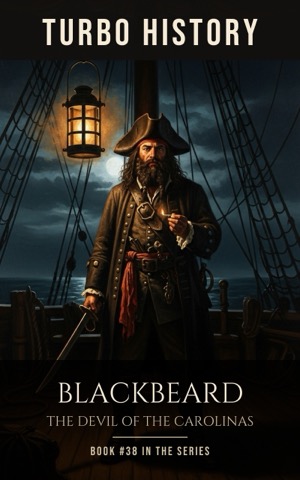
| Blackbeard: The Devil of the Carolinas Turbo History · ours | ~7,400 words Under an hour | The whole career in one sitting. How a sailor became a brand, what he actually did, and what he never had |
| A General History of the Pyrates Captain Charles Johnson, 1724 | ~733 pages in the Dover edition About 21 hours | The source of the legend. Primary-ish, published six years after Teach died, and not to be trusted whole |
| Quest for Blackbeard: The True Story of Edward Thache and His World Baylus C. Brooks, 2016 | ~614 pages About 18 hours | The specialist angle. Genealogical and archival work on who Teach actually was before he was Blackbeard |
| Villains of All Nations: Atlantic Pirates in the Golden Age Marcus Rediker, 2004 | ~248 pages About 7 hours | The argument rather than the life. Why thousands of sailors turned pirate between 1716 and 1726 |
| Under the Black Flag: The Romance and the Reality of Life Among the Pirates David Cordingly, 1995 | ~296 pages About 8 hours | Myth against evidence, subject by subject. Written by the man who ran the National Maritime Museum's pirate exhibition |
| The Last Days of Black Beard the Pirate Kevin P. Duffus, 2008 | ~239 pages About 7 hours | The local North Carolina detail. Ocracoke, Bath and the last months, mapped closely |
The picks, in detail
01
The Republic of Pirates
Woodard tells the story of the Nassau pirate republic and the men who ran it, Blackbeard, Hornigold, Vane, Bonnet and Rackham, alongside Woodes Rogers, the governor sent to shut it down. It is archive-driven, it is properly sourced, and it explains the thing most Blackbeard books skip, which is where these men came from and why they all appeared at once. Blackbeard shares the stage with half a dozen others, so if you want a single-subject biography this is not quite it.
02
Blackbeard: America's Most Notorious Pirate
Konstam is a naval historian and this is the most careful life of Edward Teach available, following him from privateering through Hornigold's crew to the blockade of Charleston and the fight with Maynard. He is good on ships, sailing and the naval detail that other writers wave through, and he is explicit about where Johnson cannot be trusted. Some of the identification of Teach's origins has been overtaken by later archival work, and the shipboard technical passages will lose readers who came for the swagger.
03
Blackbeard: The Devil of the Carolinas ours
Every book on this list goes deeper than ours, and most of them are hard work. That is not a criticism, it is the entire point of them. The Dover edition of Johnson runs to roughly 733 pages of eighteenth-century prose. Baylus Brooks gives you 614 pages of archival and genealogical reconstruction. They are good books in their different ways, and they want weeks of your life.
If you are researching the golden age of piracy properly, or sitting an exam on the Atlantic world, buy one of those and give it the time it deserves. We are not pretending to compete with them.
If you are not, ours might suit you better. It opens on the Bristol question, because the origin story everyone repeats is not settled, then goes through the wartime training, the privateer problem when peace put thousands of sailors out of work, the years in Hornigold's crew, the odd business with the gentleman pirate Stede Bonnet, and Hornigold's exit. Then the rise, the blockade of Charleston, the peak of the operation, the pardon, and the fight with Maynard at Ocracoke. There is a chapter on what else was happening in Europe, the Islamic world, China, India, Africa and the Americas between 1716 and 1718. It ends on the honest accounting: that terror was a business model and he probably never killed a captive in cold blood, that Spotswood's raid was an extrajudicial vendetta and the trial of the crew was a formality, that there was no buried treasure and the cargo auctioned in Virginia came to over two thousand pounds, and that North Carolina spent eight years in court fighting over who owns footage of his wreck.
That is what the whole series is for. Love history, but hate how it was taught at school? Same. School turned it into a memory test: names, dates, family trees, exam. The actual story never stood a chance. Turbo History is one figure or one event per book, told in under an hour. The rise, the fall, and why it still matters. Dates included, memorising optional. Sources at the back if you want to go further, and every book on this page is a good place to go next.
04
A General History of the Pyrates
This is where the lit fuses in the beard, the fourteen wives and most of the famous scenes come from, and every later writer including Stevenson has drawn on it. Read it and you understand the eighteenth-century pirate as an idea, which is the thing that actually survived. The catch is serious: the author's identity is unknown, the old attribution to Defoe is now doubted, and the book blends real court and newspaper material with stories that look invented. Treat it as evidence about 1724, not as reporting about 1718.
05
Quest for Blackbeard: The True Story of Edward Thache and His World
Brooks went into Jamaican and British records and made the case that Blackbeard was Edward Thache of a respectable Spanish Town family rather than a Bristol nobody, which is the most substantial new finding on this subject in decades. The documentary appendices are the reason to own it. It is self-published, it is over six hundred pages, the writing is heavy going, and it reads like the research file it largely is, so it is a reference book rather than a read.
06
Villains of All Nations: Atlantic Pirates in the Golden Age
Rediker looks at piracy from below, at the working conditions on merchant and naval ships that pushed men into it and at the elected captains and shared plunder they organised once they got out. It reframes Blackbeard from a monster into a symptom, which is a more useful way to think about him. It is a work of argument with a clear political sympathy for its subjects, so it romanticises in the opposite direction from Johnson, and Blackbeard appears only in passing.
07
Under the Black Flag: The Romance and the Reality of Life Among the Pirates
Cordingly takes the standard pirate images one at a time, walking the plank, buried treasure, the black flag, the women, and checks each against trial records and ships' papers. It is the fastest way to work out which of the things you believe about Blackbeard are documented and which are theatre. It covers the whole golden age rather than one man, and being thirty years old it predates the Queen Anne's Revenge excavation and the Thache archival work.
08
The Last Days of Black Beard the Pirate
Duffus knows the Carolina coast and the regional records better than any of the national writers, and the book is strong on the final year: the pardon from Governor Eden, the Tobias Knight affair, Spotswood's raid and the fight at Ocracoke. The maps and photographs are genuinely useful if you want to follow the geography. He also argues a contested case about Blackbeard's identity and local origins that most historians do not accept, so read the argument sceptically and the local detail gratefully.
Questions people actually ask
What is the best book about Blackbeard?
Colin Woodard's The Republic of Pirates is the best single book, though it is about the whole Nassau pirate world rather than Blackbeard alone. At roughly 383 pages it is archive-based and readable, and it explains why a cluster of famous pirates all appeared in the same few years. If you specifically want one man's life, Angus Konstam's Blackbeard: America's Most Notorious Pirate is the more focused biography at about 336 pages.
Where should I start with Blackbeard?
Start with Woodard, then read Konstam. Woodard gives you the world, the war that created the surplus of unemployed sailors, the Nassau base, and the governor sent to end it. Konstam then narrows to Teach himself and is better on the ships and the final fight. David Cordingly's Under the Black Flag is a good third book if you want to know which pirate clichés are actually documented.
Is A General History of the Pyrates a reliable source?
Partly, and you have to read it carefully. Published in 1724 under the name Captain Charles Johnson, six years after Blackbeard died, it draws on real trial records and newspaper reports but also contains stories that appear nowhere else and look invented. Nobody knows who Johnson was, and the old scholarly attribution to Daniel Defoe has been seriously challenged. It is the origin of most of the famous imagery, so it is worth reading, but treat modern historians as the check on it rather than the other way round.
Did Blackbeard bury treasure?
There is no evidence he did, and no coin has ever been traced to him despite three centuries of digging along the Carolina coast. Pirate crews worked for shares and a secret hoard would have been almost impossible to keep, which is why the practice appears to have been vanishingly rare. What was actually taken from his sloop was cargo, sugar, cocoa, indigo and cotton, auctioned in Virginia. Cordingly's Under the Black Flag takes the treasure myth apart properly.
What is the best short book about Blackbeard?
Kevin Duffus's The Last Days of Black Beard the Pirate is about 239 pages and is the shortest focused option, strong on the Carolina geography of the final months, though his argument about Blackbeard's identity is not widely accepted. Marcus Rediker's Villains of All Nations is about 248 pages if you want the wider argument rather than the man. Our own hour-long version covers the whole career if you want the shape of it tonight.
This book is free sometimes. Want to know when?
Blackbeard goes free on Amazon from time to time, along with the rest of the series. Leave your email and we will tell you the moment it does.
More from the series
One figure or one event per book. Under an hour each.